Machine Tool Shutdown and Startup for Long Holidays: Checklists, Batteries, Coolant, Warm-up Guide
Most breakdowns after a holiday can be prevented before it starts. Begin on batteries and coolant a few days ahead!

On the first morning after the New Year, Golden Week or Obon (mid-August) holidays, the machine has lost its home position, air is leaking, the coolant has gone bad: most of these failures can be prevented by preparing before the holiday. Based on documents from machine makers such as Makino Technical Service, Brother Industries and Seiko Instruments, operating manuals from coolant and compressor makers, and Japan's Industrial Safety and Health Regulations, this page covers the schedule before the holiday, checklists by machine, batteries and data, coolant, what happens while the machine sits idle, the startup procedure and warm-up guide, common problems, and safety in order. You can tick the checklist on this page and print it as is. For daily inspection of each machine, see the Maintenance page.
 What to do how many days before the holiday
 A few days ahead: condition the coolantRemove tramp oil, chips and sludge, and raise the concentration toward the upper end of the recommended range. Also take the sample for analysis.
 By the day before: batteries and dataReplace batteries that have not been changed in over a year, and save programs, tool offsets and parameters.
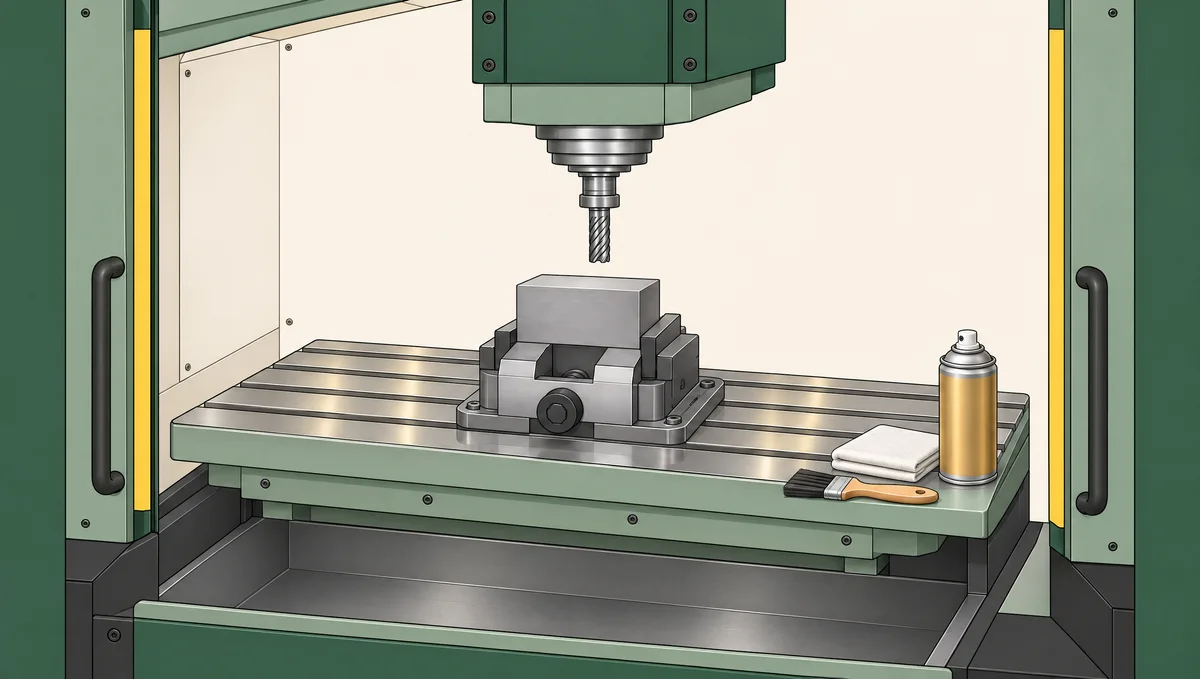
 Last day: clean, grease, rustproofBrush off chips, grease each axis and cycle it back and forth, and apply rust-preventive oil to bare table and fixture surfaces.
 Last day: park the axes and power offMove the axes to the position specified in the manual, remove the tool from the spindle, then switch off the power and put up a notice.
Start preparing the coolant a few days before the shutdown. Master Fluid Solutions says to remove tramp oil, chips and sludge, raise the concentration to the upper limit of the product's recommended range, and take the sample for analysis before shutdown[24]. Replace the batteries before the holiday starts. Makino Technical Service gives "before a long holiday" as the time to replace the absolute-position batteries, and says to do the regular replacement because inquiries pile up after a long holiday[6].
The final-day work is well summarized in Brother's "In preparation for long machine downtime". It has six items: grease each axis and run it through the full stroke about 3 times, remove the tool holder from the spindle, save the data, apply rust-preventive oil where rust is a concern, replace the batteries, and move each axis to the specified position before switching off the power[1]. The parking position differs by machine; Brother puts X and Y at the center of the stroke and Z at the top (so that, if the home position is lost to a dead battery, it can be adjusted from that position)[1]. Some makers, such as UNITED GRINDING for its grinders, specify "all axes to home"[4], so follow the operating manual for your own machine.
 By machine: checklist before shutting down
Ticked items are saved in this browser (they are not shared with other people).
Some overseas documents say "drain all the coolant" and "remove the grinding wheels", but those assume the machine will be down for several months. Documents from Makino (USA) and UNITED GRINDING separate a "full shutdown", assuming COVID-19 production stoppages, from a "partial shutdown" where people look in on the machine[3][4]. For one to two weeks at New Year, the basic approach is the partial shutdown: keep the fluid and condition it rather than draining (see "Coolant" below). For a shutdown of 30 days or more, Hurco also has a procedure of adding a rust inhibitor to the lube oil from the automatic lubricator and cycling all axes several times[5].
Batteries and data: so you do not lose the home position
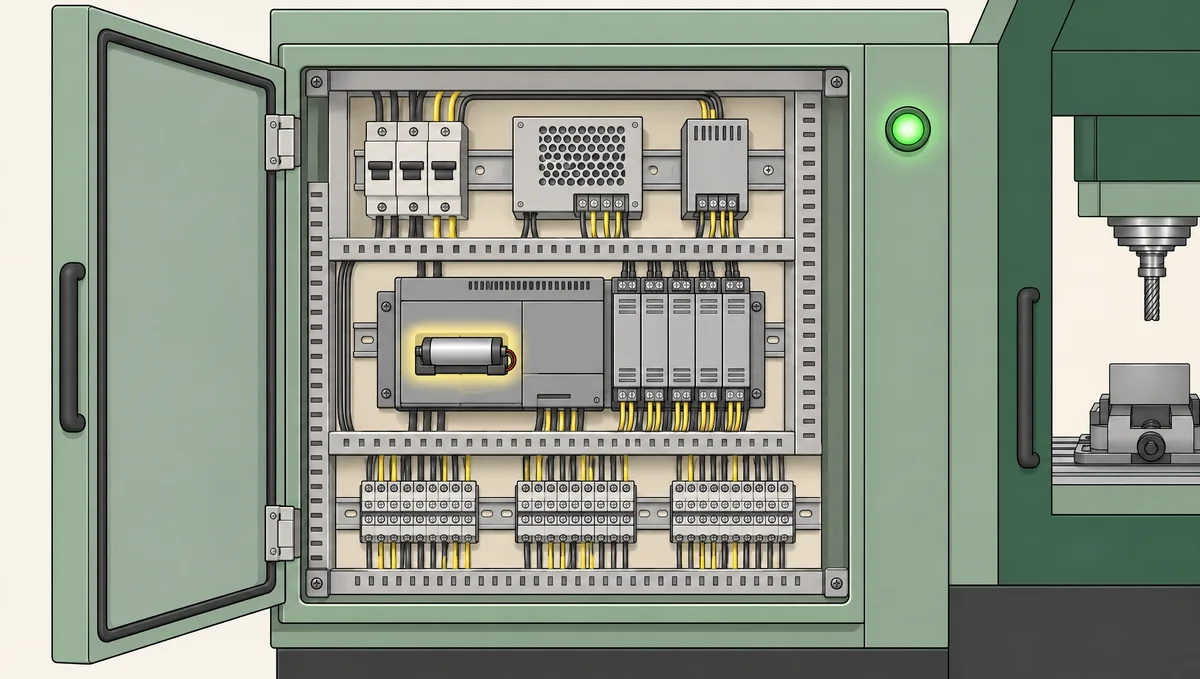
The most common causes of a machine failing to start after being stopped for several months are loss of the home position due to dead batteries, and servo overload caused by caked grinding dust, says Seiko Instruments' maintenance newsletter[9]. When the power stays off for days the battery voltage drops, and the home position and CNC data can be lost, or a false detection can prevent a restart. Brother recommends replacing batteries before a shutdown if the machine will be stopped for a while and the batteries have not been changed for more than a year[2].
"Power on" depends on the battery typeAbsolute-position (encoder) batteries are replaced with the power on, because switching off loses the stored position. On the other hand, some batteries are replaced within a short time after switching the power off. The table below is based on Makino machines and similar; models and times differ by machine. Always follow the procedure in the operating manual.
| Battery | When to replace | Power | Notes from the documents |
|---|---|---|---|
| For absolute position (pulse coder / scale) | Before a long holiday, every 2,000 hours of use or 1 year, or when a low-battery alarm appears (Makino) | Leave on, after confirming that machine motion has stopped | Switching off to replace loses the absolute position, and a manual home return is required[6]. For Brother's SPEEDIO as well, replace with the operation panel power ON[2] |
| Servo drive / CNC / robot | Before a full shutdown (UNITED GRINDING) | Leave on[4] | On Seiko Instruments grinders the servo amplifier battery lasts 5 years. The year of manufacture is printed on the side[9] |
| For NC backup | Before a long holiday, every year, or when an alarm appears (Makino) | Follow the manual's procedure | Finish within 30 minutes. If you switch off with the voltage still low and leave it for a week, memory is lost. Save all data in one batch before replacing[7] |
| For operation panel (PANEL i) | Before a long holiday, every year (Makino) | Switch off first; within 5 minutes | Turn the power on for about 30 seconds, switch it off, and swap the battery within 5 minutes. Save all data in one batch before replacing.[8] |
Saving data: Brother lists programs and the data bank[1]; Makino (USA) and UNITED GRINDING list machine data and CNC data (UNITED GRINDING also lists machining programs)[3][4]. If you save tool offsets, work coordinates and parameters too, you can reload them if data is ever lost. For the idea of tool offsets, see Work Offset and Tool Length Setup.
Do not let coolant go bad: condition it and keep it circulating instead of draining
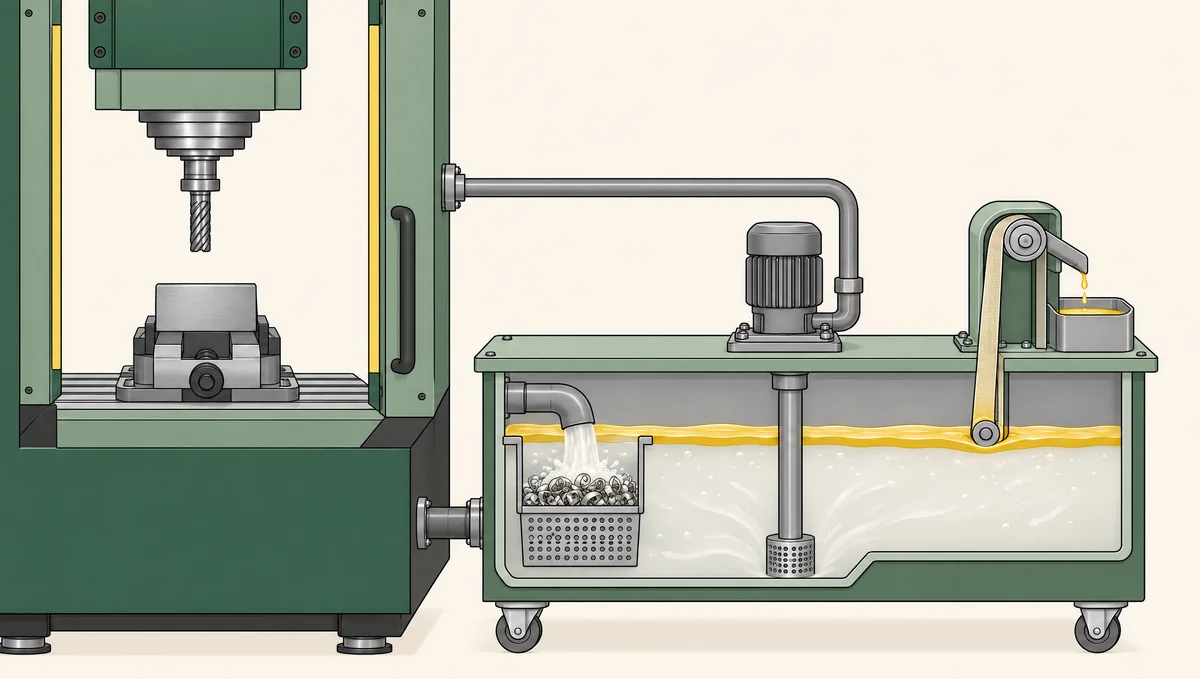
Coolant smells after a holiday because the fluid does not move while idle, tramp oil forms a lid on the surface, and anaerobic bacteria multiply. Tramp oil, chips and sludge are food and shelter for bacteria and the main cause of the rotten smell[24]. Most water-soluble fluids are mildly alkaline at pH 8–10, and pH falls as spoilage progresses, so it is a guide for control[21].
| When | What to do |
|---|---|
| Before the holiday (from a few days ahead) | Remove tramp oil, chips and sludge. Raise the concentration toward the upper end of the product's recommended range to increase pH buffering. Bring pH into range. Take the sample for analysis.[24] |
| During the holiday | If possible, run the pump to circulate the fluid[24]. Blaser says to circulate for at least 30 minutes every day during shutdown, keep the skimmer running (if there is none, remove tramp oil by hand), and run the chip conveyor before circulating to clear chips from the bottom[22][23] |
| After the holiday | In the tank, stir thoroughly, then check concentration and pH[1]. Also check the smell and color |
- How high to raise the concentration: Blaser says to keep at least 8% (by volume) during shutdown[22], but that is a value for its own products. Check the fluid maker's documents so you do not exceed the upper limit of the recommended range for the fluid you use
- Whether to blow in air: Makers disagree. Yushiro Chemical says to avoid aeration as an anti-odor measure because it causes aerobic bacteria to multiply and pH to fall[21], and UNITED GRINDING says to run a circulation pump or aeration pump during shutdown[4]. When in doubt, make "circulation" the default and ask the fluid maker about aeration
- Non-water-soluble (oil-based): Blaser says no special treatment is needed[22]
Daily concentration and pH measurement and how to recognize spoilage are covered on the Coolant management page.
 What happens while the machine is idle
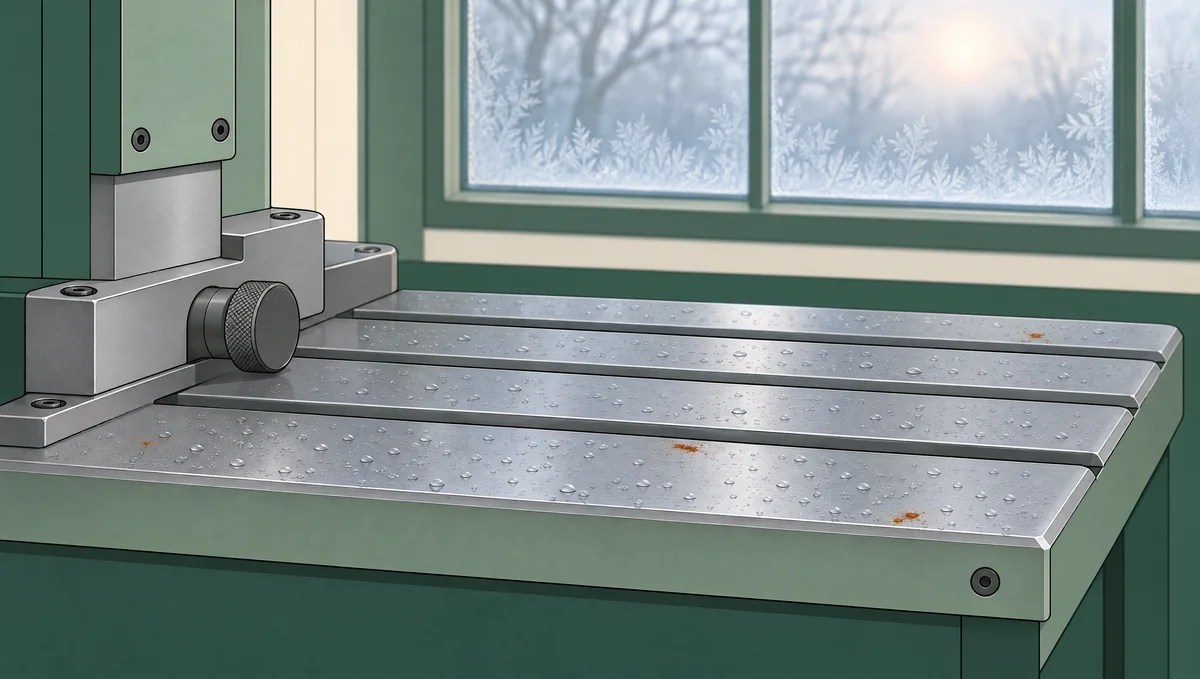
| What happens | Cause / source | Prevention |
|---|---|---|
| Home position and data are lost | The power stays off for days and the battery voltage drops[2] | Replace batteries and save data before the holiday |
| Servo overload when moved | On machines using water-soluble grinding fluid, grinding dust around moving parts cakes on[9] | Clean the inside of the machine before stopping. If stopping for long, warm up or dry-run one day a week (about 8 hours)[10] |
| Sudden stop with no alarm | Example of rust forming on the ball screw after a long stop[11] | Grease and run the full stroke before stopping[1] |
| Spindle life shortens | After 1–3 days idle, the lubricant inside the spindle settles. Running at full speed without warm-up damages it[12] | After the holiday, warm up before raising the speed |
| Chuck gripping force drops | Rust inside the chuck[25] | Pack with grease before stopping to prevent rust[25] |
| Drain freezes | Risk of failure from drain freezing: ANEST IWATA reciprocating units at ambient 2 °C or below, Meiji Air Compressor Mfg. GN/GH types at 0 °C or below[14][15] | When stopping, release all the tank air and drain completely[14] |
| Rust, condensation | Makino recommends an installation environment of 10–40 °C room temperature and 35–70% humidity (no condensation)[16] | Rust-preventive oil, covers. No document gave the temperature difference at which condensation occurs as a number |
In summer breaks (Obon), heat and humidity become the problem instead. Hurco says that when the ambient temperature is 31 °C or higher, set the spindle chiller 5 °C below ambient to reduce condensation inside the spindle head[5].
 Startup procedure after the holiday and warm-up guide
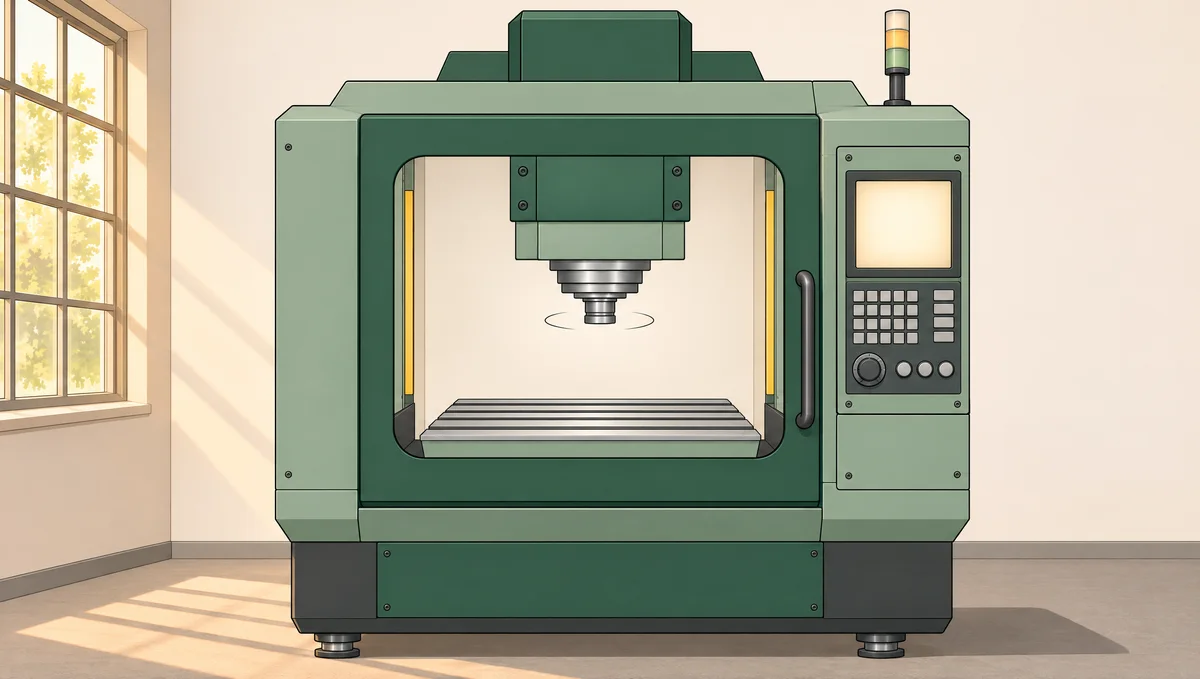
- Check the room temperatureIf it is thoroughly cold, turn on heating first and bring the room to temperature before switching on the power.
 Bring in the air slowlyStart the compressor, drain it, and open the machine-side regulator slowly from the closed position.
- Check oil, pressure and filtersCheck oil level, pressure, clogging and oil leaks. On machines with manual lubrication, lubricate before powering on.
- Power on and check alarmsCheck the alarms and battery indicator, then do home return. Some alarms appear only when it is too cold.
- Move the axes back and forth at low speedDo not go straight to rapid. Run each axis through the full stroke about 3 times at low speed.
- Run in the spindle in stagesRaise the speed little by little from a low rpm and let the spindle settle in with warm-up.
- Mix the coolant and measureStir thoroughly in the tank, then check concentration, pH and smell.
- Test cut and first-piece measurementMeasure the first piece and confirm the dimensions before moving on to production.
Makino Technical Service's "Checkpoints before restart" says that after starting the compressor you should raise the pressure to the specified value by opening the machine-side regulator a little at a time from closed; after switching on power and air, check oil level, pressure, filter clogging and oil leaks; check the spindle seal, wiper and taper (clean the taper with a cleaning fixture, not an air gun); and if the room has cooled, bring it up to temperature before powering on. Applying pressure all at once cracks the regulator bowl and auto drain, and running the pump with no oil damages the unit[16]. Hurco also has a procedure for machines with a manual lubrication plunger: pump it 3–6 times before switching on the power[5].
After a holiday, run the spindle at a speed raised in stages from a low rpm. Brother says to move each axis through the full stroke at low speed about 3 times, then run in the spindle starting at 500 min⁻¹ and stepping every 5 minutes through 500 → 1,000 → 2,000 → 4,000 → 6,000 → … up to maximum speed[1]. As a reference example of warm-up, Makino cites moving all axes at about S1000 and F1000–F2000 for about 30 minutes (noting that this is not warm-up for high accuracy)[16].
| Source | Time stopped | Warm-up / run-in |
|---|---|---|
| Hurco (high-speed motor spindle) | 60 min–48 h / 2–7 days / over 7 days | Total pre-lubrication and warm-up 5 min 30 s / 32 min 30 s / 56 min 30 s. Until finished, manual spindle start and automatic operation are not possible[5] |
| Hurco (spindle) | Over 30 days | Run in following the order in the table. The bearing area must not exceed 55 °C[5] |
| Haas (live tooling on CNC lathes) | Over 4 days / 2 weeks or more | 20-minute warm-up (250–5,000 min⁻¹, 200 s each) / 2-hour run-in[13] |
| Makino (machining center) | After a long stop / right after startup | About 30 minutes at about S1000 and F1000–2000 (reference example)[16] |
| Brother (SPEEDIO etc.) | After a long shutdown | From 500 min⁻¹, stepping every 5 minutes up to maximum speed[1] |
Until dimensions settle takes even longer. A research report of the Machine Tool Engineering Foundation says it is commonly accepted that machines generally need at least 2 hours after starting operation to become thermally stable, and 20–120 minutes of dry running to suppress thermal deformation[19]. Makino turns the power on at least 3 hours before measuring accuracy and runs a fixed program for 30 minutes before measuring[17]. After a holiday the whole machine is stone cold, so if the first-piece dimensions are off, first suspect insufficient warm-up. Thermal growth can be checked with the thermal expansion calculator.
Common problems after the holiday and what to do first
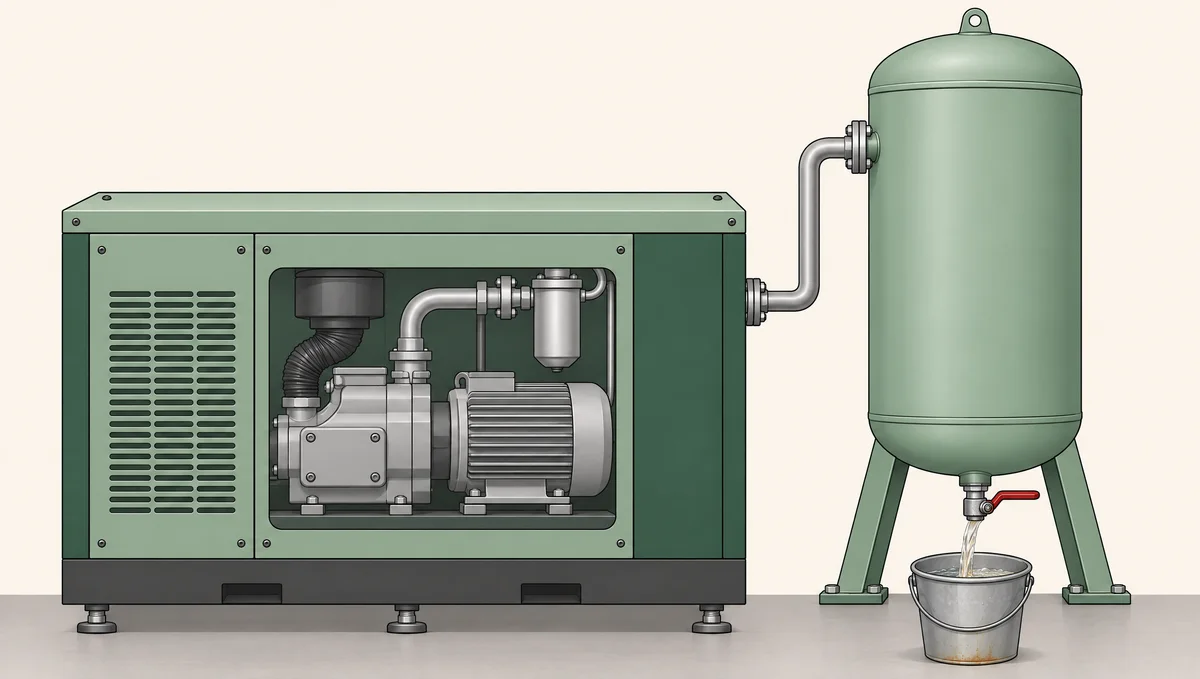
| Symptom | Common cause | What to do first |
|---|---|---|
| Alarm demanding home return / absolute position alarm | Absolute-position battery is dead[6] | Replace the battery and do a manual home return. If data was lost, restore the saved data |
| Stops because of an air leak | The auto-drain cup or fittings in the air dryer deteriorate and crack[18]. Applying pressure all at once cracks the bowl[16] | Find the leak and replace the cracked cup. Open the regulator slowly |
| Alarm for stopped cooling fan of the heat sink | The fan fails from years of dirt[18] | Clean or replace it. Note the servo amplifier display and model and contact the maker |
| Oil temperature / coolant alarm at power-on | In some cases the room is cold and the oil or coolant has gotten too cold[16] | Raise the room temperature, then reset |
| Servo overload when moved | Grinding dust or chips caked on[9] | Clean, then move at low speed |
| Compressor will not turn or pressure will not build | Seizing or valve condition after a long stop | Atlas Copco says to turn the coupling by hand with the power off to check that it turns freely, and to open the discharge valve slowly to match the piping pressure before starting[20] |
For compressors, ANEST IWATA's manual for its reciprocating units says that if stopped for a week or more, drain once a week and run unloaded for 30 minutes every month. For leak checking, hold maximum pressure for 30 minutes and check that the pressure drop is within 10% of maximum pressure[14]. For screw compressors, follow the manual for your model. For routine inspection, see the compressor maintenance page.
Safety: test runs, signals and lockout
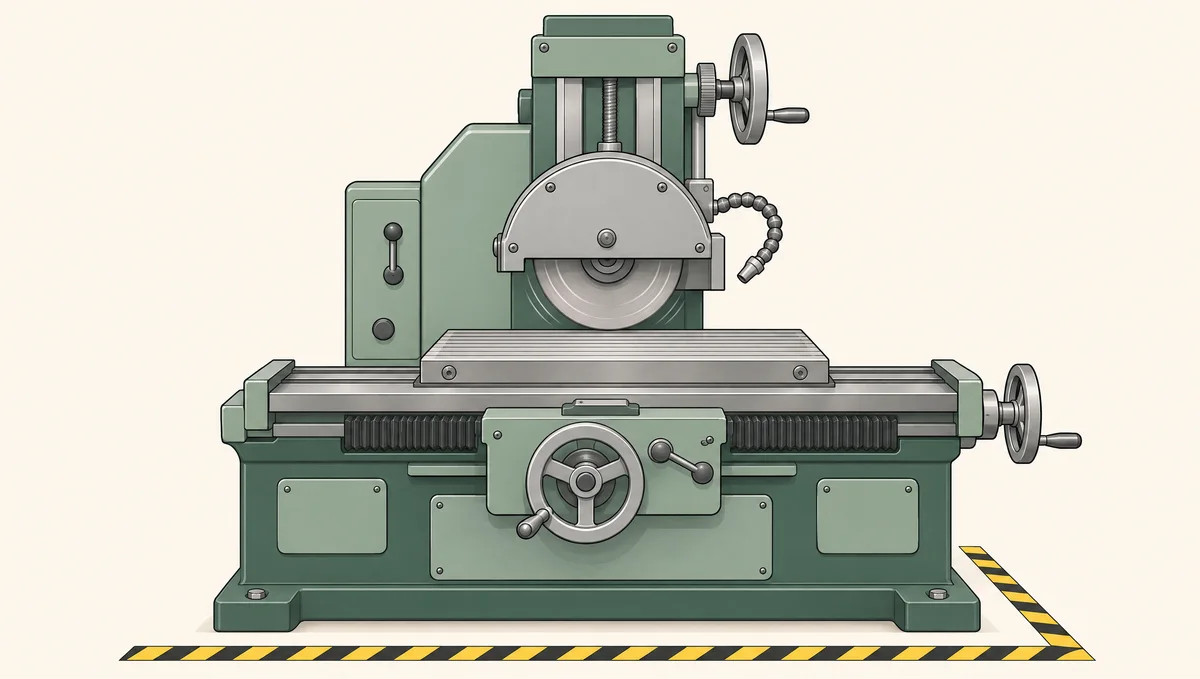
The big clean before a holiday and the restart after it are periods with many non-routine tasks. The Japan Industrial Safety and Health Association (JISHA)'s year-end and New Year zero-accident campaign lists simultaneous inspection of machinery and pre-work checks, and safety confirmation when work resumes in the new year. For inspection and repair, it says to shut off power and stop completely, post a sign such as "Inspection in progress: do not operate" near the control panel, and restore any safety devices that were disabled and covers that were removed[29] (the campaign period is set each year, so check the latest guidelines).
| Japan's Industrial Safety and Health Regulations | Details | Where it applies around a holiday |
|---|---|---|
| Article 107 | When cleaning, oiling, inspection or repair is hazardous, stop the machine, lock the starting device and post a sign, etc.[28] | Cleaning and greasing before the holiday, inspection after |
| Article 104 | If starting operation is hazardous, set a signal and designate the person who gives it[28] | Starting up after many people have inspected |
| Article 118 | Grinding wheels must be test-run for at least 1 minute before work starts that day, and at least 3 minutes after replacement[28] | First work of the day after the holiday. A wheel removed and refitted during the holiday needs 3 minutes or more |
| Article 117 | Rotating grinding wheels must have a guard (except under 50 mm diameter)[28] | Forgetting to refit guards removed for cleaning |
| Article 136 | Presses must have the clutch, brake, emergency stop and so on inspected before work starts that day[28] | When the factory has presses |
Replacing grinding wheels and test-running them is done by people who have received special training (required by law). For grinder inspection, see the grinder maintenance page; precautions for starting hydraulic units (start the pump unloaded and check the rotation direction; milky oil means water contamination) are in Nachi-Fujikoshi's materials[26].
FAQ
- Even for a break as short as New Year, should I drain the coolant?
- For one to two weeks, the basic approach is to keep it and condition it. Remove tramp oil, chips and sludge, raise the concentration toward the upper end of the recommended range, and if possible keep circulating it during the break[24][22]. The drain-everything procedure is an example for a "full shutdown" of several months[3][4].
- When should I replace batteries? Should the power stay on?
- Replace them before the holiday begins. Some documents recommend replacement if they have not been changed in over a year[2]. Absolute-position batteries are replaced with the power on, but some, such as those for the operation panel, are replaced within a short time after switching the power off[6][8]. Always follow the procedure in your machine's operating manual.
- About how many minutes should warm-up take after the holiday?
- The machine's operating manual takes priority. As examples, Makino cites about 30 minutes at about S1000 and F1000–2000[16], and for Hurco's high-speed spindle, 5 min 30 s to 56 min 30 s depending on the time stopped[5]. Until dimensions settle, about 2 hours is generally said to be needed[19].
- Is a 1-minute grinder test run still enough after a holiday?
- Before work starts that day it is at least 1 minute, and at least 3 minutes when a wheel has been replaced (Japan's Industrial Safety and Health Regulations, Article 118)[28]. If a wheel was removed and refitted during the holiday, run it for 3 minutes or more as for a replacement.
Inspection items for each machine are covered in the Machining centers / lathe / Grinders / EDM machines / Compressors maintenance pages.
Sources
- Brother Industries, "In preparation for long machine downtime" (2022 edition)
- Brother Industries, "Battery replacement before long machine downtime" (May 2020)
- Makino Inc. (USA), "Machine layup suggestions" (2020-03-23)
- UNITED GRINDING, "Quick Guide: Shutdown Procedures for Grinding Machines" (2024-11-14)
- Hurco, "Maintenance and Safety Manual for i-Series Machines v573EN"
- Makino Technical Service, "Battery replacement: for absolute pulse coder / scale"
- Makino Technical Service, "Battery replacement: for NC backup"
- Makino Technical Service, "Battery replacement: for PANEL i"
- Seiko Instruments, Precision Machinery Division, Maintenance News No. 32 (2020-10-15)
- Seiko Instruments, Precision Machinery Division, Maintenance News No. 33 (2021-02-01)
- Seiko Instruments, Precision Machinery Division, Maintenance News No. 4 (2011-05-12)
- Haas Automation Ltd (UK), "Looking After Your Spindle"
- Haas, "SL - Live Tooling - Operation" (machines from 2001–2010)
- ANEST IWATA operating manual, reciprocating compressor package type CLP15EF–110EF
- Meiji Air Compressor Mfg. operating manual, GN/GH types (revised August 2016)
- Makino Technical Service, "Checkpoints before restart"
- Makino Technical Service, "Warming up machine tools"
- Makino Technical Service, "Examples of failures likely after long holidays"
- Machine Tool Engineering Foundation, research project RU-22, "Thermal deformation reduction design with zero warm-up time"
- Atlas Copco, "Advice for stopping and restarting air compressors"
- Yushiro Chemical Industry, metalworking fluids FAQ
- Blaser Swisslube, "What to do with your metalworking fluid during longer production stops?"
- Blaser College, "Management of water-miscible cutting fluids during production stoppage" (in Spanish, 2020-04-15)
- Master Fluid Solutions, "Preparing Your Sump for a Temporary Shutdown" (2020-04-17)
- Kitagawa power chuck BR series operating manual
- Nachi-Fujikoshi standard hydraulic unit catalog, "For safe use of hydraulic equipment and systems"
- FANUC Europe, "ROBOCUT Preventive Maintenance"
- Industrial Safety and Health Regulations (e-Gov Law Search), Articles 104, 107, 117, 118 and 136
- Japan Industrial Safety and Health Association (JISHA), "FY2024 (Reiwa 6) Year-End and New Year Zero-Accident Campaign Guidelines"
More articles
 lathe
Lathe Tool Center Height: Effects of Error, ±0.1 mm for Parting Off, Setting by Center and Pip
 NC
Setting Work Zero and Tool Length on a Machining Center: Edge Finders, Touch Probes, Tool Setters, G54 and G43
 Trade shows