How to remove a broken tap: a decision flow by situation, and how to prevent breakage
Wait before you hit it. The flute shape of the tap decides which tools you can use.

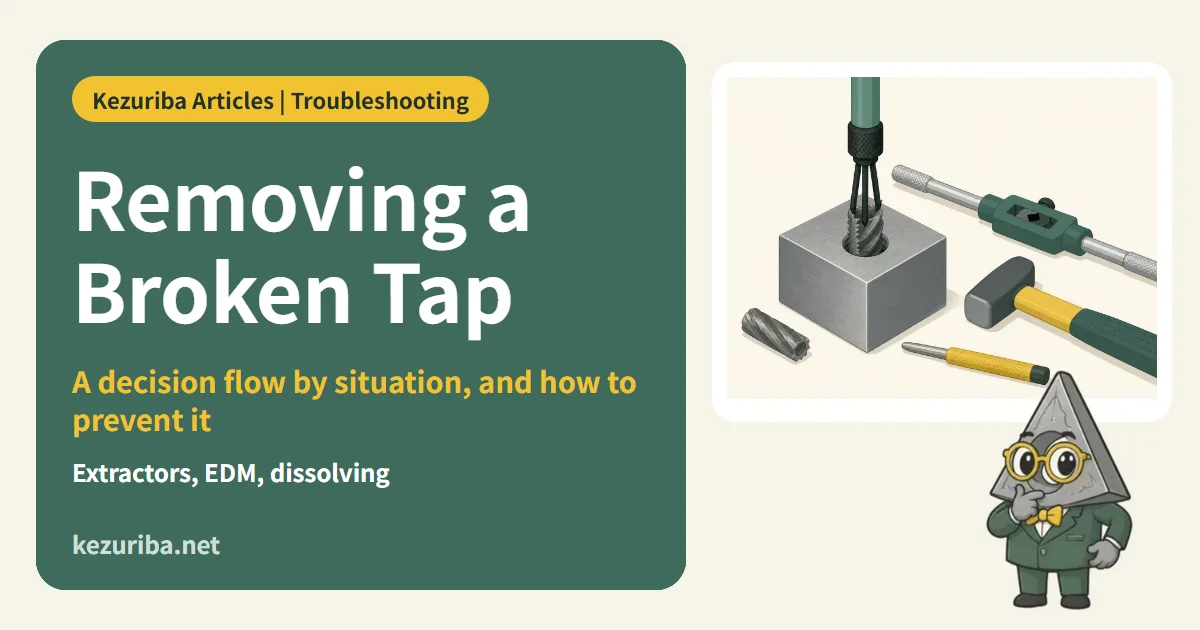
A tap has broken inside the hole. If you panic and hammer at it or dig at it with a drill, you can ruin the part along with the threaded hole. How you remove it depends on whether the tap sticks out, the tap type (flute shape), the materials of the tap and workpiece, and the machine you can use. This article, based on tool manufacturers' materials and real shop examples, covers the removal flow for each situation and how to avoid breaking taps in the first place.
Removal flow by situation
A screw extractor ("easy-out") doesn't work on a broken tapReverse-thread tools made for pulling out bolts can't drill into a hard tap, so they can't be used[11]. For taps, use a "tap extractor", whose fingers fit into the flutes.
First, identify the type of tap
A tap extractor is for hand taps (straight flutes) only, and the seller states that it can't be used on spiral, spiral point or jet taps[10]. Form taps, which have no flutes, have nowhere for the fingers to go either. First check the flute shape of the broken tap and the number of flutes (3, 4, etc.) before you start.
① If it sticks out: back it out with pliers
If the broken part sticks out of the hole and you can grip it, grip it firmly with pliers or locking pliers and turn it in the reverse direction a little at a time. Don't turn it a lot at once; the trick is to loosen it with small forward and reverse turns[11][12]. If the tap is seized tightly in the threaded hole, it can break again at the point where you grip it.
There is also a method of welding a nut onto the exposed part and turning it, but the heat can change the properties of the part, so some sources recommend it and some don't[11]. It is a method for people with the skill and equipment.
② For a hand tap: tap extractor
- Clear out all the chips: Remove the chips left in the flutes with air or a thin pick
- Insert the fingers to the bottom of the flutes: Choose an extractor that matches the tap's nominal size and number of flutes
- Lower the holder to the break and the sleeve to the workpiece surface: It is important to lower both so the fingers don't twist
- Rock the tap handle back and forth a few times to loosen the tap, then turn it in reverse to pull it out[8]
Extractor parts aren't interchangeable between flute counts, so choose one that matches the number of flutes on the tap (3 or 4). The fingers are consumable parts that bend or break, and replacement fingers are available[8]. Sets sold in Japan include combination sets of 3-finger (3–6 mm) and 4-finger (8–12 mm) extractors[10].
If the tap is only lightly seized at a shallow depth, you can also put a thin punch in a flute and tap it lightly in the reverse-turning direction to rotate it. With thin taps or at greater depth, however, it tends to crack the tap further and make things worse[13][12].
③ If you have a machine: break up the core with a removal drill or carbide end mill
When a high-speed steel (HSS) cutting tap is left in a steel workpiece, there is a method of using a carbide broken-tap removal drill on a machining center to drill out the center of the tap and break up what is left of the flutes. One tool manufacturer's FAQ gives the usage and limits as follows[2].
- Clamp the workpiece and the drill firmly and align the drill with the center of the broken tap. If the head sticks out, flatten it with a grinder first
- Cutting speed is 20–25 m/min, feed is manual (do not use automatic feed)
- When the center has been drilled out, pick out the remaining pieces with a scriber or similar
- What it can't be used on: carbide taps, form taps, and broken drills or bolts. It may damage the workpiece if it is aluminum[2][3]
Another tool manufacturer's example says that with a spiral tap, the flutes wrap around the internal thread so fragments rarely come out, while with a straight-flute tap fragments tend to come out as the hole gets deeper, so if you hear abnormal noise or see fragments, stop, remove the fragments and then continue[6]. If you don't have a removal drill, you can also machine it with a center-cutting carbide end mill smaller than the tap's root diameter, at high spindle speed and with slow pecking feed[11][12].
④ If the workpiece is aluminum or brass: dissolve the tap (last resort)
Only when the workpiece is aluminum or brass and the tap is steel (HSS), there is a known method of soaking the whole part in a concentrated solution of alum (potassium aluminum sulfate) and heating it to dissolve just the tap. It takes from a few hours to 2 days[13].
Failures have been reportedIn one reported case, the tap was still in place after a few hours and the surface of the aluminum part had been roughened all over, so it was scrapped[14]. If the workpiece is steel, it dissolves too, so this method can't be used. Nitric acid can also be used, but it causes severe chemical burns to the skin and eyes, and solutions over 10% are deleterious substances under Japanese law. Dissolving steel also gives off harmful gas, so it isn't recommended in ordinary shops[16].
⑤ If nothing else works: remove the core by EDM
EDM melts the metal away little by little with discharges between the electrode and the tap, so it works regardless of the tap's material. For carbide taps and form taps, it is practically the first choice. Some portable EDM machines for removing broken taps claim to run on AC 100 V, use tap water as the working fluid and commercial brass rods as electrodes, support M2 to M30, and work on cemented carbide too[9]. If you don't have one, outsourcing to a machining shop with an EDM machine is the safest option.
Die-sinking EDM machines that use oil as the working fluid are covered by local fire prevention ordinances. There are rules such as controlling the fluid temperature and level and banning machining with the fluid sprayed on the work (machines that use water-based fluid are not covered)[15].
After removal: if the threads are damaged
Even after the tap is out, the threads may be damaged. When you want to keep the same nominal size, the standard repair is to use a thread insert (a wire coil insert). Drill the hole with the dedicated drill, cut the thread with the dedicated tap, screw in the insert and break off the tang[2]. If the wall is too thin, go up one screw size or remake the part.
7 ways to avoid breaking taps
| Cause | Countermeasure |
|---|---|
| Tap drill hole too small | Within the tolerance range of the internal thread's minor diameter, make the tap drill hole as large as possible. In one example, going from 6.8 to 6.9 mm on M8×1.25 reduced the amount of material cut by about 15%[7][1]. Find the drill diameter in the tap drill size chart. |
| Chip clogging | Spiral taps for blind holes, spiral point taps for through holes, and form taps if you don't want chips to come out. Spiral taps are stable up to a depth of 2D[1][5] |
| Bottoming in a blind hole | Drill the tap drill hole deep enough (see the calculator below). Don't reverse suddenly in a blind hole[4] |
| Misalignment and tilted tap drill hole | Remove any bend in the hole and clamp the workpiece firmly. If misalignment is likely, use a holder that floats radially. Misalignment must be strictly avoided with carbide taps[1] |
| Not enough cutting fluid | Use tapping oil or paste. With a water-soluble fluid, raise the concentration[1] |
| Feed and speed mismatch | Even with synchronized feed (rigid tapping), absorb the shock of switching from forward to reverse with a holder with a minimal float. Feed is spindle speed × pitch (tapping calculator)[1] |
| Using a worn tap | Replace it when it gets dull. If trouble appears, first lower the cutting speed[1] |
Calculator: tap drill hole depth for a blind hole
This calculation follows the approach in a tool manufacturer's FAQ[4]. The number of threads in the chamfer varies with the tap type and product, so use the catalog value for the tap you are using.
FAQ
- Can I drill a hole in a broken tap?
- An ordinary HSS drill can't cut it; it wanders and damages the threaded hole in the workpiece. If you do drill, use a carbide broken-tap removal drill or a carbide end mill on a rigid machine[2].
- A steel tap broke in an aluminum part. What is the safest way to deal with it?
- For a hand tap, use an extractor; for anything else, EDM is recommended. A tool manufacturer warns that a removal drill may damage an aluminum workpiece[2], and the alum dissolving method has a reported failure in which the surface was roughened[14].
- One of my holes keeps breaking taps. What should I fix first?
- First make the tap drill hole larger within the tolerance, and for a blind hole make it deeper. If taps still break, review the tap type (spiral or form), the cutting fluid and the holder[7][1]. Countermeasures for each cause are also summarized in the Machining Troubleshooting Encyclopedia entry "Tap breakage".
Sources
- Tool manufacturer's tapping technical guide (tap drill holes, cutting fluid, holders, troubleshooting table, safety notes, PDF)
- Tool manufacturer FAQ: "How to remove a broken tap"
- Tool manufacturer FAQ: "Can a removal drill be used on a broken form tap?"
- Tool manufacturer FAQ: "How to think about tap drill hole depth"
- Tool manufacturer FAQ: "Machining tips for spiral taps"
- Tool manufacturer's machining example for a broken-tap removal tool (hand and spiral point taps)
- Tool manufacturer's tap catalog (example of enlarging the tap drill hole, safety warnings, English PDF)
- Tap extractor catalog (sizes, flute counts, how to use, English PDF)
- Product introduction: portable EDM machine for removing broken taps
- Sales page for a broken-tap removal tool (labeled for hand taps only)
- American Machinist "Tapping out" (a practical article on removing broken taps)
- Make It From Metal「How to Remove a Broken Tap」
- yarchive "tap_remove" (a collection of posts on punches, dissolving with chemicals and more)
- Hobby-Machinist "Dissolving a Broken Tap" (a failed attempt to dissolve it with alum)
- Funabashi City Fire Department, Fire Prevention Ordinance operating standard: "EDM machines" (PDF)
- Workplace Safety Site (Ministry of Health, Labour and Welfare): GHS label information for nitric acid
More articles
 News
NewsMachine Tool Orders All but Certain to Set an Annual Record in 2026: ¥1.4461 Trillion Through August (JMTBA)
 Qualifications
How to study for the Machine Maintenance Technician Grade 2 exam (mechanical): frequent topics from the past 3 years and a plan for the last 2 months
 NC
NC