Printed from Kezuriba (kezuriba.net/en/troubles/material-stainless/)
Stainless steel quirks (work hardening, welding, boundary wear)
Material-specific problems TurningMillingDrillingTappingReaming
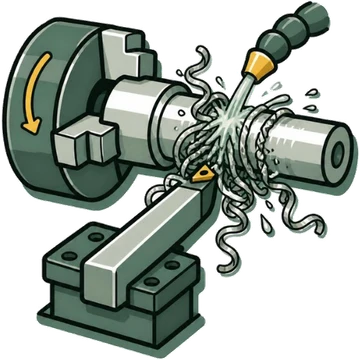
Check first
- It is sticky, work hardens easily, and has low thermal conductivity, so cutting force and cutting heat are high
- High affinity with the tool grade, so welding, built-up edge, and rake face wear tend to occur
- Rubbing on the work-hardened layer tends to cause boundary wear, which causes burrs
Try first
- Select heat-resistant tool materials and coated grades
- Do not reduce the feed too much (more rubbing advances work hardening)
- Use a step amount for the tap drill hole of about 0.5 times the drill diameter as a guideline, and do not make it too fine
?Likely causes
- It is sticky, work hardens easily, and has low thermal conductivity, so cutting force and cutting heat are highAgreed by 2+ makers[1][2]
- When rubbed by the tool during cutting, the surface becomes hard, shortening the life of later operations (tapping, reaming)One maker[2][3][4]
- High affinity with the tool grade, so welding, built-up edge, and rake face wear tend to occurAgreed by 2+ makers[1][5][6]
- Because of work hardening, hand tapping is difficult, and machine tapping is recommendedOne maker[7]
- Rubbing on the work-hardened layer tends to cause boundary wear, which causes burrsAgreed by 2+ makers[1][8][5]
- The impact when sawtooth chips break tends to chip the cutting edgeOne maker[1]
- By family, precipitation-hardening grades are the hardest to machine, followed by duplex and austenitic grades. SUS304 in particular work hardens easilyAgreed by 2+ makers[1][2]
✓Fixes
Cutting conditions
- Do not reduce the feed too much (more rubbing advances work hardening)One maker[3][9]
- Use a step amount for the tap drill hole of about 0.5 times the drill diameter as a guideline, and do not make it too fineOne maker[3]
- In face milling, raise the cutting speed (180-200 m/min) so that centrifugal force throws the chips offOne maker[10]
- For boundary wear, change the depth of cut with each passOne maker[8][5]
Tool
↔Related problems
Aluminum alloy quirks (welding, built-up edge, chips)Titanium and titanium alloy quirks (heat, welding, ignition)Cast iron quirks (powdery chips, edge chipping, black scale)Hardened steel (high-hardness steel) quirksHeat-resistant alloy (Ni-base alloy, etc.) quirksMagnesium alloy quirks (chip ignition)Copper and copper alloy quirksMild steel (low-carbon steel) quirks
📚Sources
Causes and fixes are summarized in our own words from cutting-tool makers’ troubleshooting guides and technical data. “Agreed by 2+ makers” means two or more makers say the same thing.
- Mitsubishi Materials — Workpiece material applications: M series mmc-carbide.com
- OSG — What is work hardening of stainless steel? faq.osg.co.jp
- OSG — Why is tool life short when tapping stainless steel? faq.osg.co.jp
- OSG — Can a stainless steel tap be used in a tap drill hole that has work hardened? faq.osg.co.jp
- Sandvik Coromant — Milling troubleshooting sandvik.coromant.com
- Tungaloy tungaloy.com
- Yamawa — Helpful Tips No.189: Hand tapping yamawa.com
- Sandvik Coromant — Troubleshooting in turning sandvik.coromant.com
- OSG — Why are cutting speeds for heat-resistant alloys lower than for other workpiece materials? faq.osg.co.jp
- Mitsubishi Materials — Face milling: cutting edge damage and countermeasures mmc-carbide.com