Printed from Kezuriba (kezuriba.net/en/troubles/material-aluminum/)
Aluminum alloy quirks (welding, built-up edge, chips)
Material-specific problems TurningMillingDrillingTappingReaming
Check first
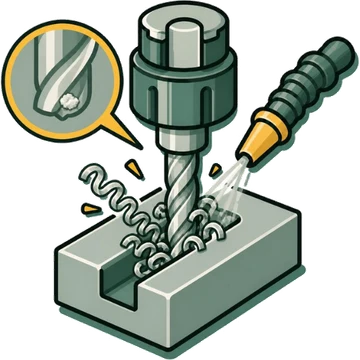
- It is soft and ductile, so chips become long and welding tends to roughen the finished surface
- Welding and built-up edge occur easily (sticky material)
- Elastic deformation causes welding on the flank as well
Try first
- Use a cutter with a large rake angle and a sharp tool made for aluminum
- Break long chips with step cycles (G73, etc.)
- Use a larger clearance angle than for steel and a tool with a mirror-finished rake face
?Likely causes
- It is soft and ductile, so chips become long and welding tends to roughen the finished surfaceAgreed by 2+ makers[1][2]
- Welding and built-up edge occur easily (sticky material)Agreed by 2+ makers[3][1][4]
- Elastic deformation causes welding on the flank as wellOne maker[5]
- Alloys with high Si content have hard particles that worsen machinabilityOne maker[1]
- Internal threads tend to shrink from elastic recovery (a material with little enlargement allowance)One maker[6][7]
- Aluminum tends to weld to thread gaugesOne maker[8]
✓Fixes
Cutting conditions
Tool
- Use a cutter with a large rake angle and a sharp tool made for aluminumAgreed by 2+ makers[4][9][1]
- Use a larger clearance angle than for steel and a tool with a mirror-finished rake faceOne maker[5]
- For reamers, consider cutting part materials with low affinity, such as diamondOne maker[10]
- For taps, consider an oversize (higher accuracy class) tapOne maker[6][7]
Coolant
- Use enough cutting fluid concentration and supply (to prevent tearing)One maker[9]
↔Related problems
Stainless steel quirks (work hardening, welding, boundary wear)Titanium and titanium alloy quirks (heat, welding, ignition)Cast iron quirks (powdery chips, edge chipping, black scale)Hardened steel (high-hardness steel) quirksHeat-resistant alloy (Ni-base alloy, etc.) quirksMagnesium alloy quirks (chip ignition)Copper and copper alloy quirksMild steel (low-carbon steel) quirks
📚Sources
Causes and fixes are summarized in our own words from cutting-tool makers’ troubleshooting guides and technical data. “Agreed by 2+ makers” means two or more makers say the same thing.
- Mitsubishi Materials — Workpiece material applications: N series mmc-carbide.com
- OSG — Chips from A5052 cannot be broken (counterboring) faq.osg.co.jp
- Sandvik Coromant — Milling troubleshooting sandvik.coromant.com
- Tungaloy tungaloy.com
- Mitsubishi Materials — Advanced workpiece materials: Causes of tool damage mmc-carbide.com
- OSG — Tool Communication Series No.6 Taps, "12. Troubleshooting in tapping operations," pp. 59-62 osg.co.jp
- OSG — Series No.34 High-speed synchro taps, "8. Troubles and countermeasures," pp. 28-29 osg.co.jp
- OSG — Material welding to the thread gauge faq.osg.co.jp
- OSG — Torn surface when machining aluminum faq.osg.co.jp
- OSG — Series No.35 Reamers, Table 6.1 Troubleshooting, pp. 30-31 osg.co.jp