Gear Machine Tooling
Hob bore series and keyway or face-key drives, hob arbors, and bore diameters of disc, hub and shank shaper cutters and shaving cutters, maker by maker.
Printed from Kezuriba (kezuriba.net/en/tooling/gear-machine/)
 Hobs
- Standard
- ISO 2490:2007 covers general-purpose single-start solid hobs (module 0.5–40), with an axial keyway or face-key (tenon) drive, and specifies their nominal dimensions[1]One source / reference
- Drive type
- Axial keyway Driven by a keyway (longitudinal key) in the bore
- Face key (tenon) Driven by face keys (cross drive)
- Bore diameter series (by manufacturer)
- Liebherr (applicable bore diameters for hob arbors):19.05, 22, 25.4, 27, 31.75, 32, 38.1, 40, 50, 60[3]Ø32 interface: 19.05–40, Ø40: 22, 27, 32, 40, 50, SK-45: 60 (all from Liebherr's arbor pages). Unit: mm. Includes inch sizes (19.05, 25.4, 31.75, 38.1)
- Liebherr (SK-45 arbors):60[4]
- Gleason (carbide bore-type hobs): bore diameter 6–50 mm, outside diameter 16–180 mm[5]
- Commonly used bore diameters
- 22, 27, 32, 40, 50[2][3]One source / referenceValues are from manufacturer documents (not from the body text of the JIS B 4354 or DIN series tables)
- Accuracy
- Accuracy grades: DIN 3968 (AA, A, etc.)[5][6]
- Accuracy (JIS)
- JIS B 4355:1998 grades AA, A, B and C[6]One source / referenceNidec writes "JIS4355-1998"
- Shank-type hobs
- Besides bore-type hobs there are shank-type hobs[5][7][6]
Hob arbors
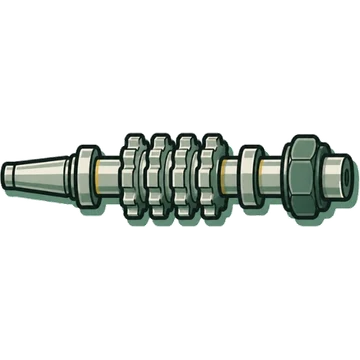
- Machine-side mounting (by manufacturer)
- Liebherr:
- HSK-C80 (bore 22–60)
- SK-A45 (22–60)
- SK-45 (60)
- Cylindrical Ø32 (19.05–50)
- Cylindrical Ø40 (22–50)
- Liebherr:
Shaper cutters
- Type
- Disc type (disc), hub / deep counterbore type (hub / deep counterbore), shank type (shank)[7][9][10][11]
- Disc-type bore diameters
- 1.25in 31.75
- 1.75in 44.45
- Hub-type bore diameters (by manufacturer)
- List of bore diameters (Nidec)
- 12.7, 16, 19.05, 22, 25.4, 31.75, 32, 44, 45, 58.7375, 63.5, 70, 88.9, 101.6[9]One source / referenceProduction range of Nidec (Indian plant). 44 and 45 are listed as written on the page (1.75 in is 44.45 mm)
- Shank type
- For shank type it states 'QAL upto 160mm' (likely an upper limit on overall length, but the source does not explain the abbreviation)[9]One source / reference
Shaving cutters
- Bore diameter
- 44.45, 63.5, 100[13]One source / referenceNidec's manufacturing range (PCD 150–350 mm, module 1.25–14)
- Machine examples
- Nidec FE series shaving machine: cutter bore ⌀63.5[14]One source / reference
Related standards
 Gear Machine Tooling FAQ
- When is face-key (clutch) drive preferred over longitudinal keyway drive for gear hobs?
- Longitudinal keyway drive is standard for general bore-type hobs on long arbors, while face-key (clutch) drive or integral HSK shank hobs are chosen when maximizing arbor core diameter, minimizing face runout, or speeding up changeovers in production hobbing.
- Which runout checks are mandatory after mounting a hob on the hob arbor?
- Measure both radial runout and axial face runout on the ground proof hubs at both ends of the hob using a dial indicator. Dirt or non-parallel spacer collars bow the arbor when clamping the nut, directly causing profile and pitch errors.
- How do I choose between disc-type, bell-type, and shank-type shaper cutters?
- Use disc-type cutters for standard external gears, bell-type (cup-type) cutters when shaping internal gears or shoulder gears with narrow relief grooves where a protruding nut would collide, and shank-type cutters for small-bore internal gears.
For the design, selection and troubleshooting of hobs themselves, see Hob guide, and for gear terminology, how gears are made and ordering tools, see the articles"Gear study".
 Sources
Values with no mark agree across two or more independent publishers. Values that differ between manufacturers are shown side by side rather than reduced to one.
- ISO, "ISO 2490:2007 Solid (monobloc) gear hobs with tenon drive or axial keyway, 0,5 to 40 module" (summary)
- Liebherr-Verzahntechnik GmbH, "Hob arbors: Interface Ø40" (part number table by bore diameter, length, and drive)
- Liebherr-Verzahntechnik GmbH, "Hob arbors: Interface Ø32" (same as above)
- Liebherr-Verzahntechnik GmbH, "Hob arbors: Interface SK-45" (same as above)
- Gleason, "Carbide Tools"
- Nidec Machine Tool India (Nidec Machine Tool), "Gear Hobs"
- Gleason, "Gleason Cutting Tools s.r.l., Viganò, Italy"
- Liebherr-Verzahntechnik GmbH, "Hob arbors" product list (HSK-C80, Ø32, Ø40, SK-45, SK-A45)
- Nidec Machine Tool India (Nidec Machine Tool), "Shaping Cutters"
- Liebherr-Verzahntechnik GmbH, "Disc-type shaper cutters DIN 5480" (stock tool table)
- Liebherr-Verzahntechnik GmbH, "Hub-type shaper cutters DIN 5480" (stock tool table)
- Liebherr-Verzahntechnik GmbH, "Finishing disc-type shaper cutters DIN 3972/II" (stock tool table)
- Nidec Machine Tool India (Nidec Machine Tool), "Gear Shaving Cutters"
- Nidec Machine Tool Corporation, "Gear Shaving Machines FE Series" (specifications: cutter bore diameter)