Carbide Tool Prices Revised for Orders from Oct 1: Inserts +25% or More, Solid Drills and End Mills “−25% to +10%” (Some Go Down)
Inserts go up, but solid tools can go down. Get fresh quotes for each diameter!

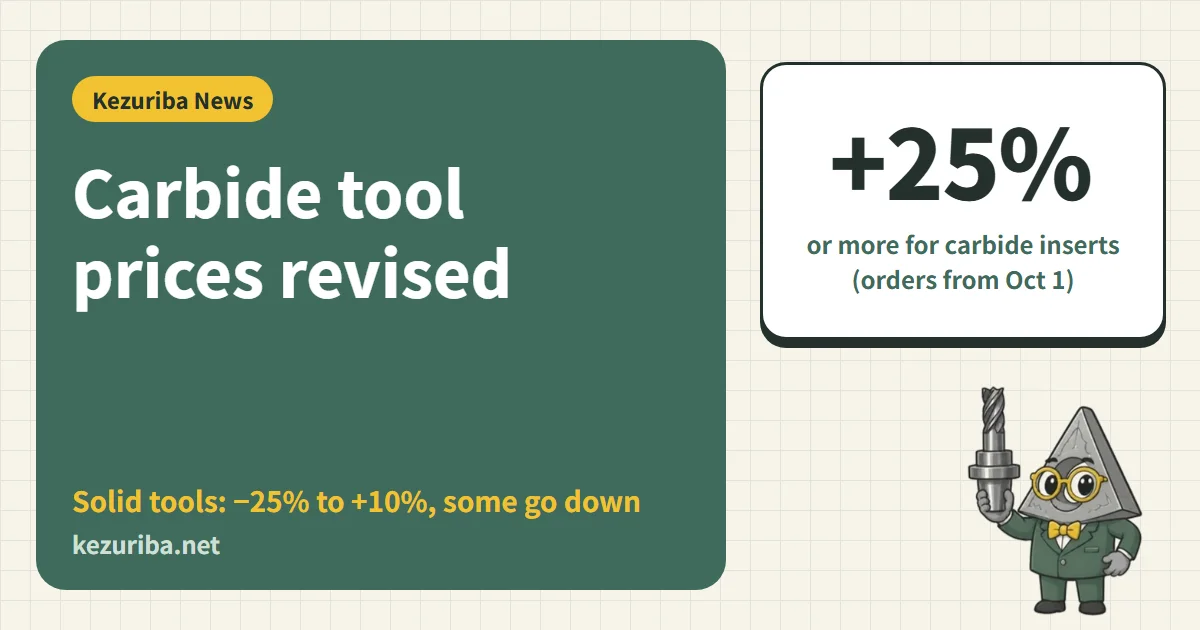
Sumitomo Electric Industries has revised the prices of its hard metal business products, including carbide tools, for orders received on or after Oct 1, 2026.[1]. Carbide inserts rise +25% or more. Meanwhile, solid drills, end mills and carbide holders change by −25% to +10% depending on tool diameter, and exchangeable-tip drill heads by −20% to 0%, so some items get cheaper in this revision[1]. The company also revised prices for orders from June 1, so this is the second revision this year[2].
- Covers orders received on or after Oct 1. Announced Aug 7[1]
- Carbide inserts +25% or more, steel tools (holders, cutters, parts) +10% or more, cermet inserts and SUMIBORON / SUMIDIA tools +5% or more[1]
- Solid drills, end mills and carbide holders: −25–+10% (depending on tool diameter). These items were “+60% or more” in the June revision[1][2]
- The reason given: raw material tungsten stays at a high level due to “difficulty in obtaining supply because of export controls in major producing countries”[1]
Revision rates for orders from Oct 1
Revision rates per product as stated in the announcement. Bars show the range of the rate; an arrow pointing right means “or more.” For products not listed and for details, customers are told to inquire individually[1].
Compared with the June revision
Here is the revision for orders from June 1 of the same year, lined up item by item. Inserts now rise by more, while solid tools go the other way (down).[2][1].
| Product category | Orders from Jun 1 | Orders from Oct 1 |
|---|---|---|
| Carbide inserts | +13% or more (excl. cermet) | +25% or more (incl. carbide parts) |
| Cermet inserts | — (not covered) | +5% or more |
| Solid drills and end mills | +60% or more | −25–+10% (incl. carbide holders; depends on tool diameter) |
| Exchangeable-tip drill heads | — (not stated) | −20% to 0% (depends on tool diameter) |
| SUMIBORON / SUMIDIA tools (all) | +5% or more | +5% or more (binderless and coated products priced individually) |
| Brazed tools | +20% or more | — (no separate mention) |
| SUMICRYSTAL and SUMIDIA WD materials | +15% / +25% or more | — (no separate mention) |
| Other carbide materials & tools | — | 0–+15% |
| Steel tools (holders, cutters, parts) | — | +10% or more |
| Alloy materials, die wear-resistant products, solid rotary tools over 12 mm dia., etc. | Changed from stock items to special (custom) products | Special (custom) products continue to be quoted case by case |
Background: raw material tungsten
The main raw material of carbide tools is tungsten (tungsten carbide). The announcement cites tungsten prices staying high because of “difficulty in obtaining supply due to export controls in major producing countries,” and an expected “prolonged market surge beyond expectations”[1].
- China’s export controls on Japan: On Jan 6, 2026, China’s Ministry of Commerce (MOFCOM) issued Announcement No. 1 of 2026, banning exports of dual-use (military and civilian) items to Japan where they are judged to strengthen Japan’s military capabilities, effective immediately. Tungsten is named among the minerals most affected[3].
- Prices move differently depending on which market and which price you look at: China's domestic prices have fallen sharply since peaking in March, but prices outside China (Europe) remain high. Over the past year, almost all the raw material Japan imports has come from countries other than China (see the table below).
| Indicator | Movements in 2026 |
|---|---|
| China domestic tungsten concentrate (wolframite, 65% or higher) | Down about 58%, from 1,050,500 yuan per standard ton on March 16 to 445,500 yuan on May 19. The reason is said to be weak downstream demand from carbide, machining and other sectors[4] |
| China domestic APT (major producers' long-term contract price) | Reported to have fallen to 580,000 yuan per t in the second half of September[5] |
| Europe (Rotterdam) APT | The average as of August 14 was $3,087.5 per mtu[7]. In the week of October 8 as well, quotes were $2,700–3,100, and prices remain at a high level[6] |
| Japan's imports of APT and similar (tungstates) | The unit price peaked at 46,134 yen/kg in June and was 33,309 yen/kg in August (about 7.6 times the January 2025 level). China's share of import volume was 2.4% for January–August 2026 (zero every month since February)[8] |
Most of the raw material that Japanese toolmakers buy comes from outside China. For that reason, the fall in China's domestic prices has not carried through directly to Japanese purchase prices, and although the import unit price is down from its peak, it is still more than 7 times the level of early 2025[8]. Why the increases for inserts became large while solid tools moved toward decreases is not stated in the announcement[1]. The circumstances of each product are best confirmed through your suppliers or distributors. For the detailed background on market prices, regulation and imports, and for charts, see Tungsten Price Surge and Carbide Tools.
What shops and buyers can do
- Check the “orders received” date: The revision starts with orders received on or after Oct 1[1]. Unit prices may differ between orders placed in September and in October, so review your quote validity periods and order dates.
- Solid tools are worth requoting: Depending on tool diameter, this revision includes price cuts[1]. If you switched to indexable tools after the June increase, compare again for each diameter.
- Think in cost per corner for inserts: The higher the insert price, the more it pays to lower cutting speed slightly to extend tool life. How to Extend Tool Life (Taylor’s Tool Life Equation Calculator) lets you try out the relationship between speed and tooling cost.
- Reduce chipping and abnormal wear: Inserts thrown away from chipping before the end of their life take the full hit of a price rise. Causes and fixes by type of damage are collected in the Machining Troubleshooting Encyclopedia.
FAQ
- When does Sumitomo Electric's carbide tool price increase take effect?
- It applies to orders received from October 1, 2026. It was announced on August 7, and since the company also revised prices for orders from June 1, this is its second revision this year.
- How much are carbide insert prices going up?
- In the revision for orders from October 1, carbide inserts (including carbide parts) go up by +25% or more. In the revision for orders from June 1, the increase was +13% or more (excluding cermet).
- Are solid drills and end mills also going up?
- In the October revision they range from −25% to +10% depending on tool diameter, so some prices go down. These items rose by +60% or more in the June revision, so it is worth getting new quotes for each diameter.
- Why are carbide tool prices going up?
- The announcement gives as the reason that the price of tungsten, the raw material, remains high because it is "hard to obtain due to export controls in the main producing country". It does not explain why inserts rose more while solid tools moved downward.
Sources
- Sumitomo Electric Industries, “Notice of Price Revision for Hard Metal Business Products” (news release, 2026-08-07, for orders received on or after Oct 1, 2026)
- Sumitomo Electric Industries, “Notice of Price Revision for Hard Metal Business Products” (news release, 2026-04-20, for orders received on or after Jun 1, 2026)
- Greenberg Traurig, LLP, “China Tightens Export Controls on Dual-Use Items to Japan” (2026-02-13, commentary on MOFCOM Announcement No. 1 of 2026)
- SMM (Shanghai Metals Market), “Tungsten Prices Halve from Their Peak” (trade press report, 2026-05-20)
- SMM (Shanghai Metals Market), "Chongyi tungsten companies announce long-term contract prices, prices cut" (trade press report, 2026-09)
- SMM (Shanghai Metals Market), market commentary on the "CIF Rotterdam 88.5% APT" price page (week of 2026-10-08)
- GBC AG, "Original-Research: Almonty Industries" (research firm report, 2026-08; cites Fastmarkets' Rotterdam APT price)
- Ministry of Finance, Trade Statistics (China's share calculated by Kezuriba from import volumes by country for tungstates, 2841.80-000)
More articles
 News
Japan Machine Tool Orders Hit an Annual Record: ¥1.8737 Trillion Through October 2026, ¥57.9 Billion Above the 2018 Record (JMTBA Flash Report)
 News
JIMTOF 2026 Wrap-up: Attendance and Exhibition Trends (Post-Show Report)
 News