JIMTOF 2026 Live Report: New Product Announcements Explained (Specs, Changes from Previous Models, How They Work, What They Mean)
A model number alone tells you little. Read the numbers and “what changed from before” — that is how to read show news!

This is a day-by-day report that explains each announcement made during JIMTOF 2026 (the 33rd Japan International Machine Tool Fair, October 26–31, 2026, Tokyo Big Sight). Instead of stopping at a model name and the words “world premiere”, each entry lays out the key specifications, what changed compared with the previous model or the conventional method, how the technology works in plain words, which parts and shops it is meant for, and what has not yet been announced — all taken from the makers’ and the organizer’s own documents. It is updated every night during the show. For getting around the venue, see our Visitor Guide & Hall Map; for the full list of new products announced before the show, see New Products & World Premieres (with booth numbers).
- Announcements are grouped by day, largest first. Click a title in the index below to jump to its explanation.
- The right-hand column of each spec table shows the comparison point (previous model or conventional method). Items the maker has not published are left out.
- Benefits described under “What it means on the shop floor” are the makers’ own claims; results in your shop will vary with parts, materials and lot sizes.
- Use the category buttons to filter by machine tools, CNC, tooling, metrology and more.
Overview and index of announcements
Below is how many announcements we have covered so far and how they split by category. JIMTOF is a machine tool show, but its announcements span the whole shop: CNCs and AI, automation that moves parts and chips, cutting tools and metrology.
Mon, Oct 26 — Day 1 announcements
Day 1 brought a cluster of world premieres in the East Halls that combine turning and milling in one machine: DMG MORI’s INH 63 FD (a 5-axis horizontal machining center that also turns), Matsuura’s MX-850T PC4 (5-axis with turning for Ø850 mm parts), Nakamura-Tome’s RX-50 (a turret-less, ATC-type multitasking machine) and Murata Machinery’s MVH600. The other thread is automation of the manual work around the machine — parts, chuck jaws, tools and even chip buckets — seen in DMG MORI’s GX Flex and AMRs and Okuma’s MU-350V cell. In-machine measurement of wall thickness and tools (Renishaw RUP60, Blum LC54-DIGILOG) is also on show. Switzerland’s United Machining Solutions (East 8, E8001) gave Japan premieres to the CUT P 350 wire EDM, the S23 cylindrical grinder and the VISION LASER for laser-cutting PCD tool edges, so finishing processes — EDM, grinding and laser — also got new machines. According to the organizer, 1,134 companies from 22 countries and regions occupy 4,422 booths; with East Halls 4–6 closed for renovation, the show is smaller than 2024 (1,268 companies, 5,744 booths).
AGIE CHARMILLES CUT P 350: new high-precision wire EDM for fine and precision parts makes its Japan debut
Switzerland's United Machining Solutions is showing the AGIE CHARMILLES CUT P 350 high-precision wire EDM in Japan for the first time. The product page states the CUT P series was scheduled for release in September 2026, and a technical specification sheet dated 10/2026 lists its figures alongside the larger CUT P 600.
| Key specs | Announced |
|---|---|
| X, Y, Z travel | 350 × 250 × 250 mm |
| U, V travel / taper angle | ±45 mm / ±30° (at 50 mm height) |
| Max. part size / weight | 820 × 680 × 250 mm / 400 kg |
| Axis resolution | 0.1 µm (X, Y, U, V, Z; linear scales on X, Y, U, V) |
| Wire diameter | ø0.05–0.30 mm (standard guide ø0.20 or ø0.25) |
| Best Ra | Steel 0.15 µm / carbide 0.08 µm |
| Dielectric | Deionised water, 760 l, 2 filter cartridges |
| Machine dimensions / weight (without dielectric) | 1,705 (W) × 3,278 (D) × 2,712 (H) mm / 2,865 kg |
- The CUT P 350, a new model in the AGIE CHARMILLES CUT P series listed for release in September 2026, is on show in Japan for the first time; United Machining Solutions describes it as a new technology making its Japan debut.
- Compared with the CUT P 600 on the same sheet (X, Y, Z 600 × 400 × 350 mm, 1,000 kg parts), the CUT P 350 is the smaller-part size, with machine weight of 2,865 kg instead of 4,300 kg. The 0.1 µm resolution and the best finish (Ra 0.08 µm on carbide) are the same on both.
- In its JIMTOF exhibitor news, the company lists micro-feature machining, high-precision mould making and medical and precision parts as the three themes of the display.
Wire EDM cuts by firing a continuous stream of small sparks between a thin metal wire and the workpiece under water; the heat melts away the material a little at a time. Because nothing touches the part, hardened steel or carbide can be cut into fine shapes. The CUT P 350 uses wire from 0.05 to 0.30 mm in diameter and moves the X, Y table and the upper guide (U, V axes) in 0.1 µm steps. Offsetting the upper and lower guides tilts the wire, which allows tapers of up to ±30°.
It targets shops cutting small parts where variation is not acceptable, such as fine punches and dies for stamping tools, watch components and medical parts. The maker says it delivers precision and long-term stability in micromachining while reducing dependence on the operator.
Not yet announced: Price, Japanese launch timing, the generator and the CNC/HMI names, and cutting-speed figures have not been published.
Related: Machining basics · JIMTOF2026 new productsSources: AGIE CHARMILLES CUT P product page · CUT P 350 / 600 technical specifications (PDF, 10/2026) · JIMTOF exhibitor news (2026-10-20) · United Machining Solutions JIMTOF 2026 page
STUDER S23: compact universal cylindrical grinder for external, internal and thread grinding in one setup makes its Japan debut
Switzerland's STUDER is showing the S23 CNC universal cylindrical grinder in Japan for the first time, after its world debut at EMO Hannover in September 2025. STUDER positions it between its entry-level and premium machines; at JIMTOF it demonstrates high-precision external and internal thread grinding and process consolidation.
| Key specs | Announced |
|---|---|
| Distance between centers / center height | 650 mm or 1,000 mm / 175 mm |
| Max. workpiece weight | 120 kg |
| X travel / speed | 285 mm / 10,000 mm/min |
| Z travel / speed | 800 mm (650 mm model), 1,150 mm (1,000 mm model) / 20,000 mm/min |
| Wheelhead spindle | Up to 12.5 kW, up to 3,200 min⁻¹ |
| Max. wheel diameter / width | 500 mm / 110 mm |
| B axis (wheelhead swivel) | −30° to 190°, automatic 1° Hirth, up to three wheels |
| Table swivel / base | Up to 8.5° (swiveling table) / Granitan S103 mineral cast |
- First showing in Japan. STUDER says the S23 fills the gap between its entry-level and premium segments.
- The automatically swiveling B-axis wheelhead, indexing in 1° steps, can carry two external wheels and one internal wheel, so external and internal grinding are done without re-clamping.
- A C axis enables out-of-round and thread grinding, and the controls run the group-wide C.O.R.E. OS with STUDER's pictogram-based programming (StuderPictogramming).
A cylindrical grinder brings a fast-spinning wheel against a rotating workpiece to finish shaft and pin diameters and bores to micron-level size and roundness. On the S23 the wheelhead swivels automatically on a B axis (a rotary axis that turns the whole wheelhead), presenting the external and internal wheels in turn. Coordinating the workhead's C axis (which controls the part's rotation angle) with the wheel motion lets it grind non-round shapes such as cams and thread grooves. The base is mineral cast (stone aggregate bonded with resin), which STUDER says resists heat and vibration.
It suits shaft-type parts such as hydraulic components, pumps and tool shanks where external diameters, bores and threads must share one axis. STUDER says it fits both one-off work in small shops and volume production in large plants, and that combining several grinding operations in one setup reduces re-clamping errors and changeover time.
Not yet announced: Price, Japanese availability and the dimensions and accuracy of the demonstration parts at JIMTOF have not been published.
Related: Grinding basics · Thermal displacement · JIMTOF2026 new productsSources: STUDER S23 product page · STUDER news release (2025-09-22) · United Machining Solutions JIMTOF 2026 page
WALTER VISION LASER: laser machine for edging brazed PCD and diamond tools makes its Japan debut
Tool-grinder brand WALTER (UNITED GRINDING Group) is showing the VISION LASER, announced in June 2025, in Japan for the first time. It is designed for PCD, CVD diamond, MCD (monocrystalline diamond) and carbide tools, and the JIMTOF exhibitor news says the booth shows machining with edge quality of 3 µm or better and surface roughness of Ra 0.1.
| Key specs | Announced |
|---|---|
| X, Y, Z travel | 500 × 350 × 700 mm |
| Rotary axes | A axis endless / C axis ±150° (torque drive) |
| Workpiece | Length 400 mm, diameter 3–250 (300) mm, max. 50 kg |
| Tool materials | PCD, CVD-D, MCD, carbide |
| Edge quality / surface roughness (shown at the booth) | 3 µm or better / Ra 0.1 |
| Robot Loader 25 (option) | 6 axes, up to 70 workpieces, up to 20 kg and 250 mm diameter |
| Software / OS | GTR ProfDia Laser / C.O.R.E. |
- Edging brazed PCD tools has typically been done by wire EDM. The VISION LASER forms the edge with a laser, so it needs no wire, coolant or filters, and machines the tool in one clamping, according to the maker.
- All five CNC axes use linear drives and the C axis uses a torque drive; the axes, the laser focus position and the centre of rotation are calibrated automatically.
- The software, GTR ProfDia Laser, works like GTR ProfDia Erosion, long used for wire EDM, which the maker says eases the switch for experienced users.
PCD (polycrystalline diamond) is an extremely hard material made by sintering diamond grains; it is brazed onto a carbide body to make cutting edges for machining aluminium or CFRP. Because it is too hard to grind easily, edges have usually been cut by wire EDM. The VISION LASER rotates the tool while a laser beam removes the diamond layer bit by bit to form the edge and rake face. The maker says chip breakers (grooves that break chips into short pieces) and concave internal contours can also be lasered.
It targets toolmakers and regrinding shops that produce PCD tools for automotive aluminium parts or aerospace CFRP. The maker says it eliminates consumables such as wire and dielectric, and that unattended operation is possible with the robot loader.
Not yet announced: Price, Japanese availability, laser type and power, and cutting-speed figures have not been published in the Japanese announcement.
Related: Cutting tool basics · Aerospace machining · JIMTOF2026 new productsSources: UNITED GRINDING VISION LASER product page · UNITED GRINDING news release (2025-06-18) · JIMTOF exhibitor news (2026-10-17)
JIMTOF2026 opens: 1,134 exhibitors from 22 countries and regions in 4,422 booths, without East Halls 4–6
The 33rd Japan International Machine Tool Fair opened at Tokyo Big Sight on 26 October 2026 and runs for six days until 31 October. The organizers announced 1,134 exhibitors (including direct, co- and internal exhibitors) from 22 countries and regions, occupying 4,422 booths. Because East Halls 4–6 are closed for major renovation of Tokyo Big Sight, the exhibition area is 92,850 m², smaller than last time.
| Key specs | Announced | JIMTOF2024 (32nd) |
|---|---|---|
| Exhibitors | 1,134 (including direct, co- and internal exhibitors) | 1,268 (1,027 direct + 241 co-/internal) |
| Booths | 4,422 booths | 5,744 booths (record high) |
| Countries and regions | 22 | 19 |
| Exhibition area | 92,850 m² (East, West and South Halls, excluding East Halls 4–6) | 118,540 m² (entire venue) |
| Dates | 26–31 October 2026 (6 days) | 5–10 November 2024 (6 days) |
| Opening hours | 10:00–17:00 (until 16:00 on the last day) | West/South 9:00–17:00, East 10:00–18:00 (until 16:00 on the last day) |
| Visitors (registered, counted once per person) | To be announced by the organizers after the show | 129,018 (10,423 from overseas) |
| Admission | JPY 3,000 on the day / JPY 1,000 in advance (tax incl., students free); full registration required, exhibitors included | — |
- 1,134 exhibitors, 134 fewer than the 1,268 last time. Both figures count direct, co- and internal exhibitors in the same way.
- 4,422 booths, about 23% fewer than the record 5,744 last time, because East Halls 4–6 are unavailable during renovation.
- 22 countries and regions take part, three more than the 19 last time.
- All halls now open 10:00–17:00. Last time the West and South Halls opened at 9:00 and the East Halls closed at 18:00.
JIMTOF is organized by the Japan Machine Tool Builders' Association (JMTBA) and Tokyo Big Sight, and has been held every two years since 1962. Booths are booked in units of 3 m × 3 m = 9 m². This edition overlaps with renovation work at the venue, so East Halls 4–6 are closed. That is why the exhibition area and booth count are smaller than last time.
When planning a visit, note that East Halls 4–6 are closed and that every hall opens at 10:00 this time (in 2024 the West and South Halls opened at 9:00). Attendance is counted by registration, with each person counted once however many days they come, so the official post-show figure can be compared directly with 2024’s 129,018.
Not yet announced: Day-one attendance, total and overseas attendance for the whole show, and the split of domestic and overseas exhibitors (none officially announced at the time of writing).
Related: JIMTOF2026 guide · JIMTOF2026 new products · ManufacturersSources: JIMTOF2026 PR Office: 1,134 exhibitors in 4,422 booths (28 Sep 2026, Japanese) · JIMTOF2026 official outline (Japanese) · JIMTOF2024 final report (PDF, Japanese)
DMG MORI INH 63 FD: a 5-axis horizontal machining center that can also turn (mill-turn table version)
DMG MORI gave the world premiere of an FD version of its INH 63 5-axis horizontal machining center (launched in 2023) that adds turning. The pallet becomes a φ800 mm round table, and the machine can both mill and turn with the table inclined. Price and release date have not been announced.
| Key specs | Announced | INH 63 (standard version) |
|---|---|---|
| Pallet work surface | φ800 mm | 630 × 630 mm |
| Max. pallet load | 1,500 kg (A-axis not tilted) | 1,000 kg |
| Max. workpiece size | φ1,070 × 900 mm | φ1,070 × 1,000 mm |
| Travels X / Y / Z (INH 63) | 1,050 / 1,100 / 1,050 mm | — |
| Indexing range (INH 63) | A-axis 240° (+45° to −195°), B-axis 360° | — |
| Max. spindle speed (INH 63) | 12,000 min⁻¹ (high-speed options 16,000 and 20,000 min⁻¹; high-torque option 8,000 min⁻¹) | — |
| Machine mass (incl. coolant tank and 123-tool magazine) | 35,050 kg | 34,500 kg |
| Floor space (W × D) | 4,639 × 6,795 mm | 4,474 × 6,755 mm |
- The standard INH 63 only mills; the FD version adds turning, combining both processes on one machine
- The pallet changes from a 630 × 630 mm square to a φ800 mm round table, and the max. load rises from 1,000 kg to 1,500 kg (A-axis not tilted)
- Max. workpiece height drops from 1,000 mm to 900 mm; the machine is 550 kg heavier and needs slightly more floor space
A horizontal machining center has its spindle (the shaft that spins the tool) mounted sideways, and the pallet carrying the part moves during cutting. The INH 63 is a 5-axis machine with an A-axis that tilts the pallet and a B-axis that rotates it, so many faces can be cut in one setup. In the FD version the round table itself spins the part so a stationary tool can turn it, as on a lathe. DMG MORI says machining with the table inclined helps chips fall away and adds flexibility.
It targets larger parts that need both round surfaces (turning) and holes or pockets (milling), such as flanges, housings and valve bodies, aiming to cut re-clamping and transfers between a lathe and a machining center. DMG MORI promotes process integration, but has not published figures such as how many separate machines it replaces. The 50-taper spindle and 1,500 kg load suggest heavy parts for construction machinery and energy.
Not yet announced: Max. table speed for turning, turning tool holder setup, price, release / order date, and what “FD” stands for have not been announced
Related: 5-axis machining · Machining centers · Lathes & turningSources: DMG MORI JIMTOF2026 special page · DMG MORI INH series product page (specifications incl. FD) · JIMTOF2026 exhibitor details (DMG MORI)
DMG MORI NTX 2500 3rd Generation with GX Flex: a new gantry loader that also changes chuck jaws and tools
DMG MORI showed the world premiere of GX Flex, a newly developed gantry loader (an overhead handling unit that runs above the machine), paired with the NTX 2500 3rd Generation mill-turn center launched in September 2025. DMG MORI says it automates not only part handling but also chuck jaw changes and tool changes. Specifications, price and release date of GX Flex have not been announced.
| Key specs | Announced |
|---|---|
| Max. machining diameter (NTX 2500 | 1500) | φ670 mm |
| Max. machining length | 1,616 mm (1500) / 3,136 mm (3000) |
| Max. spindle speed (NTX 2500 | 1500) | 4,000 min⁻¹ |
| Max. turn-mill spindle speed | 20,000 min⁻¹ (option) |
| Tool storage capacity | 38, 76, 114, 194 or 246 tools |
| Length of compactMASTER turn-mill spindle | 350 mm (C6 or HSK-A63) |
| GX Flex automation scope | Part handling, chuck jaw change, tool change |
- Earlier GX loaders handled loading raw parts and unloading finished ones for mass production; GX Flex also takes over chuck jaw and tool changes
- Because the system itself swaps jaws (refitting the chuck jaws to suit each part shape), it aims to keep running unattended even when the part type changes
A mill-turn center is a lathe (which spins the part to cut it) with an added milling spindle, so turning and drilling or slotting are done on one machine. The NTX has a turn-mill spindle on a B-axis (an axis that swivels the tool spindle), so it can also cut angled holes and curved surfaces. A gantry loader is a robot running on rails above the machine that reaches in from the top to load and unload parts. GX Flex also carries chuck jaws and tools, so changeover work is done by the system.
For high-mix turned parts (shafts, flanges, hydraulic components), jaw changes and tool swaps at every part change often stop unattended night and weekend running. DMG MORI says GX Flex automates this changeover. How many part types or jaw sets it can handle has not been published, so fit for a given product mix still needs checking.
Not yet announced: GX Flex payload, part size range, number of stored jaws and tools, numeric differences from earlier GX loaders, which NTX 2500 model (1500 / 3000) is shown, price and release date have not been announced
Related: Lathes & turning · 5-axis machining · Cycle time calculatorSources: DMG MORI JIMTOF2026 special page · DMG MORI NTX 2500 3rd Generation product page · DMG MORI news (2025-09-03): NTX 3rd Generation series
Matsuura MX-850T PC4: a 5-axis multi-tasking machining center that also turns parts up to φ850 mm and 500 kg
The second model in the MX-T series, which combines 5-axis machining and turning in one machine, makes its world debut at JIMTOF2026. It takes much larger workpieces than the entry-level MX-520T launched in 2024. Matsuura announced it on September 3, 2026 and plans to start sales in 2027; the show machine carries the 4-pallet PC4 system.
| Key specs | Announced | MX-520T PC7 (Matsuura's entry model) |
|---|---|---|
| Max. workpiece size | φ850 × H450 mm (pallet version φ850 × H385 mm) | φ520 × H330 mm |
| Max. workpiece mass | 500 kg (pallet version 400 kg) | 175 kg |
| Travel X/Y/Z | 900/780/650 mm | — |
| Travel A/C axes | -125 to +30° / 360° | — |
| Table (C-axis) speed and torque in turning mode | 800 min⁻¹, 600 N·m (direct drive) | — |
| Spindle (standard) | 12,000 min⁻¹, 18.5/22 kW, 191 N·m | — |
| Spindle (options) | 15,000 min⁻¹ (15/30 kW, 350 N·m), 20,000 min⁻¹ (15/18.5 kW, 108 N·m) | — |
| Spindle nose | HSK-T63 | — |
| Tool magazine (option) | 90 / 120 tools | — |
| Pallet systems (option) | PC4 (4 pallets) / PC7 (7 pallets, new) | — |
- Compared with the MX-520T, workpiece volume grows about 3.3 times (about 3.0 times with pallets) and allowable mass 2.5 times (about 2.3 times with pallets).
- It keeps the strokes of the base MX-850 (C-axis rapid 40 min⁻¹), but its 4/5-axis table now spins up to 800 min⁻¹ with 600 N·m from a direct-drive motor for turning; even in milling mode the C-axis reaches 100 min⁻¹.
- A new tower pallet system, PC7, was developed for the MX-850/MX-850T: it raises the pallet count from 4 to 7 in the same floor space as the existing PC4.
- The MiOS 4 operating system adds operator support and safety functions for multi-tasking, including spatter protection and an unbalance check for turning.
The table that holds the workpiece does two jobs. For 5-axis machining it tilts and rotates so the tool can reach the part from many directions. For turning, the table itself spins like a lathe chuck while a turning tool held in the spindle cuts the outside or inside diameter. Tilting the A-axis (the tilting axis) lets it turn in a horizontal orientation as well as vertically. The HSK-T63 spindle nose is a tool-interface standard for multi-tasking machines, so drills, end mills and turning tools all fit the same spindle, and a brake locks the spindle so the turning tool does not move while cutting.
It fits shops that turn flanges, housings or ring-shaped parts a few hundred millimeters across on a lathe and then move them to a machining center for holes and pockets. Matsuura says that doing everything in one clamping cuts the setup time and re-clamping error of each transfer and consolidates processes. A lift-up chip conveyor directly under the table and the 7-pallet PC7 are aimed at long unattended runs on medium and large parts.
Not yet announced: Price, exact launch date (only "2027"), CNC model, turning accuracy figures, and the maximum tool count with PC4 or PC7 fitted.
Related: 5-axis machining · Machining centers · Lathes and turning · JIMTOF2026 new productsSources: Matsuura press release (Sep 3, 2026, PDF) · JIMTOF2026 exhibitor page (Matsuura)
Nakamura-Tome RX-50: a turret-less ATC multi-tasking machine with a 30,000 min⁻¹ tool spindle and up to 119 tools
An ATC-type multi-tasking machine meant to finish expensive-material parts such as watch, medical and jewelry components right from the first piece, without repeated trial cuts. Announced on October 26, 2026 and shown for the first time anywhere at JIMTOF2026, under the slogan "make every precious piece a sure piece."
| Key specs | Announced |
|---|---|
| Max. turning diameter / length | φ350 mm / 615 mm |
| Bar capacity (L / R spindle) | φ65 mm / φ42 mm |
| Chuck size (L / R) | 6 in or 8 in / 5 in or 6 in |
| Spindle speed (L / R) | 4,500 / 6,000 min⁻¹ |
| Spindle motor (L / R) | 15/11 kW / 11/7.5 kW |
| Distance between spindle faces | max. 900 mm / min. 220 mm |
| Tool spindle (NT Smart Cube) | 30,000 min⁻¹, 299 mm long |
| ATC tool capacity | 60 (up to 119 as an option) |
| Chip-to-chip time | 3.3 s |
| Machine size | Body 3,000 × 2,000 mm (4,309.2 × 2,378 mm with chip tank and conveyor), height 2,250 mm |
- It has no turret at all: just two opposed spindles and an independent tool spindle, the same simple layout as Nakamura-Tome's NTRX-300 series.
- The in-house compact tool spindle unit, NT Smart Cube, is 299 mm long and runs up to 30,000 min⁻¹.
- The two spindles sit vertically and symmetrically on a horizontal bed, a layout the company says minimizes the effects of heat and vibration.
- Extra magazines stack vertically, so tool capacity rises to 119 without enlarging the machine body.
The two opposed spindles face each other: the part is cut while held on the left, then handed to the right so the back side can be machined. The tool spindle rotates cutters like a machining-center spindle and swaps them from the magazine by ATC (automatic tool changer). With no turret, the tool spindle is isolated from turret vibration and heat, which the company says helps keep positioning accurate. Chip-to-chip time is the gap between one tool finishing its cut and the next one starting, and the Chronocut α software trims idle moves and other waiting time.
It fits low-volume shops making parts where the bar stock itself is expensive, such as titanium, cobalt-chrome or precious metals, and where a scrapped trial piece hurts. Nakamura-Tome says it put accuracy for reliably finishing costly parts ahead of mass-production efficiency. The spindle center is only 450 mm from the machine front, and the control panel swivels and slides toward the ATC magazine, which helps in small-lot work with frequent setups.
Not yet announced: Price, launch date, sales target, whether it has Y- and B-axes and their strokes, positioning or machining accuracy figures, and CNC model.
Related: Lathes and turning · Thermal displacement · Cycle time calculatorSources: Nakamura-Tome RX-50 product announcement (Oct 26, 2026) · Nakamura-Tome RX-50 product page · Nakamura-Tome JIMTOF2026 page · JIMTOF2026 exhibitor news
Murata Machinery MVH600: a vertical CNC turning center with a 24-inch chuck and automatic loading of parts up to 100 kg
A vertical CNC turning center that pairs the machining area with a gantry loader for automated production of large, heavy parts. It makes its world debut at JIMTOF2026; Murata's exhibitor news says it automates workpieces up to 100 kg.
| Key specs | Announced |
|---|---|
| Type | Vertical CNC turning center |
| Chuck size | 24 in |
| Gantry loader payload | 100 kg |
| Loader motion | 3 axes (including front-to-back) |
| Live tooling | Yes |
| Loading and unloading of stock | By forklift from the front, or by hand cart |
| Safety fence | Not required (loader is enclosed by covers) |
- It combines a vertical machining area with Murata's gantry loader so parts up to 100 kg are loaded and unloaded without anyone lifting them.
- A "front access" layout lets a forklift deliver stock and remove finished parts directly at the front of the machine; narrow aisles can use a hand cart instead.
- The loader is fully covered, so no safety fence is needed, and the 3-axis loader can stock parts in several rows to extend unattended time (Murata says it verifies the actual stock quantity per case).
In a vertical lathe the spindle points upward and the part lies flat on the chuck, so even a heavy part sits on the chuck under its own weight. The gantry loader is a handling unit running on a gate-shaped rail over the machine; it places the part on the chuck and takes it out when finished. Live tooling (driven drills and end mills on the turret) lets the same machine drill and mill after turning.
It suits plants that still load brake discs, flanges or large rings one at a time with a crane because they are too heavy to lift by hand. Murata's stated aim is to reduce operator burden in automated production of large, heavy parts. Because stock can be dropped off in batches by forklift, the layout is set up for unattended night shifts.
Not yet announced: Maximum turning diameter and length, spindle speed and power, machine dimensions and weight, number of parts that can be stocked, CNC, price and launch date (detailed specs may be in a catalog that requires a request form; not checked).
Related: Lathes and turning · Manufacturers · JIMTOF2026 new productsSources: JIMTOF2026 exhibitor news (Murata Machinery, Oct 20, 2026) · Murata Machinery MVH600 product page · Murata Machinery JIMTOF2026 page
Makino a630iT: 630 mm pallet, #50-taper 5-axis HMC with the new Professional 7 control makes its Japan debut
The a630iT is a 5-axis horizontal machining center with a 630 mm square pallet and a #50-taper spindle. Its trunnion table carries parts up to Ø1,000 × 800 mm and 1,000 kg, and the Professional 7 control, a 136-tool magazine and a two-tier chip conveyor are standard. JIMTOF 2026 is its first showing in Japan.
| Key specs | Announced |
|---|---|
| Pallet size | 630 × 630 mm |
| Travel X / Y / Z | 1,000 / 1,000 / 1,050 mm |
| A-axis (tilt) | 240° (−195° to +45°), gear drive |
| B-axis (rotary) | 360°, direct drive |
| Spindle speed | 20–10,000 min⁻¹ (standard); Makino's US site also lists 8,000 and 15,000 min⁻¹ options |
| Spindle taper | BT50 (HSK-A100 optional) |
| Rapid traverse | 60,000 mm/min (X/Y/Z); A 7,200°/min; B 18,000°/min |
| Max. workpiece / payload | Ø1,000 × 800 mm / 1,000 kg |
| Tool capacity | 136 tools (standard) |
| Max. tool dia. / length / weight | Ø102 / 356 mm (with / without adjacent tools), 690 mm, 35 kg |
- First showing in Japan. Makino's US site describes it as the next step from the nx-Series HMCs, built as an integrated “B over A” trunnion (rotary B-axis mounted on the tilting A-axis)
- According to Makino US, it is the first machine with the FANUC-based Pro7 (Professional 7) control: two vertical 24-inch screens, and NC-program analysis that predicts finish times and tool usage
- The A-axis tilts from −195° to +45°, wide enough to reach negative-angle (undercut) faces
- A 136-tool magazine, Vision B.T.S. (a camera in the magazine that spots broken tools immediately) and a two-tier chip conveyor are all standard
In a horizontal machining center the spindle lies sideways, so chips fall away easily. The a630iT carries both rotary axes on the table side: the A-axis, which tilts the part, is gear-driven, and the B-axis, which spins it, is a direct drive turned straight by its motor. Because the A-axis tilts as far as −195°, many faces and angled holes can be cut in one setup without re-clamping. The #50 taper spindle holds large, heavy tools for heavy cutting.
Aimed at shops machining large, complex parts up to about Ø1,000 mm and 1 t that want fewer re-setups. Makino says the slant-column structure and #50 spindle machine difficult materials and complex shapes efficiently, and that the machine supports hydraulic/pneumatic supply through the pallet (option) and connection to automation systems.
Not yet announced: Japanese release date and price; spindle power and torque (not on the Japanese product page).
Related: 5-axis machining · Machining centers · Getting into aerospace partsSources: Makino Japan: a630iT product page · Makino Inc. (US): a630iT product page · Makino: JIMTOF 2026 exhibit page · JIMTOF 2026 exhibitor details (Makino)
FANUC "Physical AI CNC": a CNC pitched as safely automating the thinking work
FANUC is showing a "Physical AI CNC" described as safely automating intellectual work. In its IMTS 2026 announcement in September 2026, FANUC America listed AI-generated optimal toolpaths, program generation from user instructions, automated machining improvement using digital twins, and an autonomous failure-recovery demo. Release timing and supported CNC models have not been announced.
| Key specs | Announced |
|---|---|
| Description in exhibitor listing | Safely automates intellectual work |
| AI function 1 (announced at IMTS 2026) | AI-powered optimal toolpath generation |
| AI function 2 | Program generation based on user instructions |
| AI function 3 | Automated machining improvement using digital twin technology |
| Demo | Autonomous failure recovery |
| Related software (listed at IMTS 2026) | CNC Reflection Studio, CNC Guide 2, Surface Estimation, Tool Path Optimizer, Smart Digital Twin Manager |
- FANUC's earlier AI features from 2022, AI Thermal Displacement Compensation and AI Servo Tuning, handled compensation values and tuning. This time the targets are toolpaths and programming, work that people used to decide themselves (per the IMTS 2026 announcement).
- The same booth also shows physical AI applied to robots on an open platform, such as driving robots with generative AI, extending FANUC's robot-side physical AI work to the CNC.
- FANUC America announced AI-driven machining through the CNC first, at IMTS 2026 in the US in September 2026; at JIMTOF 2026 it appears under the name "Physical AI CNC".
Physical AI means connecting AI that handles text and images to the control of machines that move in the real world, such as robots and machine tools. Built into a CNC (the controller that drives a machine tool numerically), AI can work out the tool's path through the material (the toolpath) or write a part program from an operator's plain-language instructions. Because the result is first tried on a digital twin, a virtual copy of the real machine, collisions and machining problems can be checked in advance. At IMTS 2026 FANUC also announced a demo in which a stopped machine examines the situation and recovers on its own.
In high-mix, low-volume job shops, programming and setting cutting conditions eat up skilled staff's time, and a machine that stops at night often stays idle until morning. FANUC says the CNC safely automates intellectual work, pointing at less programming effort and shorter downtime. How much can actually be handed over needs to be checked at the booth demo and in later specifications.
Not yet announced: Release date, price, which CNC models it runs on (Series 500i-A or 100i-A), and whether it is offered as an option or standalone software have not been announced.
Related: NC and CNC basics · CAD/CAM · JIMTOF 2026 previewSources: JIMTOF 2026 exhibitor details (FANUC) · FANUC America press release (IMTS 2026, September 3, 2026)
FANUC Series 500i-A CNC, the new Series 100i-A, and αi-D servos
FANUC is showing its latest Series 500i-A CNC alongside a new model number, Series 100i-A, and αi-D series servos. The 500i-A and αi-D were announced in January 2024; the 100i-A appears only by name in the exhibitor listing, with no specifications yet on FANUC's website.
| Key specs | Announced |
|---|---|
| 500i-A processing performance | 2.7× the previous model (fully parallel CNC software) |
| Max. paths (501i-A / 501iS-A) | 15 paths |
| Max. total controlled axes (501i-A / 501iS-A) | 96 axes (72 feed axes, 24 spindles) |
| Max. simultaneously controlled axes | 24 axes (501iS-A), 5 axes (502iS-A) |
| Functional safety | IEC 61508 / ISO 13849-1 Category 4, SIL3, PLe |
| αi-D servo system losses | About 10% lower than FANUC's previous generation |
| αi-D servo amplifier width | Up to 30% narrower |
| αi-D servo motor protection rating | IP67 (standard) |
| Series 100i-A | Specifications not yet published |
- Series 100i-A is a model number that first appeared in the JIMTOF 2026 exhibitor listing. As of October 26, 2026, FANUC's CNC lineup page shows the 500i-A but not yet the 100i-A.
- The 500i-A uses a "dual-engine" design that separates the control engine from the UI engine, a first for FANUC CNCs, and FANUC rates its processing performance at 2.7× the previous model.
- The αi-D cuts total servo system losses by about 10% and large servo motor power losses by 30%, and makes amplifiers up to 30% narrower (all versus FANUC's previous products).
- In August 2026 FANUC launched its "5-Axis Integrated Initiative", which lets machine tools and post-processors (software that converts CAM output into machine-specific NC programs) matched to its latest 5-axis CNC functions carry a compliance logo.
The CNC is the machine tool's brain: it reads the program and tells each axis motor where to go and how fast. Because the 500i-A handles machining calculations and screen display on separate engines, operating the screen is less likely to delay axis control. It can handle up to 15 paths (independent programs running at the same time on one CNC) and up to 96 axes, so it suits mill-turn machines (machines that both turn and mill in one setup) and multi-axis special machines. The αi-D is a new generation of motors and amplifiers (the units that feed current to the motors); FANUC shows an example where faster communication roughly halves contour error and position error at axis reversal.
This is the control platform for builders of 5-axis and mill-turn machines and the part makers who use them. In simultaneous 5-axis work such as aerospace and medical parts, performance depends on CNC computing power, 5-axis software and the CAM post-processor all lining up. FANUC says pairing the CNC with αi-D servos makes servo control faster and more precise while cutting energy costs. Which machines and price range the 100i-A targets is still to be announced.
Not yet announced: Series 100i-A specifications, positioning, release date and price; pricing for the 500i-A and αi-D.
Related: NC and CNC basics · 5-axis machining · Machining centersSources: JIMTOF 2026 exhibitor details (FANUC) · FANUC Series 500i-A product page · FANUC new FA product: Series 500i-A (January 2024) · FANUC new FA product: αi-D series servos (January 2024)
TAKISAWA TEX-2500S GR: a multi-tasking machine that adds hobbing, skiving and gear milling
This is TAKISAWA's mid-class multi-tasking machine TEX-2500S, with two opposed spindles and a B-axis tool spindle, fitted with the new "GR" option for gear cutting. The GR option is announced at JIMTOF2026, and the official exhibitor listing calls it a world-first exhibit. The base TEX-2500S went on full sale in June 2026.
| Key specs | Announced |
|---|---|
| Chuck size | 10 + 10 in (two opposed spindles) |
| Max. turning diameter / length | φ400 mm / 1,100 mm |
| Bar capacity (left spindle) | φ80 mm |
| Spindle speed (left / right) | 4,000 / 4,000 min⁻¹ (22/15 kW) |
| Tool spindle | 12,000 min⁻¹, 22/15 kW, CAPTO C6 |
| B-axis swivel range | 240° (±120°) |
| ATC tool capacity | 30 (option 60) |
| Gear cutting with GR option | Hobbing, skiving, gear milling |
| Floor space (W × D × H) | 5,505 × 3,220 × 2,552 mm |
| Machine weight | 12,000 kg |
- The GR option announced here lets the machine go from turning to gear cutting by hobbing, skiving or gear milling in a single clamping.
- Against TAKISAWA's earlier machine, floor space is about 30% smaller, the tool spindle 15% shorter and tool change 14% faster, thanks to a magazine layout that changes tools without swiveling the tool spindle.
- The base TEX-2500S was first shown at EMO 2025. The official JIMTOF exhibitor listing calls the GR version a world-first exhibit, while Nidec's show page describes it as its first showing at a Japanese exhibition.
Two spindles face each other so the part can be handed over and both ends machined, while the tool spindle swaps cutters by ATC (automatic tool changer) and tilts on the B-axis (the swivel of the tool spindle). Hobbing turns a thread-like cutter (the hob) and the workpiece together at a fixed ratio so the teeth are generated a little at a time. Skiving spins a tilted gear-shaped cutter and the workpiece in sync at high speed to peel out the tooth spaces, and can also cut internal gears. Gear milling cuts one tooth space at a time with an end mill or similar tool; in every case the key is control that keeps the tool spindle and workpiece spindle exactly synchronized.
It targets parts such as geared shafts and small gears for EVs and robots that are turned on a lathe and then carried to a hobbing machine, cutting out the transfer and re-setup. TAKISAWA says the GR version completes high-precision gear work, now in growing demand from EV and robot markets, from turning onward in one clamping. Likely users are high-mix, low-volume shops whose volumes do not justify a dedicated gear cutter, but accuracy and speed against dedicated machines have not been published.
Not yet announced: Module range, maximum gear diameter and accuracy grade with the GR option, sample parts, GR pricing and availability, and the CNC model.
Related: Gears · Skiving article · Lathes and turning · Machining EV partsSources: JIMTOF2026 exhibitor page (TAKISAWA) · Nidec machine tools JIMTOF2026 page · TEX-2500S full-sale launch release (Jun 29, 2026, PDF) · TAKISAWA TEX-2500S product page
Star Micronics SB-12RII: a φ13 mm Swiss-type lathe whose sub spindle now grips parts up to 105 mm long
Announced on September 7, 2026, this succeeds the SB-12R type G, the small-diameter model of the SB series, which has sold more than 30,000 units. It targets small precision parts for medical devices, connectors and humanoid robots, is shown in Japan for the first time at JIMTOF2026, and goes on sale in Japan and overseas from spring 2027.
| Key specs | Announced | SB-12R type G (previous model) |
|---|---|---|
| Max. machining diameter | φ13 mm | — |
| Max. headstock stroke | 205 mm (guide bush) / 2.5 × bar diameter, max. 30 mm (non-guide bush) | — |
| Main spindle | 15,000 min⁻¹, 2.2/3.7 kW | — |
| Sub spindle | 12,000 min⁻¹, 1.5/2.2 kW (motor output about 3× the previous model) | — |
| Max. part length gripped by sub spindle | 105 mm | 80 mm |
| Cross live tools | 8,000/12,000 min⁻¹, 1.2 kW | — |
| Back live tools | 8,000 min⁻¹, 1.0 kW | 0.75 kW |
| High-speed thread whirling unit (option, in development) | Max. 5,000 min⁻¹ | — |
| Machine size (W × D × H) | 2,070 × 1,095 × 1,775 mm (depth about 10% less than before) | — |
- Back-working is stronger: sub-spindle motor output is about three times the SB-12R type G's, the back live-tool motor rises from 0.75 kW to 1.0 kW, and the sub spindle can grip parts up to 105 mm long instead of 80 mm.
- The top speed of the front live tools is raised (figure not published), and an inclined-hole unit is offered as an option for the first time in the SB series.
- Machine depth is about 10% shorter than the previous model, and a new sleeve holder with 60 mm clearance to the guide bush joins the existing 76 mm type.
In a Swiss-type lathe the headstock grips the bar and moves it back and forth, while the tools cut right next to the guide bush, a sleeve that steadies the bar. Because cutting always happens close to that support, long slender parts deflect very little. For short parts the machine can switch to non-guide-bush mode, cutting the leftover bar end to about one third. The front tool post rides on slanted sliding guideways for rigidity, and thread whirling cuts threads with a ring carrying several inserts spinning at high speed.
It suits shops mass-producing parts under φ13 mm, such as small medical screws and pins, connector pins, or slender shafts for humanoid robots. Star says the stronger sub spindle and back live tools shorten cycle time on parts with long back-working after cut-off, and the inclined-hole unit may bring angled holes that used to need a separate operation into the machine.
Not yet announced: Price, exact launch date (only "from spring 2027"), CNC, number of axes and tools, and the new top speed of the front live tools. Specs for the SX-38R type B, also shown as new, could not be confirmed in official material.
Related: Lathes and turning · Collets · Cycle time calculatorSources: Star Micronics SB-12RII launch release (Sep 7, 2026, Japanese) · Star Micronics SB-12RII release (English) · Star Micronics JIMTOF2026 page
DMG MORI AMR 1000 and AMR 2000: Japan premiere of autonomous mobile robots for chip buckets, pallets and tools
DMG MORI showed two autonomous mobile robots (AMRs), which navigate the shop floor on their own, for the first time in Japan. The AMR 1000 carries chip buckets and pallets; the AMR 2000 carries a tool magazine and a robot to transport and change tools fully automatically. Price and release date for Japan have not been announced.
| Key specs | Announced |
|---|---|
| AMR 1000 max. payload | 1,000 kg |
| AMR 1000 dimensions (L × W × H) | 1,070 × 770 × 480 mm |
| AMR 1000 max. speed / running time | 6 km/h / 8 h (charging 0–100% in 2 h) |
| AMR 1000 drive and charging | Omnidirectional (0 m turning radius), inductive charging, max. gradient 7% |
| AMR 1000 pallet sizes | 800 × 600 to 1,100 × 1,100 mm, or 1,200 × 800 mm |
| AMR 1000 communication interface | VDA 5050 |
| AMR 2000 (tool handling) max. number of tools | 24 tools |
| AMR 2000 (tool handling) max. tool weight | 30 kg (transport weight 720 kg = 24 × 30 kg) |
- The AMR 1000 is shown in Japan for the first time. Unlike conventional AGVs that follow guide lines on the floor, it uses laser navigation to choose its own route
- Besides pallets and material, it can carry chip buckets, replacing the job of wheeling full chip bins away from machines by hand
- The AMR 2000 carries a tool magazine and a robot, and not only moves tools between a central tool store and machines but also changes them
An AMR (autonomous mobile robot) uses laser sensors to see walls and machines, works out its own position, and drives to its destination while avoiding people and obstacles. The AMR 1000 drives omnidirectionally and can rotate on the spot, so it works in narrow aisles. A vertical lifting axis raises pallets or chip buckets to carry them. It charges inductively from a floor unit without plugging in, and can receive transport orders automatically from a host computer.
Even with automated machining, unattended hours do not grow if people are still needed to clear chips, replenish material or swap tools. DMG MORI positions the AMR 1000 for shop floors where people and machines work together, and the AMR 2000 for fully automatic tool transport and changing. It is an option for reducing night-time stops in high-chip aluminum or steel production lines and high-mix plants with many tools.
Not yet announced: Japanese price and release date, Japan-market specifications (figures above are from DMG MORI global product pages), chip bucket capacity, and which tool holders and machine models the AMR 2000 supports have not been announced
Related: Coolant and chip management · Tooling · ManufacturersSources: DMG MORI JIMTOF2026 special page · DMG MORI AMR 1000 product page · DMG MORI tool handling page (AMR 2000)
DMG MORI DMC 65 monoBLOCK 2nd Generation with MATRIS WPH 210: one automation system for both parts and pallets
DMG MORI gave the Japan premiere of a cell linking the DMC 65 monoBLOCK 2nd Generation 5-axis machine with MATRIS WPH 210, a system that handles both workpieces and pallets. DMG MORI says it suits high-mix, variable-volume production. The booth also uses it to demonstrate simultaneous 5-axis machining and in-machine measurement.
| Key specs | Announced |
|---|---|
| MATRIS WPH 210 max. pallet weight | 150 kg |
| MATRIS WPH 210 max. workpiece weight | 20 kg |
| MATRIS WPH 210 max. number of fixtures and pallets | 12 to 38 |
| Machine | DMC 65 monoBLOCK 2nd Generation 5-axis machine (monoBLOCK structure, rotary tilting table) |
- MATRIS WPH handles both workpieces (gripped by a robot) and pallets (moved with their fixtures) in one automation system; the larger WPH 210 is shown in Japan for the first time
- Compared with the smaller WPH 70 (45 kg pallets, 10 kg parts, up to 12), the WPH 210 handles 150 kg pallets, 20 kg parts and up to 38 fixtures and pallets
Small parts are picked one at a time by a robot and loaded into the machine; complex parts that need fixtures travel on pallets with their fixtures. MATRIS WPH does both in one unit and stores fixtures of different sizes on adjustable shelves. DMG MORI says the setup station (where people mount parts and fixtures) is designed for easy work and the system is simple to operate. The DMC 65 monoBLOCK is a 5-axis machine with a one-piece (monoBLOCK) frame and a rotary tilting table that turns and tilts the part.
In job shops and prototype plants where lots of a few to a few dozen parts change constantly, installing a part-handling robot and a pallet changer separately costs both space and money. DMG MORI says handling both in one system gives flexibility for high-mix, variable-volume work. The limits of 150 kg for palletized parts with fixtures and 20 kg for robot-gripped parts need to be checked against actual parts.
Not yet announced: Specifications of the DMC 65 monoBLOCK 2nd Generation (travels, spindle, table), the cell layout shown (number of shelves, robot model), max. part size, price and Japanese release date have not been announced. DMG MORI notes that WPH figures vary with the connected machine
Related: 5-axis machining · Machining centers · Gauges and measurementSources: DMG MORI JIMTOF2026 special page · DMG MORI MATRIS WPH product page · JIMTOF2026 exhibitor details (DMG MORI)
Renishaw RUP60: on-machine ultrasonic wall-thickness probe makes its Japan debut
UK-based Renishaw is showing the RUP60, a probe that measures metal thickness ultrasonically on the machine tool, for the first time in Japan. Announced in July 2026, it debuted at IMTS 2026 in Chicago and AMB 2026 in Stuttgart. Renishaw describes it as its first on-machine ultrasonic thickness measurement probe for machine tools.
| Key specs | Announced |
|---|---|
| Thickness range | 0.7–30 mm (metals) |
| Accuracy | Better than 10 μm |
| Repeatability | 2 μm |
| Time per point | 2 s |
| Stylus | One stylus for all thickness measurements |
| Communication | QE radio protocol, new RMM-QE receiver |
| Target machines | 3-axis and 5-axis CNC machine tools |
| Software | Inspection Plus, Set and Inspect, Renishaw Central |
| Calibration | A calibration artefact of the same material, or the workpiece itself if its thickness at the calibration point is known |
- Renishaw calls it its first on-machine ultrasonic thickness probe for machine tools. Its existing ultrasonic probe, the RUP1, is for the REVO system on CMMs.
- Renishaw says it measures reliably with or without couplant (the fluid that carries ultrasound into the part).
- A new Universal Sensor Interface (USI) supports the RUP60 together with Renishaw's other QE probes.
- At JIMTOF2026 it is shown in Japan for the first time, alongside the RMP400S multi-purpose machine tool probe.
The probe sends ultrasound (sound too high-pitched to hear) into the part from its surface and calculates the thickness from the time it takes to bounce back from the opposite face. This means wall thickness can be measured even when only one side of the part is accessible. The probe is loaded into the spindle like a tool and sends the values to the CNC by radio, so a cut–measure–cut cycle can run without taking the part off the machine.
Large parts that can only be reached from one side, such as aircraft structural parts and big thin-walled components, have often had to be moved off the machine to separate measuring equipment or checked with handheld gauges. Renishaw points out that manual measurement takes time and floor space and is prone to errors from incorrect positioning or inadequate coupling. It states that automating the measurement on the machine reduces operator involvement and needs no specialised training.
Not yet announced: Japanese pricing and launch timing, supported CNCs, which materials cannot be measured (for example whether cast iron is excluded), and machine-side requirements.
Related: Measurement and gauges · Measurement errors article · Entering aerospace machining · 5-axis machiningSources: Renishaw press release: RUP60 · Renishaw RUP1 ultrasonic probe for the REVO system · JIMTOF2026 exhibitor page: Renishaw (Japanese)
JTEKT LC2000: a combination grinder that lays down a laser-clad coating and then finish-grinds it on the same machine
JTEKT announced the LC2000, a cylindrical grinder with integrated laser cladding, on August 25, 2026, and started sales on October 26, the first day of JIMTOF. It performs surface treatment through finish grinding of rolls, shafts and rods on one machine in a single clamping, aiming to replace hard chrome plating, which uses hexavalent chromium.
| Key specs | Announced |
|---|---|
| Distance between centers | 2,000 mm |
| Grinding diameter | φ0 to φ300 mm |
| Swing over table | φ320 mm (option φ400 mm) |
| Max. load between centers | 150 kg |
| Laser | Diode laser, max. output 5,000 W (machine rated as a Class 1 laser product) |
| Torch | Swivel type, swivel angle 0±45°, powder focus distance 25–30 mm |
| Coating thickness | Up to about 2 mm |
| Wheel spindle / control | STAT BEARING® hydrostatic bearing / TOYOPUC®-GC70 (TOYOPUC®-Touch panel) |
| Min. setting increment | φ0.0001 mm |
- A process that used to be outsourced hard chrome plating (weeks to months) followed by grinding is combined on one machine. JTEKT claims 50% less setup, 90% lower process cost and 90% shorter lead time versus outsourced plating (results vary by part and conditions)
- Creates corrosion- and wear-resistant coatings without hexavalent chromium, which is a specified chemical substance under Japan’s Industrial Safety and Health Act and increasingly regulated worldwide
- Can also repair and regenerate damaged, worn or undersized parts by building up material and regrinding
Laser cladding melts a thin layer of the part surface with a laser and feeds metal powder into the melt pool, building up a new metal layer (coating). The LC2000 is based on JTEKT’s proven G3 cylindrical grinder, with the laser unit integrated at the machine side. The part stays between centers: first the coating is built up, then the wheel grinds it to final size and finish, so re-clamping misalignment is avoided. JTEKT says commercially available metal powders can be used and it will co-develop powders with customers.
Main targets are high-precision rolls used in paper, steel, metal rolling, film, rubber and tire, printing, textile, glass and ceramics plants, plus hydraulic cylinder rods and shafts. It may help shops facing longer outsourcing waits as platers close, or needing to move away from hexavalent chromium. JTEKT says cladding gives less variation in thickness and adhesion than plating, improving finishing yield.
Not yet announced: Price, sales target, usable powder materials and coating hardness, cladding time per part, and wheel diameter and peripheral speed have not been announced
Related: Grinding · Materials · MaintenanceSources: JTEKT news (2026-08-25): LC2000 developed · JTEKT LC2000 product page (specifications) · JTEKT news (2026-09-28): exhibiting at JIMTOF2026
JTEKT G5 Series (exhibit: G5P250G): large CNC cylindrical grinder up to 4,000 mm between centers and 1,500 kg
JTEKT announced the G5 Series large CNC cylindrical grinder, following the compact G1 and mid-size G3, on August 25, 2026, and started sales on October 26. The G5P250G is on show at JIMTOF. Two automation packages take over diameter measurement and steady-rest adjustment that skilled operators used to do.
| Key specs | Announced |
|---|---|
| Distance between centers | 1,000 / 1,600 / 2,500 / 3,200 / 4,000 mm |
| Grinding diameter | φ0 to φ550 mm |
| Swing over table | φ560 mm |
| Max. load between centers | 500 kg (options 1,000 / 1,500 kg) |
| Wheel diameter | φ610 mm (option φ760 mm) |
| Wheel peripheral speed | 33 m/s (option 45 m/s) |
| Wheel spindle motor | 11 kW (option 15 kW) |
| Net weight | 8,000 / 10,000 / 12,000 / 14,000 / 17,000 kg (by center distance) |
- A large model following the compact G1 and mid-size G3 (both 2022), covering long, heavy parts up to 4,000 mm between centers and 1,500 kg (no numeric comparison with G1 or G3 was published)
- Package A automates steady-rest adjustment, measurement and shape correction, including stepped parts. Package B measures diameter in real time during grinding and corrects it, with the rest automatically following workpiece deflection
- JTEKT claims Package B cuts operator work time by up to 35%
A cylindrical grinder spins a part held between two centers (pointed supports) and brings a high-speed grinding wheel against it to finish the outside diameter to micrometer accuracy. Long, heavy parts sag in the middle under their own weight and grinding force, so a steady rest supports them partway along; adjusting it has relied on skilled operators’ feel. On the G5 the machine adjusts the rest and measures the diameter, feeding results straight into the next grinding pass. The wheel spindle runs in STAT BEARING® hydrostatic bearings (supported on an oil film), and the slide ways are hand-scraped (a manual finishing method that makes surfaces flat).
It targets shops grinding rolls for steel, battery and paper production and long shafts for machine tools, construction and industrial machinery. Such large parts take a long time to grind, and operators often have to stay at the machine for every rest adjustment and measurement. JTEKT says the automation packages reproduce skilled grinding and reduce operator attendance, while noting that fitting a package may limit max. diameter and load.
Not yet announced: What each part of the model code G5P250G means (not explained), the center distance of the exhibit, headstock speed, NC model, price and sales target have not been announced
Related: Grinding · Gauges and measurement · Thermal displacementSources: JTEKT news (2026-08-25): G5 Series developed · JTEKT G5 Series product page (specifications) · JTEKT JIMTOF2026 special page
Mitsubishi Electric SV12P sinker EDM: new control for better shape accuracy and shorter machining time
Mitsubishi Electric is showing the SV12P from its high-precision SV-P sinker EDM line as a machine whose new control improves shape accuracy and shortens machining time, together with a newly developed scheduler for automated operation. The exhibition materials do not describe the new control or quantify the gains.
- The exhibition page says a new control improves shape accuracy and shortens machining time. The existing SV-P on the product page already has six Maisart controls; which of these the new control changes, and how, has not been disclosed.
- Mitsubishi Electric is also presenting a newly developed scheduler to support automated operation of its EDMs.
Sinker EDM brings an electrode (copper or graphite) shaped as the negative of the target form close to the workpiece and melts the material away bit by bit with sparks, copying the shape. Accuracy and speed depend on holding a constant gap between electrode and workpiece and on lifting the electrode (a "jump") to flush out debris with fresh fluid. The SV-P adjusts the gap and jumps in real time with its Maisart AI and uses its own Thermal Buster technology to limit thermal growth of the machine.
In molds that must copy the electrode shape faithfully, such as plastic molds with thin deep ribs, forging dies and semiconductor package molds, shape rounding and long machining times are recurring problems. Mitsubishi Electric says the new control improves shape accuracy and cuts machining time, but the size of the gain has to be checked at the booth.
Not yet announced: The new control's name and mechanism, improvement versus earlier machines, whether it can be applied to installed machines, price, and scheduler details.
Related: Machining basics · Entering semiconductor work · JIMTOF 2026 previewSources: Mitsubishi Electric JIMTOF 2026 exhibition page · JIMTOF 2026 exhibitor details (Mitsubishi Electric) · Mitsubishi Electric SV12P product page · Mitsubishi Electric SV-P series
Mitsubishi Electric MG12R wire EDM: AI control extended to carbide, copper and aluminum, plus a new scheduler
Mitsubishi Electric is showing the MG12R, the compact model of its higher-end MG-R line within the MG series of wire EDMs launched in July 2025. It widens the range of materials covered by its Maisart AI control and adds 1 Push Technology, which converts older machines' programs, and a new scheduler. At JIMTOF the company pairs it with a newly developed scheduler for automated operation.
| Key specs | Announced |
|---|---|
| Travel X × Y × Z | 400 × 300 × 220 mm (XY shaft linear motor drive) |
| Travel U × V | ±60 × ±60 mm |
| Max. workpiece size (W × D × H) | 810 × 700 × 215 mm |
| Max. workpiece mass | 500 kg |
| Table size (W × D) | 640 × 540 mm |
| Wire diameter (standard) | φ0.10–0.30 mm |
| Machine mass | 2,700 kg (including dielectric tank) |
| Power consumption | Up to 30% lower (under Mitsubishi Electric's specified conditions) |
| Punch-die fit example (technical report) | 3 μm fit clearance |
- Maisart nozzle-gap control and corner control used to be applied mainly to steel; the MG series extends them to cemented carbide, copper and aluminum (Mitsubishi Electric technical report).
- "1 Push Technology" automatically converts NC programs from earlier machines (MP series for D-CUBES, and FA-S) for the MG once the operator picks the number of passes and the material.
- The new scheduler sets the order and start positions of multiple jobs on one screen, so no dedicated program is needed for continuous unattended runs.
- Mechanisms such as a new quick-retry unit keep automatic wire threading reliable with less maintenance than earlier machines, and pump control matched to machine state, with pumps taking about 70% of power use, cuts total consumption by up to 30%.
Wire EDM cuts metal like a fret saw by firing a continuous stream of small sparks between a thin wire and the workpiece, melting the metal away. Discharge becomes unstable on stepped parts where the wire-guide nozzle sits far from the workpiece and at tight corners, so skilled operators have had to tune conditions. Maisart is Mitsubishi Electric's AI control that detects the discharge state and automatically optimizes speed and electrical energy; the MG broadens the materials it works on. When the wire will not thread easily, a bar moves back and forth to mimic a person's hand insertion.
The machine targets die shops cutting stamping punches and dies or precision carbide parts that want to run without relying on skilled staff for condition setting and keep cutting overnight. In its technical report Mitsubishi Electric shows examples of within ±3 μm dimensional accuracy in nozzle-gap cutting across several materials and a 3 μm clearance in punch-die fitting. Pump energy savings matter most in shops running around the clock.
Not yet announced: Price (the product page lists no standard price), and details of the newly developed scheduler presented at JIMTOF.
Related: Machining basics · Machining troubles · JIMTOF 2026 previewSources: Mitsubishi Electric JIMTOF 2026 exhibition page · JIMTOF 2026 exhibitor details (Mitsubishi Electric) · Mitsubishi Electric MG12R specifications · Mitsubishi Electric Technical Report Vol. 100 No. 4, "New Wire-Cut EDM MG Series"
Seibu Electric MM75UP and M35LP wire EDMs: ±1.0 μm pitch accuracy and a new QR-code scheduler
Seibu Electric is showing the MM75UP, a large-stroke high-precision wire EDM rated for ±1.0 μm pitch accuracy, and the M35LP ultra-precision wire EDM (oil type), whose strokes are larger than the previous model. The M35LP carries a newly developed scheduler that handles drawing numbers and programs as QR codes.
| Key specs | Announced |
|---|---|
| MM75UP pitch accuracy | ±1.0 μm |
| M35LP X travel | 350 mm |
| M35LP Y travel | 300 mm |
| M35LP Z travel | 170 mm |
| M35LP dielectric | Oil |
- The M35LP's strokes grow to X 350, Y 300 and Z 170 mm compared with the previous model, accommodating larger precision parts and several workpieces laid out within the wider travel.
- A newly developed scheduler reads drawing numbers and programs as QR codes; Seibu Electric says it enables intuitive operation.
- For the MM75UP, Seibu Electric proposes loading several plates at once to raise productivity on high-precision dies, aimed at semiconductor, data center and AI-related work.
Pitch accuracy is how precisely holes and features are spaced according to the drawing. ±1.0 μm means keeping the error to roughly one seventieth of a human hair (about 0.07 mm). A large-stroke machine can line up several plates on a wide table and cut them one after another in a single setup. Oil-type machines use oil rather than water as the dielectric, which generally makes it easier to avoid electrolytic surface damage on the workpiece, and they are used for ultra-precision work.
In plate work that lays out many holes and features at micron-level spacing, such as dies for semiconductor equipment and data center components, the number of setups and positional error are the pain points. Seibu Electric says mounting several plates at once raises productivity on high-precision dies. The QR-code scheduler aims to cut manual input and mix-ups between drawing numbers and programs.
Not yet announced: MM75UP travels, maximum workpiece size and mass; the previous M35LP model's figures and maximum workpiece size; prices and release dates for both machines.
Related: Machining basics · Entering semiconductor work · JIMTOF 2026 previewSources: JIMTOF 2026 exhibitor details (Seibu Electric)
Walter Groov·tec GD: double-serration grooving system adds 8 mm width plus face and internal grooving tools
Germany's Walter is showing Groov·tec GD, a grooving system in which the insert and the tool body interlock via a double serration profile. Its 2026 product highlights add an 8 mm insert width to the G5011 external tools and list the G5111 face grooving tool, the G5221 internal grooving boring bar and the universal G55xx as new products.
| Key specs | Announced | G5011 before the 8 mm addition (Walter documentation) |
|---|---|---|
| Insert widths (G5011) | 2.5 / 3.0 / 4.0 / 5.0 / 6.0 / 8.0 mm | 2.5–6 mm |
| Max. grooving depth (G5011) | 26 mm | — |
| Cutting depths / parting-off diameter (G5011) | T12, T21, T26, T33 / up to 65 mm | — |
| Shank sizes (G5011) | 12×12, 16×16, 20×20, 25×25, 32×32 mm / 5/8", 3/4", 1" / Walter Capto C3–C6 | — |
| Precision cooling (G5011) | On rake and flank faces, up to 150 bar | — |
| Face grooving G5111 | Groove diameter 34–500 mm, depths T12/T21/T25 mm, widths 3.0–6.0 mm, coolant 10–160 bar | — |
| Internal grooving boring bar G5221 | Min. bore ø44 mm, max. groove depth 12 mm, widths 3.0 / 4.0 / 5.0 mm | — |
| Grades (Tiger·tec Gold) | 4 PVD (WSM13G, WSM23G, WSM33G, WSM43G), 3 CVD (WKP13G, WKP23G, WKP33G) | — |
- GD26 inserts in 8 mm width have been added to the G5011 external tools, extending the range from 2.5–6 mm up to 8 mm.
- The G5111 face grooving tool, the G5221 internal grooving boring bar and the G55xx for both radial and axial grooving are new, so one GD26 insert family now covers external, face and internal grooving.
- In a Walter application example, the G5111 grooved C45 steel axially (Dmin 40 mm, vc 150 m/min, f 0.2 mm) and WKP23G reached 400 parts per edge versus 200 for a competitor's ISO P20 grade (+100%).
The insert and its seat in the tool body each carry fine saw-tooth ridges and grooves (serrations) on two faces, which interlock to hold the insert. Even under side loads, the insert cannot easily be pushed out of the seat sideways. A raised centre serration prevents incorrect installation. The insert is double-edged, and Precision cooling (small coolant outlets aimed at the rake and flank faces) cools the edge and controls chips.
Grooving and parting tools are long and narrow, and in longitudinal (side) turning or copy turning with a grooving tool the insert is pushed sideways, which can cause dimensional scatter or chipping. The system targets lathe operations in automated lines and high-volume production where grooving must run without interruption, and Walter states that it improves stability and allows higher cutting parameters. The 8 mm width extends it to wider grooves that would otherwise need more passes.
Not yet announced: Japanese pricing and launch timing, which items will be stocked in Japan, when the 8 mm width and the G5111, G5221 and G55xx will be available in Japan, and which exact items are on display at JIMTOF.
Related: Lathes · Tools and tooling · Machining troubles · Tool life articleSources: Walter Product Highlights 2026-1 (PDF) · JIMTOF2026 exhibitor page: Walter Japan (Japanese)
Blum-Novotest LC54-DIGILOG: compact laser tool measuring system for micro tools
Germany's Blum-Novotest is showing the LC54-DIGILOG, a new laser system that measures tools without contact inside the machine tool. It succeeds the LaserControl Nano NT and is the most compact unit in Blum's DIGILOG series. It had its world premiere at EMO 2025 in Hanover.
| Key specs | Announced |
|---|---|
| Tool diameter range | Max. 16 mm / min. 5 μm or 10 μm (depends on installation; 5 μm on consultation) |
| Repeatability | 0.2 μm (2σ, depends on installation and mounting stability) |
| Dimensions | 120 × 55 × 54 mm (L × W × H) |
| Measuring and inspection time | Up to 60% shorter with DIGILOG technology (manufacturer figure) |
| Runout check (RunoutControl) | Less than 1 second |
| Measuring cycles | Cover more than 90% of common cutting tools |
| Cleaning nozzle | Redesigned HPC nozzle (mountable on either side, integrated check valve) |
- It succeeds the LaserControl Nano NT and is the smallest DIGILOG unit (120 × 55 × 54 mm), making it easier to fit into compact machine tools.
- MicroTool mode activates automatically for micro tools. Blum says the laser focus diameter has been reduced by 30% and the beam shape optimised.
- The LC-VISION software, which visualises measurement results, gains a new GrindingControl function for grinding tools (shown at JIMTOF).
A laser transmitter and receiver face each other inside the machine. A rotating tool is moved into the beam, and its length, diameter and any edge breakage are read from where the beam is interrupted. Instead of a simple blocked/clear signal, DIGILOG reads the change in light intensity as a continuous value several thousand times per second, so it can see each cutting edge and the runout (offset from the rotation centre). The effect of coolant or dirt stuck to the tool is excluded from the result.
With micro tools below 1 mm in diameter, breakage is hard to spot by eye and small amounts of wear or runout lead to dimensional errors. The system targets micromachining of moulds, medical parts and electronic components, where shops want to check length, diameter and breakage without removing the tool and automate compensation or tool-change decisions. Blum states that measuring and inspection time can be cut by up to 60%.
Not yet announced: Japanese pricing and launch timing, list of supported CNCs, IP rating, laser class, and a numerical comparison with the predecessor.
Related: Measurement and gauges · Tools and tooling · Measurement errors article · Machining centersSources: Blum-Novotest LC54-DIGILOG product page · Blum-Novotest news: world premiere of the LC54-DIGILOG at EMO 2025 · JIMTOF2026 exhibitor page: Blum-Novotest (Japanese)
Announced before the show, on display at JIMTOF
New products that makers announced in press releases before the show and are exhibiting at JIMTOF 2026, newest first.
Makino V600: successor to the V56 series (about 3,000 units sold), a die/mold VMC with 1,200 kg payload and a 23% smaller footprint
Makino launched the V600 vertical machining center on 23 October 2026. It replaces the V56 series, of which about 3,000 units have been sold, taking larger and heavier parts than the previous V56i while using less floor space and cutting the power draw of the spindle/axis temperature controller by 81%. It is on show at JIMTOF 2026.
| Key specs | Announced | V56i (previous model) |
|---|---|---|
| Table size | 1,050 × 650 mm | — |
| Travel X / Y / Z | 1,050 / 650 / 450 mm | — |
| Spindle speed / taper | 50–20,000 min⁻¹, HSK-A63 | — |
| Rapid traverse | 20,000 mm/min | — |
| Max. workpiece | 1,050 × 770 × 450 mm | — |
| Max. table load | 1,200 kg | 800 kg |
| Tool capacity (standard) | 20 tools (40 or 60 optional) | 15 tools |
| Spindle/axis temperature controller power | 1.6 kW | 8.3 kW |
| Coolant capacity (with lift-up chip conveyor) | 580 L | 430 L |
| Floor space (W × D) / weight | 3,760 × 4,380 mm / 12,400 kg | — |
- Travels, work size and table all grow over the V56i (38% larger machining area, per Makino), yet the footprint shrinks by 23%; Makino puts space efficiency at 1.8 times the previous model
- New 20,000 min⁻¹ spindle: same power and torque as before but lighter, smaller and much cooler-running. Temperature-controller draw falls from 8.3 kW to 1.6 kW (−81%), and machine power use drops 31% at standby and 40% while cutting, versus the previous model
- The tool magazine now extends rearward rather than sideways, so the machine stays 2.7 m wide with 20, 40 or 60 tools. Standard capacity rises from 15 to 20, and a wider tool-loading station takes up to three tools at a time
- The new Super GI.6 control offers finer machining-mode choices (balancing accuracy against time), with GI Smoothing adjusted automatically to match. A revised feed-axis mechanism and control reduce the streaks left on the surface where an axis reverses
A vertical machining center points its spindle downward and is the workhorse for cavity roughing and finishing in die/mold work. In finishing, the instant an axis reverses direction can leave a faint streak on the surface; Makino says the V600's revised feed mechanism and control reduce this. eSTABILIZER compensates for changes in machine posture as shop temperature shifts (thermal displacement), and the optional bed/column stabilizer fills the castings with a dedicated fluid to slow temperature swings. GI Smoothing limits over-cutting around corners and trims needless acceleration and deceleration.
Suited to die and mold shops whose tools keep getting bigger and heavier while floor space stays fixed. Makino says the V600 holds accuracy above the V56i over long runs, and supports automation with a wider robot shutter opening and the hydraulic/pneumatic/lube unit moved to the rear. The energy figures give plants a concrete basis for comparing running costs.
Not yet announced: Price, sales target, spindle power and torque figures, and the CNC model are not given.
Related: Machining centers · Thermal displacement · SpindlesSources: Makino press release: V600 launch (23 Oct 2026) · Makino: V600 product page · Makino: JIMTOF 2026 exhibit page
Mazak INTEGREX i-450S NEO AM: a hybrid multi-tasking machine that deposits, machines and grinds in one setup
Yamazaki Mazak has developed the INTEGREX i-450S NEO AM, which combines powder-laser metal additive manufacturing (AM) with turning, milling and grinding in a single clamping, and began selling it on 26 October 2026. A new Multi-Jet Nozzle keeps powder flow even when the head is tilted.
| Key specs | Announced |
|---|---|
| Main chuck | 12 in |
| Max. machining diameter | Ø670 mm |
| Max. machining length | 1,590 mm |
| AM process | Powder laser (metal powder melted by a laser) |
| AM head | Independent AM head for 5-axis deposition + Multi-Jet Nozzle (new) |
| Processes in one machine | Deposition, cutting (turning and milling), grinding |
| On sale from | 26 October 2026 |
- Grinding is added to deposition and cutting, so a part can be taken through to final finish without re-clamping
- The new Multi-Jet Nozzle feeds metal powder evenly even with the AM head tilted, for stable deposition
- A separate AM head reduces cabling and hose constraints and interference with the part, preserving a large working envelope
- Builds on the AM know-how Mazak has accumulated since it introduced its first hybrid AM multi-tasking machine in 2014
Powder-laser metal AM blows metal powder from a nozzle into a laser spot, melting it and building up thin layers. Because the laser heats only a small area, Mazak says heat input to the base part and distortion stay small. The deposited metal is then turned and milled to shape on the same machine and finally ground (finished with an abrasive wheel) in a single clamping. Since the AM head is tilted for 5-axis work, a new nozzle keeps the powder stream from going lopsided when tilted.
Mazak positions it as a substitute for surface treatments such as hard chrome plating and hardening, and for repairing worn parts, and says it addresses environmental regulation, the shortage of skilled workers and long lead times from outsourcing. Shops that send out coating or build-up repair can use it to judge whether that work could come in-house end to end.
Not yet announced: Laser power, compatible powder alloys, deposition rate, spindle speeds and power, grinding wheel specifications and price are not given.
Related: Machining · Grinding · JIMTOF 2026 new productsSources: Yamazaki Mazak press release (23 Oct 2026, PDF) · Yamazaki Mazak news: INTEGREX i-450S NEO AM · Yamazaki Mazak: JIMTOF 2026 exhibits
Mazak INTEGREX j-300S NEO: mid-size multi-tasking machine with a second spindle and up to about 40% more metal removal
Yamazaki Mazak has developed the INTEGREX j-300 NEO / j-400 NEO multi-tasking series and began selling it on 26 October 2026. It adds mid-size models for 10- to 15-inch chucks above the 8-inch INTEGREX j-200 NEO launched in 2024; the second-spindle INTEGREX j-300S NEO is on show at JIMTOF 2026.
| Key specs | Announced | Previous model (as cited by Mazak; model not named) |
|---|---|---|
| Main chuck | 10 in | — |
| Max. machining diameter | Ø510 mm | — |
| Main spindle | 4,000 min⁻¹, 22 kW (40% ED) | — |
| Second spindle | 5,000 min⁻¹, 18.5 kW (40% ED) | — |
| Milling spindle | 12,000 min⁻¹, 22 kW, 75.4 N·m (40% ED) | — |
| B-axis indexing range | −30° to +210° | — |
| B-axis min. index step (standard) | 1° (0.0001° optional) | 5° |
| Tooling | HSK-A63, 20 tools (36 or 72 optional) | — |
| Travel X / Y / Z | 615 / 260 / 1,231 mm | — |
| Machine weight | 14,600 kg | — |
- Upgraded main and milling spindles deliver up to about 40% more metal removal than the previous model, according to Mazak
- The B-axis range is widened and the standard minimum index step drops from 5° to 1°, with 0.0001° indexing available as an option
- New “S” versions (j-300S NEO, j-400S NEO) add a second spindle so front and back operations run back to back on one machine
- Energy-saving equipment such as an inverter-driven hydraulic unit cuts power use by about 20% versus the previous model, and Energy Saver shows consumption on the control screen
A multi-tasking machine combines a lathe (which spins the work) and a machining center (which spins the tool). The j-300S NEO has two opposed spindles: after the main spindle machines the front, the part is handed to the second spindle so the back can be cut. The milling spindle tilts on the B-axis (a rotary axis that angles the tool) from −30° to +210° and, as standard, stops in 1° steps, so one tool can handle OD, face and angled work. Ai Thermal Shield uses temperature sensors to limit tool-tip drift.
For shops that split 10-inch-class flanges, shafts, fittings and similar parts—mixing turning with milling and drilling—between a lathe and a machining center. Mazak pitches it as process integration for higher productivity; the practical test is how many setups and transfers it removes. On-screen power monitoring helps plants that want to track energy costs.
Not yet announced: Price, sales target, the cutting conditions behind the “about 40%” figure, the name of the previous model compared, and the standard CNC are not stated.
Related: Lathes and turning · 5-axis machining · Thermal displacementSources: Yamazaki Mazak press release (22 Oct 2026, PDF) · Yamazaki Mazak: INTEGREX j-300S NEO specifications · Yamazaki Mazak: INTEGREX j NEO series · Yamazaki Mazak: JIMTOF 2026 exhibits
Okuma MU-250H: compact 5-axis HMC on a 5.7 m² footprint; its loader-type AWC cell is 64% smaller than the previous model's
Okuma has developed the MU-250H, a compact 5-axis horizontal machining center for simultaneous 5-axis work on small parts of roughly 250 mm square × 180 mm high. It is the new 5-axis HMC listed without a name before the show, and JIMTOF 2026 is its world premiere. A No. 40 spindle is standard, and Okuma's own loader-type AWC fits the automated cell into 9.3 m².
| Key specs | Announced |
|---|---|
| Travel X / Y / Z | 250 / 250 / 570 mm |
| A-axis / B-axis | +30° to −120° / 360° |
| Spindle | 15,000 min⁻¹, 25 / 11 kW (15% ED / cont.), 73 / 45.7 N·m |
| Spindle taper | 7/24 taper No. 40 (HSK-A63 optional) |
| Table | CAPTO C6 interface; max. part Ø355 × 360 mm high, 60 kg |
| Rapid traverse | X/Y 50 m/min, Z 60 m/min, A 18,000°/min, B 36,800°/min |
| ATC capacity | 10 tools (24 or 48 optional) |
| AWC | Ø250 × 180 mm parts, 30 kg × 2, 35 stations, double hand |
| Footprint | Machine alone 5.7 m² (1,830 × 3,137 mm); AWC cell 9.3 m² (2,764 × 3,362 mm, 64% smaller than the previous model) |
| Steel removal rate | 133 cm³/min (S45C, Ø50 mm face mill) |
- The table sits at the side of the work zone and chips drop straight onto a conveyor directly beneath the cut; Okuma says this eliminates the chip build-up that stalls automation
- Okuma's in-house loader-type AWC with a double hand swaps parts quickly; the 9.3 m² cell is 64% smaller than the previous model's and is rated for 12+ hours of unattended high-mix running
- A No. 40 high-power spindle (25 kW, 73 N·m) is standard on a machine that occupies just 5.7 m², for titanium, stainless steel and hard milling after heat treatment
- Adds a zero-backlash trunnion drive, Hyper-Surface II (surface quality without slowing corners) and AI Machine Diagnosis for spindle and feed-axis faults
A horizontal machining center has its spindle lying sideways. The MU-250H uses a trunnion table—a cradle that tilts, carrying a rotary table on top—to move the A-axis (tilt) and B-axis (rotation) together for 5-axis cutting. Its zero-backlash drive removes play in the gearing, so the frequent direction reversals of 5-axis work leave less error. In the loader-type AWC, an overhead loader with two hands pulls the finished part and places the next one in one sequence, drawing from a side store that holds up to 35 parts.
Okuma targets small parts with complex shapes and freeform surfaces for medical devices, data-center generators and cooling equipment, and aircraft. It says the MU-250H answers three complaints: machines and automation that are oversized for the part and waste floor space, stoppages to clear chips, and small 5-axis machines that lack cutting power. Useful for plants that want 5-axis automation within limited floor space.
Not yet announced: Price, release date, sales target, the OSP control model, and which previous model the 64% figure is measured against are not stated.
Related: 5-axis machining · Machining centers · Machining troublesSources: Okuma MU-250H release (PDF) · Okuma news (22 Oct 2026) · Okuma: JIMTOF 2026 site · JIMTOF 2026 exhibitor details (Okuma)
Yushiro ALFRED: remote monitoring system that watches coolant concentration and pH
Metalworking fluid maker Yushiro is presenting ALFRED, a "coolant remote monitoring system" that automatically maintains water-soluble cutting fluid (coolant), at JIMTOF2026 (company release of 22 October 2026). Its JIMTOF exhibitor page says the system monitors concentration and pH in real time and makes the daily condition visible. The controller and the actual management screen are on display.
| Key specs | Announced |
|---|---|
| Official name | Coolant remote monitoring system: ALFRED |
| For | Water-soluble cutting fluids (coolant) |
| Parameters monitored | Concentration and pH (real time) |
| On display | Controller unit and management screen |
| Slogan | "No measuring, no guessing, no stopping." |
- Coolant concentration and pH, previously measured and logged by hand, are monitored in real time and visualised by the device (JIMTOF exhibitor page).
- It is a fluid-management device from a fluid maker rather than a machine or tool builder. Yushiro positions it as fluid-management digitalisation for the shop floor "starting from the coolant".
- JIMTOF2026 is its first public showing.
Coolant is a fluid concentrate diluted with water. Yushiro's own guidance says most water-soluble fluids are mildly alkaline at pH 8–10, that pH drops as the fluid spoils (so it is a useful indicator), and that low concentration can cause rust. ALFRED keeps measuring concentration and pH and shows the daily condition on a management screen. Yushiro says it can "automatically maintain" the coolant, but the measuring method and whether top-up is also automated have not been disclosed.
In plants with many machine tools, common problems are the daily effort of measuring and logging coolant concentration and pH by hand, inconsistent management depending on who does it, and spoilage or rust being noticed too late. Yushiro states that ALFRED reduces the checking and logging workload, cuts management man-hours, standardises management quality and helps detect abnormalities early. It cites labour shortages, demands for higher productivity and lower environmental impact as the background.
Not yet announced: Price, launch date, measuring method and sensor specifications, whether automatic top-up is included, how many tanks one unit can monitor, communication method, and whether it works with other makers' coolants.
Related: Coolant management · Maintenance · Machining troublesSources: Yushiro press release (22 Oct 2026, Japanese) · JIMTOF2026 exhibitor page: Yushiro (Japanese) · Yushiro metalworking fluids FAQ (Japanese)
Mitsubishi Materials RS0112: multi-function shoulder milling cutter now covers insert corner radii from 0.2 to 3.2 mm
Mitsubishi Materials is showing RS0112, a multi-function shoulder milling cutter it launched on 1 April 2026. On 20 October it announced that from 1 November the inserts will cover corner radii from 0.2 to 3.2 mm, with each radius also offered in the general-purpose M and the edge-strengthened R chipbreakers.
| Key specs | Announced | Mitsubishi Materials' previous cutter (company documentation; model not named) |
|---|---|---|
| Cutter diameters | Shank ø12–ø50, arbor ø32–ø100, screw-in ø16–ø40 mm | — |
| Number of teeth | 1–12 | — |
| Max. depth of cut (APMX) | 10 mm | — |
| Insert corner radii (from Nov 2026) | 0.2 / 0.4 / 0.8 / 1.0 / 1.2 / 1.6 / 2.0 / 2.4 / 3.0 / 3.2 mm | — |
| Chipbreakers | G class FR-M; M class ER-M (general), ER-R (strengthened edge), ER-H (hardened steel) | — |
| Insert grades | MV1020, MV1030, MP1220, MP1230, MP1240, VP15TF, MX3030, TF15 | — |
| Cutter body | Insert seating area +50% and, with a fine-pitch screw, clamping torque +40% versus the previous design | — |
| Insert seat wear (SCM440 impact test) | 0.065 mm after 3.95 million impacts | 0.170 mm after 1 million impacts |
| Wall step (SCM440, ap 6.5 mm × 3 passes) | 18 μm | 52 μm |
- From 1 November 2026 the inserts come in ten corner radii from 0.2 to 3.2 mm, and each radius is offered in both the general-purpose M and the edge-strengthened R chipbreaker.
- The clearance between the insert corner and the body has been enlarged, so the company says larger-radius inserts can be fitted without re-machining the body.
- In the company's SCM440 tests, the wall step was 18 μm versus 52 μm for the previous cutter, with a floor finish of Ra 0.26 μm. In a separate SCM440 fracture-resistance test (MV1030, vc 200 m/min, fz 0.15 mm/t) it reports more than twice the tool life of previous tools.
It is a shoulder milling cutter (for milling a wall and floor at a right angle) that also handles face milling and ramping (milling while descending at an angle). The V-shaped insert balances sharpness and edge strength, and a large-radius cutting edge finishes the floor and wall cleanly. The wiper edge (which smooths the floor) has a positive geometry to lower cutting forces. The body gives the insert a larger seating area and clamps it with a fine-pitch screw.
It is aimed at shops that cut parts in many materials such as alloy steel, stainless steel, cast iron and titanium alloys with one cutter, and at shops that need uninterrupted machining such as unattended night shifts. The wider choice of corner radii makes it easier to match the fillet radius specified on a drawing with one cutter. The company says it cuts stably even on small BT30 machining centres.
Not yet announced: Prices and number of the added insert items, the exact previous model used for comparison, and overseas availability.
Related: Machining · Machining centres · Tools and tooling · MaterialsSources: Mitsubishi Materials: new product lineup for November 2026 (20 Oct 2026, Japanese) · Mitsubishi Materials: RS0112 multi-function shoulder milling cutter launched (1 Apr 2026, Japanese) · RS0112 brochure B285J (revised Oct 2026, PDF, Japanese) · JIMTOF2026 exhibitor page: Mitsubishi Materials (Japanese)
Kyocera KGX series: multi-function grooving and parting system sharing one insert across external, face and internal tools
Kyocera launched this grooving and parting system on 19 October 2026 and is showing it for the first time at JIMTOF2026. The KGX external, KGXF face and KGXI internal holders accept the same inserts, which are held by a special V-shaped seat and a forward-inclined clamp bolt. The inserts use the new PR20 series of PVD grades developed for grooving and parting.
| Key specs | Announced |
|---|---|
| Holder types | KGX (external), KGX-JCT (external, high-pressure coolant), KGXM / KGXS (external and face), KGXF (face), KGXI (internal) |
| Cutting widths (KGX external) | 1.95–4.25 mm |
| Max. groove depth (KGX external) | 6–25 mm (4 mm width; 23.4 mm with a double-ended insert) |
| Shank sizes (KGX external) | 16×16, 20×12, 20×20, 25×25 mm |
| Face grooving KGXF | Face groove outer diameter from ø25 mm (one holder with no upper limit), depth 12–25 mm, widths 3.0–4.0 mm |
| Internal grooving KGXI | Min. bore ø25 mm (ø18 mm for KGXI…S), groove depth 4.5–11 mm |
| Inserts | Double-ended, length 20 / 26 mm, width tolerance ±0.03 mm (M class) and ±0.02 mm (G class) |
| Grades | PVD (MEGACOAT NANO EX) PR2015 / PR2025 / PR2035, uncoated carbide GW15 |
| KGX-JCT coolant pressure rating | Up to 15 MPa |
- The insert seating faces are common across the external, face and internal holders, so the same inserts can be used in all of them; Kyocera says this lets shops consolidate their tooling.
- A special V-shaped seat stops the insert from shifting sideways, and the clamp bolt is inclined forward to lengthen the lever between fulcrum and load point. In Kyocera's comparison, vibration during cutting was about 20% lower than competitor A (KGXR2525M-3T20, vc 120 m/min, f 0.10 mm/rev, 10 mm groove depth, wet).
- The inserts use the new PR20 series of PVD grades for grooving and parting: PR2015 (first choice for cast iron), PR2025 (steel) and PR2035 (stainless steel).
- In a KGX-JCT high-pressure coolant example (S45C chuck part, vc 155 m/min, f 0.17 mm/rev), Kyocera reports 750 parts per corner versus 400 for the previous tool, a 1.8× tool life.
Grooving tools (which cut narrow grooves on a lathe) and parting tools (which cut a part off the bar) are long and slim, so side forces easily push the insert out of place. KGX supports the underside of the insert in a V-shaped seat so it cannot move sideways. The clamp bolt is tilted forward to lengthen the lever arm, giving a higher clamping force for the same tightening. The KGX-JCT version routes coolant through the holder and sprays it right at the cutting edge to break chips into short pieces.
It targets high-volume turned parts with standard grooves such as O-ring and circlip grooves, and frequent parting. Kyocera says the G-class inserts suit standard grooves and that reduced vibration and holder wear give long, stable operation. Sharing inserts across external, face and internal tools suits shops that want to cut tool inventory and management work.
Not yet announced: Pricing, total item count, overseas launch timing, life comparison of the PR20 grades with Kyocera's previous grades, and what will be demonstrated at JIMTOF.
Related: Lathes · Tools and tooling · Machining troubles · Tool life articleSources: Kyocera: KGX series multi-function grooving and parting tools launched (19 Oct 2026, Japanese) · Kyocera KGX series brochure (PDF, Japanese) · Kyocera JIMTOF2026 exhibition notice (13 Oct 2026, via Kyodo News PR Wire, Japanese) · JIMTOF2026 exhibitor page: Kyocera (Japanese)
Okuma MU-350V: 5-axis VMC with a 33-station AWC and 120-tool ATC as standard, packing a 24-hour unattended cell into 16.3 m²
Okuma has developed the MU-350V, a high-precision 5-axis vertical machining center for small and medium parts up to Ø360 mm. It is the new 5-axis VMC listed without a name before the show, and JIMTOF 2026 is its world premiere. An AWC holding up to 33 work holders and a 120-tool ATC are standard, and Okuma says the cell runs 24 hours unattended on what it calls a class-leading small footprint.
| Key specs | Announced |
|---|---|
| Travel X / Y / Z | 762 / 460 / 460 mm |
| A-axis / C-axis | +20° to −110° / 360° |
| Spindle | 15,000 min⁻¹, 22 / 18.5 kW (10 min / cont.), 199 / 146 N·m (242 N·m high-torque option) |
| Spindle taper | 7/24 taper No. 40 (HSK-A63 optional) |
| Table | HSK-A100 clamping; max. part Ø360 × 300 mm high, 80 kg |
| Rapid traverse | X/Y 40 m/min, Z 32 m/min, A 9,000°/min, C 10,800°/min |
| ATC | 120 tools (chain magazine); max. tool Ø125 mm, 240 mm, 8 kg |
| AWC | 33 × Ø360 × 300 mm (option: 48 × Ø240 × 300 mm), 80 kg |
| Floor space (W × D) | 4,500 × 3,613 mm (16.3 m²) |
| Machine weight | 13,100 kg |
- The 33-station AWC and 120-tool ATC come standard, laid out to fit 4,500 × 3,613 mm (16.3 m²), which Okuma calls among the smallest in its class
- A larger AWC holding 48 parts of Ø240 × 300 mm is optional; the Ø360 mm holders also take multi-part fixtures, so small parts can be ganged on one holder to stretch run time
- AI Machining Diagnosis (drilling) retracts the tool automatically when it detects an abnormality mid-cut, and AI Machine Diagnosis pinpoints faults in the spindle and feed axes
- Steep internal covers, targeted chip washing of the Y-axis telescopic cover and an electric ATC shutter with far fewer sensors reduce chip-related stoppages
An AWC (Automatic Workpiece holder Changer) stores “work holders”—each a part already mounted on its fixture—in a rack and swaps them in and out automatically. Because the fixture changes with the part, high-mix work doesn't multiply setup effort. The machine supports its spindle on a gantry-type structure, and the part sits on a trunnion table (a tilting cradle carrying a rotary table) that moves the A-axis (tilt) and C-axis (rotation). Five-Tuning II measures and corrects 5-axis geometric errors, such as offsets in the rotary-axis centers, using only a touch probe and a reference sphere; the Thermo-Friendly Concept keeps thermal growth small as room temperature changes.
For plants making parts up to Ø360 mm in high-mix, low-volume batches for automotive, medical, construction and industrial machinery. Okuma says it tackles labor-heavy fixture changes, lack of floor space for automation, and unattended runs cut short by sudden stops or chip clearing, through process integration and long continuous operation. A reference point for shops that want to run nights and weekends.
Not yet announced: Price, release date, sales target and the OSP control model are not stated.
Related: 5-axis machining · Machining centers · Thermal displacementSources: Okuma MU-350V release (PDF) · Okuma news (15 Oct 2026) · Okuma: JIMTOF 2026 site
Brother SPEEDIO M300Xd2-64T: 64 tools on a 30-taper multi-tasking machine
A compact multi-tasking machine for both turning and milling. Brother announced its development on August 19, 2026, showed it as a technology exhibit at IMTS 2026 and AMB 2026, and launched it together with the M300Xd2 on October 13; JIMTOF2026 is its show debut in Japan.
| Key specs | Announced |
|---|---|
| Tool capacity | 64 (21-tool front turret magazine + 43-tool side stocker) |
| Spindle | 30 taper, 12,000 min⁻¹ standard |
| Spindle options | 20,000 min⁻¹, high-torque 10,000 min⁻¹, high-speed 27,000 min⁻¹ (CTS available on all) |
| Turning spindle | 2,000 min⁻¹ (standard) / 1,500 min⁻¹ (high torque) |
| Pallet changer PC-1 (option) | Up to 40 pallets |
| List price (machine only, excl. tax) | JPY 18.89 million (M300Xd2: JPY 12.89 million) |
| Launch date | October 13, 2026 |
- Brother says it is the first 30-taper multi-tasking machine able to carry 64 tools (August 19 announcement), more than double its earlier model.
- More spindle choices: the standard spindle goes to 12,000 min⁻¹, and 20,000 min⁻¹, high-torque 10,000 min⁻¹ and high-speed 27,000 min⁻¹ versions are added, all available with CTS. The Z-axis stroke is also extended.
- For chip control, an oscillation cutting function is newly offered as an option, and the base shape and chip-shower piping were redesigned.
A 30-taper spindle uses a small tool interface, which keeps moving parts light and fast. A turning spindle on the table side rotates the part for turning, while tools in the main spindle drill and mill (multi-tasking). The 64 tools come from a 21-tool turret magazine at the front and a 43-tool stocker set at 90 degrees to it, with Brother's own transfer mechanism passing tools between them. Oscillation cutting vibrates an axis slightly along the cutting direction, synchronized with the turning spindle, so chips break into short pieces; CTS (coolant-through-spindle) pumps coolant through the tool and out at the cutting edge.
It fits high-mix plants in automotive, semiconductor, aerospace and medical work where tools and setups change often. Brother says more tools plus turning and milling in one machine cut changeover time, and that it takes less space than a 40-taper vertical machining center holding a similar number of tools. Paired with the PC-1 pallet changer (up to 40 pallets) it can run long unattended night shifts.
Not yet announced: Maximum workpiece size, axis strokes (including how much Z was extended), rapid traverse, machine dimensions and weight, tool change time figures, and the exact configuration shown at JIMTOF.
Related: Machining centers · Tooling · CoolantSources: Brother SPEEDIO M300Xd2 / M300Xd2-64T launch release (Oct 13, 2026) · Brother 64-tool model development release (Aug 19, 2026)
Yamazaki Mazak FJV-45/65: double-column machining center with 1,120 mm between columns and a 3,000 kg table load
Yamazaki Mazak has developed the FJV-45/65 double-column machining center for medium-to-large workpieces such as semiconductor-equipment and die components (announced 8 October 2026). It offers 1,120 mm between the columns, a 3,000 kg maximum table load and a No. 50 taper spindle as standard. It is on show at JIMTOF2026, with sales starting on 26 October 2026.
| Key specs | Announced | FJV-35/60 (the 860 mm-gate model in the same FJV series, Mazak product page) |
|---|---|---|
| Distance between columns | 1,120 mm | 860 mm |
| Table working surface | 1,740 × 1,000 mm | 1,740 × 750 mm |
| Max. table load (evenly distributed) | 3,000 kg | 2,500 kg |
| Travel X / Y / Z | 1,600 / 1,100 / 660 mm | 1,500 / 800 / 660 mm |
| Standard spindle (BT50) | 10,000 min⁻¹, 37 kW (40% ED) / 30 kW (continuous), 350 N·m (40% ED) / 239 N·m (continuous) | Same |
| Optional spindles (series-wide) | High-torque 7,000 min⁻¹, 442 N·m (40% ED) / high-speed BT40 18,000 min⁻¹, 84 N·m (40% ED) | — |
| Rapid traverse X / Y / Z | 40,000 / 40,000 / 30,000 mm/min | Same |
| Tool capacity / max. tool diameter | 30 tools / Φ125 mm (Φ210 mm without adjacent tools) | Same |
| Machine size (W × D × H) | 3,780 × 5,687 × 3,500 mm | 3,595 × 5,637 × 3,500 mm |
| Machine weight | 20,100 kg | 17,600 kg |
- Until now the FJV series jumped from 860 mm to 1,500 mm between the columns; the FJV-45/65 fills the gap with 1,120 mm.
- Compared with the FJV-35/60, which has the same table length, table depth grows from 750 to 1,000 mm, Y travel from 800 to 1,100 mm and table load from 2,500 to 3,000 kg, while the machine width only goes from 3,595 to 3,780 mm and depth from 5,637 to 5,687 mm.
- Optional angle holders let side faces be machined in the same setup, and a door integrated with the roof panel makes it easier to load large workpieces.
A double-column machining center supports its spindle on a cross-rail spanning two columns that stand on either side of the table, so the machine straddles large workpieces like a gate. The distance between columns decides how wide a part can pass through. The FJV-45/65 widens this frame while keeping servo motors directly coupled to the ball screws and roller guides (rolling-element ways) on all axes. Ai Thermal Shield compensates for tool-tip drift using spindle speed and temperature-sensor data.
The machine targets shops whose parts, such as semiconductor-equipment frames and plates or die components, are too wide for an 860 mm-gate machine but whose floor space cannot take a 1,500 mm-class machine. Mazak states that the No. 50 spindle and the rigid double-column structure allow larger cutters and higher feeds, shortening machining time.
Not yet announced: Price (not in Mazak's own release), what the 45 and 65 in the model name refer to, whether options such as the two-pallet changer are available on the FJV-45/65, and what is being cut at JIMTOF.
Related: Machining centers · Thermal displacement · Entering semiconductor parts · Tool holdersSources: Yamazaki Mazak press release, 8 Oct 2026 (PDF, Japanese) · Product page: FJV-45/65 specifications (Japanese) · Product page: FJV-35/60 specifications, compared model (Japanese) · Product page: FJV series spindle options (Japanese)
Citizen Machinery Cincom L32 and Miyano BNE-65ATC high-spec models: B-axis ATC tool spindles bring machining-center work onto sliding- and fixed-headstock lathes
Citizen Machinery has developed two high-spec derivatives, of the Cincom L32 sliding-headstock lathe and the Miyano BNE-65ATC fixed-headstock lathe, combining a B axis, ATC, high-speed rotary tools and LFV (announced 8 October 2026). Both are shown for the first time on Citizen's JIMTOF2026 stand; orders open in February 2027.
| Key specs | Announced | B-axis tool spindle of the existing Cincom L32 (Citizen release) |
|---|---|---|
| Max. machining diameter (L32 / BNE-65ATC) | φ32 mm (optional φ38 mm) / φ65 mm | — |
| Max. main spindle speed (L32 / BNE-65ATC) | 8,000 min⁻¹ / 5,000 min⁻¹ | — |
| Max. B-axis tool spindle speed (L32) | 30,000 min⁻¹ | 12,000 min⁻¹ |
| Max. B-axis tool spindle speed (BNE-65ATC) | 6,000 / 12,000 min⁻¹, switchable | — |
| ATC capacity (L32 / BNE-65ATC) | 12 / 24 tools | — |
| High-pressure coolant (L32 ATC tool spindle) | Nozzle rated up to 10 MPa | — |
| Order start | February 2027 | — |
- On the Cincom L32 high-spec model, the maximum speed of the swivelling B-axis ATC tool spindle, which supports simultaneous 5-axis machining, rises from 12,000 to 30,000 min⁻¹ (2.5 times).
- Both use a newly developed gear speed-increasing mechanism. On the BNE-65ATC the tool spindle switches between 6,000 and 12,000 min⁻¹, giving surface speed for small tools or torque for heavy cuts.
- The BNE-65ATC combines a 24-tool ATC with its turret, can apply LFV (low-frequency vibration cutting) to angled drilling on the B axis, and supports through-tool coolant.
A Swiss-type or fixed-headstock lathe turns bar stock, but here it also carries a tool spindle with a B axis (a rotary axis that tilts the tool) and an ATC (automatic tool changer), so rotating tools can drill and mill. Moving the tilted B axis together with the other axes gives simultaneous 5-axis machining, so angled holes and curved surfaces can be finished on one machine. Small tools need high rpm to reach adequate cutting speed, hence the new gear speed-increasing mechanism. LFV is Citizen's technique of oscillating the tool slightly back and forth to break chips short, which keeps chips from tangling in angled holes.
The models target shops making small- and medium-diameter parts for medical and dental, aerospace, semiconductor, watch and jewellery applications, where parts are turned and then moved to a machining center for angled holes and curved faces. Citizen states that they cut out reloading, transfer and re-positioning, and that several programs can run back-to-back from one setup.
Not yet announced: Prices, sales targets, spindle and tool-spindle motor ratings, machine dimensions and weight, CNC, and figures comparing the BNE-65ATC with its predecessor.
Related: Lathes · 5-axis machining · Machining troubles · Entering aerospace partsSources: Citizen Machinery news, 8 Oct 2026 (Japanese) · JIMTOF2026 exhibitor page: Citizen Machinery (Japanese)
Sumitomo Electric SEC-Wave Mill WEZ: new size 06 from ø8 mm to replace solid end mills
On 6 October 2026, Sumitomo Electric announced a small size 06 for its SEC-Wave Mill WEZ high-precision shoulder milling cutter, usable from a tool diameter of ø8 mm. Sales start in November 2026 with 28 bodies and 13 inserts. The WEZ series is among the products on Sumitomo Electric's JIMTOF2026 booth.
| Key specs | Announced | WEZ range at launch (announced October 2018) |
|---|---|---|
| Tool diameter (size 06) | From ø8 mm | Min. ø14 mm |
| Range (size 06) | 28 bodies, 13 inserts | — |
| Holder for small and Swiss-type lathes | ø7 mm shank for ER11 collets (stock item) | — |
| Tungsten use | 98.5% less than a solid end mill (manufacturer figure) | — |
| Inserts | Shoulder milling and high-feed inserts fit the same body | — |
| Sales start | November 2026 | — |
- Size 06 makes an indexable shoulder mill (only the cutting edge is replaced) available from ø8 mm. At its 2018 announcement the smallest WEZ was ø14 mm.
- A ø7 mm shank holder that fits ER11 collets is stocked, so the cutter can be used for milling on small and Swiss-type lathes.
- High-feed inserts fit the same body, allowing small-diameter high-feed milling from ø8 mm while reducing the number of tools.
A shoulder milling cutter machines a wall and floor at a right angle. The WEZ uses a small carbide insert only at the cutting edge, while the body is reused, so only the insert is replaced when worn. Compared with a solid end mill made entirely of carbide, it uses far less carbide, whose main raw material is tungsten. The same body takes either standard shoulder milling inserts or high-feed inserts, which cut at shallow depth with fast feed.
Sumitomo Electric says rising tungsten prices are increasing demand to replace solid end mills with indexable tools to cut tooling costs. Size 06 suits shops that want to reduce tool costs and tungsten use in small-diameter shoulder and high-feed milling around ø8–14 mm, where solid tools were previously the only option, and in milling on small and Swiss-type lathes. The manufacturer states that the sharp cutting action suppresses chatter and gives high wall accuracy.
Not yet announced: Price, insert designations, maximum depth of cut and number of teeth for size 06, cutting data compared with solid end mills, and the smallest diameter immediately before this addition (including sizes added after 2018).
Related: Tools and tooling · Tungsten and carbide in 2026 · Carbide tool price rises (Oct 2026) · LathesSources: Sumitomo Electric press release (6 Oct 2026, Japanese) · Sumitomo Electric JIMTOF2026 exhibition notice (Japanese) · Sumitomo Electric WEZ launch release (Oct 2018, Japanese)
Shibaura Machine VM-450A(5): precision 5-axis machining center with a 40,000 min⁻¹ spindle, derived from the ultra-precision UVM line
Shibaura Machine has launched the VM-450A(5), a precision 5-axis machining center that carries over technology from its ultra-precision UVM series while widening the range of uses (announced 30 September 2026). The company says it was developed with the automotive optical and medical parts markets in North America and Japan in mind, and the machine is shown publicly for the first time at JIMTOF2026.
| Key specs | Announced |
|---|---|
| Configuration | Three linear-motor linear axes plus a two-axis rotary table driven by direct-drive motors |
| Max. feed rate (linear axes) | 50 m/min |
| Rotary table min. setting unit | 0.0001° |
| Spindle | Rolling-bearing spindle, up to 40,000 min⁻¹ |
| Tool holder | HSK-E40 |
| Software | FormEye (tool-shape measurement), VectPath (tool-path vector correction), ShapeEye (workpiece measurement) |
- Whereas the ultra-precision UVM-450D(5AH) shown alongside it uses aerostatic bearings (bearings floated on air), the VM-450A(5) is a newly developed, more versatile precision 5-axis machine with a rolling-bearing spindle and HSK-E40 tooling.
- Shibaura states that UVM-series software and programs can be used as they are.
- The first markets are automotive optical and medical parts in North America and Japan, with press dies and precision parts planned next.
The X, Y and Z axes are driven directly by linear motors rather than ball screws, feeding at up to 50 m/min. The workpiece sits on a two-axis table turned by direct-drive (DD) motors, which rotate without reduction gears, and is tilted and rotated for 5-axis cutting; the table angle can be commanded in 0.0001° steps. FormEye measures the tool shape, VectPath corrects the tool path and ShapeEye measures the workpiece, so accuracy does not depend on a skilled operator's judgment.
The machine targets shops that 5-axis machine small, complex parts needing fine surface accuracy, such as automotive optical components and medical parts. Shibaura states that it balances precision, speed and productivity, and that reusing UVM software and programs gives good cost performance.
Not yet announced: Travels, spindle power, ATC capacity, table diameter, tilt range and maximum load, positioning accuracy, machine dimensions and weight, CNC, price and sales targets.
Related: 5-axis machining · Machining centers · Spindles · MeasurementSources: Shibaura Machine product news: VM-450A(5) launch, 30 Sep 2026 (Japanese) · Shibaura Machine JIMTOF2026 exhibit overview (Japanese) · JIMTOF2026 exhibitor page: Shibaura Machine (Japanese)
Sodick A40G and A60G sinker EDMs: 50th-anniversary next-generation models, on sale from October 26
On August 25, 2026, Sodick announced the A40G and A60G linear-motor precision sinker EDMs, which went on sale on October 26, the first day of JIMTOF. Prices are open; production targets are 300 units a year for the A40G and 200 for the A60G. The booth also demonstrates automation with the ALN600G iGroove+ Edition wire EDM and Sodick's own SZ50 workpiece changer.
| Key specs | Announced |
|---|---|
| Travel X × Y × Z | A40G 400 × 300 × 270 mm / A60G 600 × 420 × 370 mm |
| Table size (W × D) | A40G 600 × 400 mm / A60G 750 × 550 mm |
| Work tank inside (W × D × H) | A40G 750 × 620 × 350 mm / A60G 950 × 740 × 450 mm |
| Max. workpiece mass | A40G 550 kg / A60G 1,500 kg |
| Max. electrode load | 50 kg (both models) |
| Machine mass | A40G 4,000 kg / A60G 5,150 kg |
| Max. machining current | 40 A (options 80 / 120 / 160 A; 120 A and 160 A on A60G only) |
| Simultaneous axes | Up to 4 (optionally up to 6) |
| NC | Sodick in-house NC (KSMC-M4 LINK) |
| New ATC electrode change time | 10% shorter than Sodick's previous machines |
- The "ES Servo", developed for the GrandSurfaceEDM large-area option, is now standard and is extended beyond IC package molds to large-area, deep-cavity and gate-hole work.
- The new NC screen adds "My Collections", where each operator registers procedures and favorite functions, and a new schedule operation supporting job reordering, interrupts, BREAK and SKIP. Machining data entered in LN Pro mode can be run directly, without dealing with the NC program.
- The new ATC uses a servo-driven magazine to cut change time by 10% versus Sodick's previous machines. With ATC-20 / 40 / 60 versions and the SZ25 / SZ50 electrode and workpiece changers plus a dedicated scheduler, internal setup can also be automated.
- NC control of the dielectric cooler and pump operation control are said to stabilize machining quality while lowering power consumption.
All three axes are driven by linear motors (think of a rotary motor unrolled flat, pushing the axis directly in a straight line) instead of ball screws, so gap adjustment responds quickly and there is no contact wear to erode accuracy over time. ES Servo suppresses "hunting", the small continuous up-and-down oscillation of the electrode during machining, to keep flatness and surface roughness on target. The C and CR axes that rotate the electrode are stiffer, so even large electrodes for large-area work stay steady. Discharge control uses Sodick's Arcless 4.
Encapsulation molds for semiconductor packages, molds with large flat faces, and plastic molds with deep ribs and gate holes all struggle with uneven surfaces and setup effort. Sodick says the machines deliver more stable quality than before in large-area work with big electrodes and in deep machining. For mold shops that often get rush jobs, the new schedule operation lets jobs be reordered while running, reducing replanning of setups.
Not yet announced: Actual prices (open pricing), and speed or accuracy figures compared with earlier models such as the AL40G.
Related: Machining basics · Entering semiconductor work · JIMTOF 2026 previewSources: Sodick press release (August 25, 2026) · Sodick JIMTOF 2026 feature page · JIMTOF 2026 exhibitor details (Sodick)
Mini glossary for reading the announcements
Short explanations of terms used in the entries above, with links to our detailed pages.
| Term | In a nutshell |
|---|---|
| 5-axis machining | Three linear axes (X, Y, Z) plus two rotary axes that tilt or turn the table or spindle, so angled holes and freeform surfaces can be cut in one setup. |
| Multitasking / mill-turn | A machine that combines turning (the part spins) and milling (the tool spins), removing re-clamping errors and waiting time between machines. |
| Gear skiving | A gear-cutting method in which a gear-shaped cutter rotates in sync with the workpiece at a crossed angle, peeling material tooth by tooth; fast even for internal gears. |
| Gantry loader / AMR | A gantry loader runs on overhead rails to load and unload parts; an AMR (autonomous mobile robot) drives across the floor choosing its own path. |
| Wire EDM / sinker EDM | Metal is removed by sparks between an electrode and the part. Wire EDM cuts with a thin wire; sinker EDM sinks a shaped electrode. Works on hardened steel. |
| In-machine measurement | Measuring parts or tools inside the machine with a spindle probe or laser, without unclamping, to cut re-setup and waiting time. |
| Physical AI | AI that reads the real state of machines and objects through cameras and sensors and decides how the machine should act, rather than only generating text. |
| Serrated insert seats / damped holders | Serrations lock the insert to the tool body with saw-tooth grooves so it cannot shift; damped holders absorb chatter with an internal mass and spring. |
Frequently Asked Questions (FAQ)
- When is JIMTOF 2026 open?
- Six days from Monday, October 26 to Saturday, October 31, 2026, in the East, West and South Halls of Tokyo Big Sight, open 10:00–17:00 (until 16:00 on the final day, October 31).
- How often is this report updated?
- Every night during the show we add the day’s announcements after checking them against the makers’ and organizer’s own documents. When new figures or prices appear for an earlier entry, we update that entry and mark the date.
- What is the difference between a world premiere and a Japan premiere?
- A world premiere has not been shown anywhere before; a Japan premiere may have appeared at overseas shows such as EMO or IMTS but is being shown in Japan for the first time. We follow each maker’s own wording.
- Why do some entries have no price or release date?
- Makers often show specifications at a trade fair and announce prices and release dates later. We do not guess; such items are listed under “Not yet announced”.
Sources
- JIMTOF 2026 official “Outline”
- JIMTOF 2026 official exhibitor news
- AGIE CHARMILLES (United Machining Solutions): AGIE CHARMILLES CUT P product page
- AGIE CHARMILLES (United Machining Solutions): CUT P 350 / 600 technical specifications (PDF, 10/2026)
- AGIE CHARMILLES (United Machining Solutions): JIMTOF exhibitor news (2026-10-20)
- AGIE CHARMILLES (United Machining Solutions): United Machining Solutions JIMTOF 2026 page
- STUDER (United Machining Solutions): STUDER S23 product page
- STUDER (United Machining Solutions): STUDER news release (2025-09-22)
- WALTER (United Machining Solutions): UNITED GRINDING VISION LASER product page
- WALTER (United Machining Solutions): UNITED GRINDING news release (2025-06-18)
- WALTER (United Machining Solutions): JIMTOF exhibitor news (2026-10-17)
- Organizers (JMTBA and Tokyo Big Sight): JIMTOF2026 PR Office: 1,134 exhibitors in 4,422 booths (28 Sep 2026, Japanese)
- Organizers (JMTBA and Tokyo Big Sight): JIMTOF2024 final report (PDF, Japanese)
- DMG MORI: DMG MORI JIMTOF2026 special page
- DMG MORI: DMG MORI INH series product page (specifications incl. FD)
- DMG MORI: JIMTOF2026 exhibitor details (DMG MORI)
- DMG MORI: DMG MORI NTX 2500 3rd Generation product page
- DMG MORI: DMG MORI news (2025-09-03): NTX 3rd Generation series
- Matsuura: Matsuura press release (Sep 3, 2026, PDF)
- Matsuura: JIMTOF2026 exhibitor page (Matsuura)
- Nakamura-Tome: Nakamura-Tome RX-50 product announcement (Oct 26, 2026)
- Nakamura-Tome: Nakamura-Tome RX-50 product page
- Nakamura-Tome: Nakamura-Tome JIMTOF2026 page
- Murata Machinery: Murata Machinery MVH600 product page
- Murata Machinery: Murata Machinery JIMTOF2026 page
- Makino: Makino Japan: a630iT product page
- Makino: Makino Inc. (US): a630iT product page
- Makino: Makino: JIMTOF 2026 exhibit page
- Makino: JIMTOF 2026 exhibitor details (Makino)
- FANUC: JIMTOF 2026 exhibitor details (FANUC)
- FANUC: FANUC America press release (IMTS 2026, September 3, 2026)
- FANUC: FANUC Series 500i-A product page
- FANUC: FANUC new FA product: Series 500i-A (January 2024)
- FANUC: FANUC new FA product: αi-D series servos (January 2024)
- TAKISAWA: JIMTOF2026 exhibitor page (TAKISAWA)
- TAKISAWA: Nidec machine tools JIMTOF2026 page
- TAKISAWA: TEX-2500S full-sale launch release (Jun 29, 2026, PDF)
- TAKISAWA: TAKISAWA TEX-2500S product page
- Star Micronics: Star Micronics SB-12RII launch release (Sep 7, 2026, Japanese)
- Star Micronics: Star Micronics SB-12RII release (English)
- Star Micronics: Star Micronics JIMTOF2026 page
- DMG MORI: DMG MORI AMR 1000 product page
- DMG MORI: DMG MORI tool handling page (AMR 2000)
- DMG MORI: DMG MORI MATRIS WPH product page
- Renishaw: Renishaw press release: RUP60
- Renishaw: Renishaw RUP1 ultrasonic probe for the REVO system
- Renishaw: JIMTOF2026 exhibitor page: Renishaw (Japanese)
- JTEKT: JTEKT news (2026-08-25): LC2000 developed
- JTEKT: JTEKT LC2000 product page (specifications)
- JTEKT: JTEKT news (2026-09-28): exhibiting at JIMTOF2026
- JTEKT: JTEKT news (2026-08-25): G5 Series developed
- JTEKT: JTEKT G5 Series product page (specifications)
- JTEKT: JTEKT JIMTOF2026 special page
- Mitsubishi Electric: Mitsubishi Electric JIMTOF 2026 exhibition page
- Mitsubishi Electric: JIMTOF 2026 exhibitor details (Mitsubishi Electric)
- Mitsubishi Electric: Mitsubishi Electric SV12P product page
- Mitsubishi Electric: Mitsubishi Electric SV-P series
- Mitsubishi Electric: Mitsubishi Electric MG12R specifications
- Mitsubishi Electric: Mitsubishi Electric Technical Report Vol. 100 No. 4, "New Wire-Cut EDM MG Series"
- Seibu Electric: JIMTOF 2026 exhibitor details (Seibu Electric)
- Walter: Walter Product Highlights 2026-1 (PDF)
- Walter: JIMTOF2026 exhibitor page: Walter Japan (Japanese)
- Blum-Novotest: Blum-Novotest LC54-DIGILOG product page
- Blum-Novotest: Blum-Novotest news: world premiere of the LC54-DIGILOG at EMO 2025
- Blum-Novotest: JIMTOF2026 exhibitor page: Blum-Novotest (Japanese)
- Makino: Makino press release: V600 launch (23 Oct 2026)
- Makino: Makino: V600 product page
- Yamazaki Mazak: Yamazaki Mazak press release (23 Oct 2026, PDF)
- Yamazaki Mazak: Yamazaki Mazak news: INTEGREX i-450S NEO AM
- Yamazaki Mazak: Yamazaki Mazak: JIMTOF 2026 exhibits
- Yamazaki Mazak: Yamazaki Mazak press release (22 Oct 2026, PDF)
- Yamazaki Mazak: Yamazaki Mazak: INTEGREX j-300S NEO specifications
- Yamazaki Mazak: Yamazaki Mazak: INTEGREX j NEO series
- Okuma: Okuma MU-250H release (PDF)
- Okuma: Okuma news (22 Oct 2026)
- Okuma: Okuma: JIMTOF 2026 site
- Okuma: JIMTOF 2026 exhibitor details (Okuma)
- Yushiro: Yushiro press release (22 Oct 2026, Japanese)
- Yushiro: JIMTOF2026 exhibitor page: Yushiro (Japanese)
- Yushiro: Yushiro metalworking fluids FAQ (Japanese)
- Mitsubishi Materials: Mitsubishi Materials: new product lineup for November 2026 (20 Oct 2026, Japanese)
- Mitsubishi Materials: Mitsubishi Materials: RS0112 multi-function shoulder milling cutter launched (1 Apr 2026, Japanese)
- Mitsubishi Materials: RS0112 brochure B285J (revised Oct 2026, PDF, Japanese)
- Mitsubishi Materials: JIMTOF2026 exhibitor page: Mitsubishi Materials (Japanese)
- Kyocera: Kyocera: KGX series multi-function grooving and parting tools launched (19 Oct 2026, Japanese)
- Kyocera: Kyocera KGX series brochure (PDF, Japanese)
- Kyocera: Kyocera JIMTOF2026 exhibition notice (13 Oct 2026, via Kyodo News PR Wire, Japanese)
- Kyocera: JIMTOF2026 exhibitor page: Kyocera (Japanese)
- Okuma: Okuma MU-350V release (PDF)
- Okuma: Okuma news (15 Oct 2026)
- Brother: Brother SPEEDIO M300Xd2 / M300Xd2-64T launch release (Oct 13, 2026)
- Brother: Brother 64-tool model development release (Aug 19, 2026)
- Yamazaki Mazak: Yamazaki Mazak press release, 8 Oct 2026 (PDF, Japanese)
- Yamazaki Mazak: Product page: FJV-45/65 specifications (Japanese)
- Yamazaki Mazak: Product page: FJV-35/60 specifications, compared model (Japanese)
- Yamazaki Mazak: Product page: FJV series spindle options (Japanese)
- Citizen Machinery: Citizen Machinery news, 8 Oct 2026 (Japanese)
- Citizen Machinery: JIMTOF2026 exhibitor page: Citizen Machinery (Japanese)
- Sumitomo Electric: Sumitomo Electric press release (6 Oct 2026, Japanese)
- Sumitomo Electric: Sumitomo Electric JIMTOF2026 exhibition notice (Japanese)
- Sumitomo Electric: Sumitomo Electric WEZ launch release (Oct 2018, Japanese)
- Shibaura Machine: Shibaura Machine product news: VM-450A(5) launch, 30 Sep 2026 (Japanese)
- Shibaura Machine: Shibaura Machine JIMTOF2026 exhibit overview (Japanese)
- Shibaura Machine: JIMTOF2026 exhibitor page: Shibaura Machine (Japanese)
- Sodick: Sodick press release (August 25, 2026)
- Sodick: Sodick JIMTOF 2026 feature page
- Sodick: JIMTOF 2026 exhibitor details (Sodick)
More articles
 News
JIMTOF 2026 New Products & World Premieres: 5-Axis, Multitasking, Physical AI CNC & Carbide Tooling
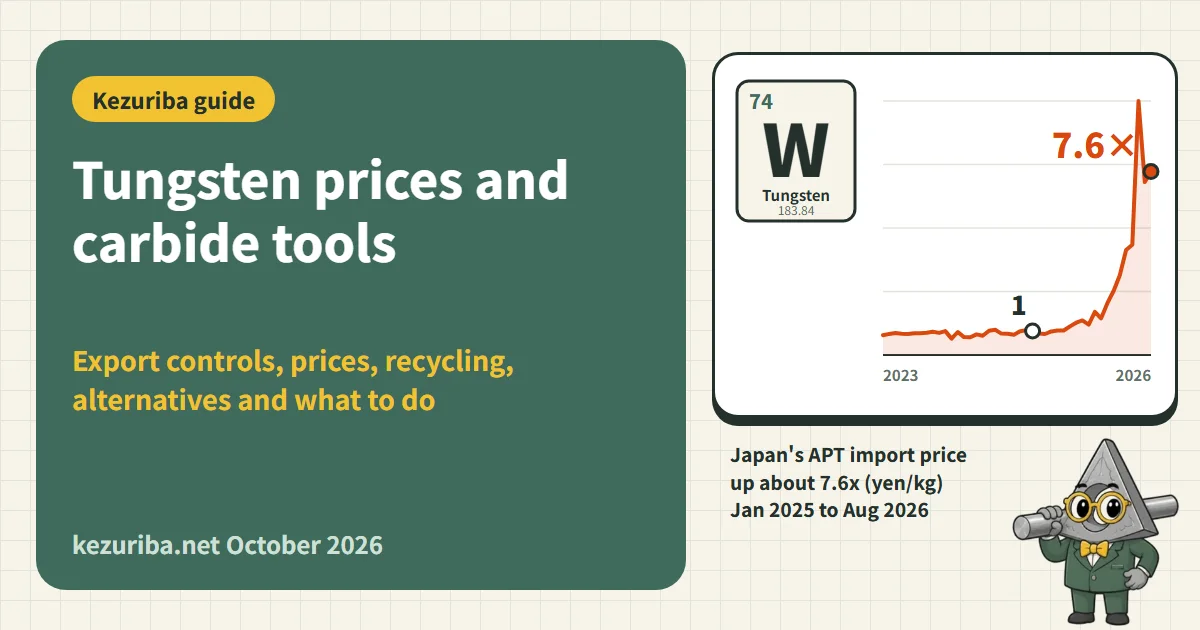 News
Tungsten Price Surge and Carbide Tools: China's Export Controls, Price Trends, Toolmakers' Price Increases, Recycling, Alternative Grades and Shop-Floor Countermeasures (2026 Edition)
 News