Tungsten Price Surge and Carbide Tools: China's Export Controls, Price Trends, Toolmakers' Price Increases, Recycling, Alternative Grades and Shop-Floor Countermeasures (2026 Edition)
Raw material is up 7x, tools 10–50%. Use every insert down to its last corner!

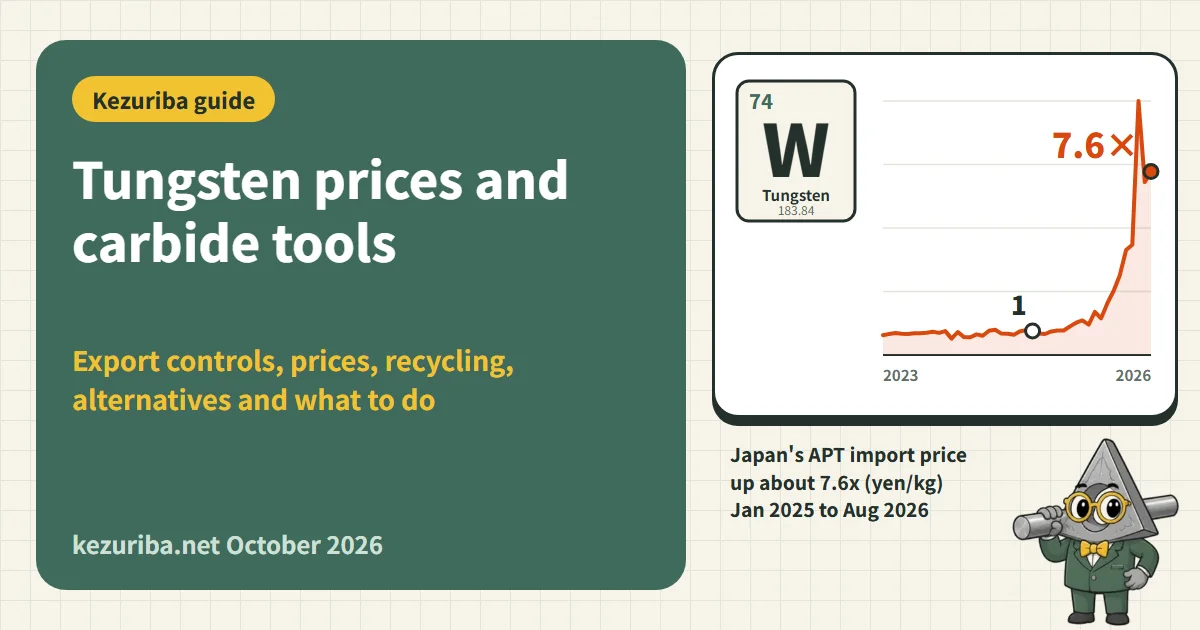
Tungsten, the main raw material of carbide tools, has been at historic highs since 2025. China put its exports under licensing, and in 2026 it also tightened export controls on dual-use (civil-military) items bound for Japan. The unit value of the tungstates (APT etc.) that Japan imports rose about 7.6x from January 2025 to August 2026 per kg[1], and toolmakers in Japan and abroad announced two or three rounds of price increases or order restrictions in 2026 alone. This article covers what happened, how it affects tool prices, how long it may last, and what the shop floor and purchasing can do, step by step, based on statistics and manufacturers' announcements.
- Of the world's tungsten mine production, about 79% is in China (2025 estimate). In February 2025 China put APT, tungsten carbide and other items under export licensing, and the Rotterdam APT price roughly doubled during 2025, from $331 to $675/mtu[2][7]
- In January 2026, export controls on dual-use (civil-military) items bound for Japan were tightened, and European APT was reported at $2,100–2,400 per mtu in March and above $3,000 in April[9][27][28]
- Japan's import unit value for APT etc. peaked in June 2026 at 46,134 yen/kg and was 33,309 yen/kg in August. Meanwhile, the unit value of carbide inserts exported from Japan rose only about 32% over the same period, far less than the raw material[1]
- Tool price increases are larger for bigger tools and solid tools. Some makers have switched solid tools over φ12 mm to make-to-order, and a materials maker has cut its order intake to about 80% of the previous year[45][49][50][36]
- What you can do on the shop floor: use tools to the very end, choose smaller tools, regrind, review your grades, and send used tools to domestic recycling. Japan's recycling rate for carbide tools is still only about 30%[27]
Tungsten and carbide tools
The "cemented carbide" in carbide tools is a material made by sintering tungsten carbide (WC) grains together with cobalt (Co). About 94% of the weight of tungsten carbide is tungsten (calculated from the atomic weights W 183.84 and C 12.011), so in a carbide with 10% cobalt, about 85% of the tool's weight is tungsten. A Sumitomo Electric technical paper also states that cemented carbide contains more than 80% tungsten[74].
- About three-quarters of Japan's tungsten goes into carbide tools: of Japan's 2020 domestic demand of 5,047 t (tungsten content), carbide tools took 3,796 t (about 75%) and special steels (HSS, tool steels, etc.) 952 t (about 19%)[3]. Worldwide, cemented carbide accounts for about 60% of demand (one estimate puts it at 64% in 2025), used not only in cutting tools but also in mining and construction tools and wear parts[6][74].
- All raw material is imported: Japan relies entirely on overseas sources for its primary tungsten raw materials (ores and intermediates)[76].
- HSS uses tungsten too: high-speed steel (HSS) is steel alloyed with tungsten, molybdenum, vanadium and other elements, and its raw material ferrotungsten has also risen in price (Fig. 1 below)[1].
What happened: a timeline since late 2024
- The U.S. Trade Representative (USTR) announces that Section 301 tariffs on three tungsten products from China will rise to 25% from January 1, 2025[14]
- In MOFCOM Announcement No. 10 of 2025, China's Ministry of Commerce (MOFCOM) and General Administration of Customs put APT, tungsten oxide, tungsten carbide and other tungsten-related items under export licensing (effective immediately; not a ban, but case-by-case licensing)[11][7]
- Rotterdam APT rises from $331 to $675/mtu and concentrate from $266 to $551/mtu. Kazakhstan's Boguty deposit starts production[2]
- China publishes its 2026 export licensing list of dual-use items (effective January 1), which includes APT, tungsten oxide and tungsten carbide[8]
- In MOFCOM Announcement No. 1 of 2026, China's Ministry of Commerce bans all exports of dual-use items to Japanese military end users, military end uses and the like (effective immediately)[12][9]
- Japan New Metals, which makes tungsten powder in Japan, announces that on shipments from April it will limit orders to about 80% of its FY2025 volume[36]
- China's domestic long-term contract price for APT reaches 1.07 million yuan per t (about 210,000 yuan in April 2025). On February 24, 20 Japanese companies are added to China's export control list[19][18][10]
- European APT hits a record of about $2,250 per mtu (mid-March). China's domestic concentrate price peaks on March 16[20][27][29]
- Rotterdam APT is reported above $3,000/mtu. Toolmakers announce price increases one after another (on orders from June), and Mitsubishi Materials Hardmetal announces order restrictions on carbide blanks and other products[28][33][35]
- By May 19, China's domestic concentrate price falls about 58% from its March high, reportedly due to weak downstream demand (carbide, machining)[29]
- Japan's import unit value for APT etc. hits a record 46,134 yen/kg[1]
- Mitsubishi Materials announces expansion of its tungsten recycling facilities in Germany and Akita[78][77]
- Third round of tool price increases (on orders from September, October and November). Meanwhile, Sumitomo Electric cuts prices on some solid tools[32][46][50][41]
Price trends: raw materials up 7–10x, tools up 10–50%
Using "value ÷ quantity" from Japan's Ministry of Finance trade statistics, we calculated the per-kg unit value of raw materials and products and plotted them with January 2025 = 100 . These are not market prices but averages for goods actually imported into or exported from Japan; still, they are a primary source available free every month[1].
- Tungstates (APT etc.), imports
- Ferrotungsten, imports (HSS raw material)
- Cobalt, imports
- Carbide plates, rods etc., exports
- Carbide & cermet inserts, exports
Show the data table (yen/kg)
| Month | APT | FeW | Cobalt | Carbide plates & rods | Carbide inserts |
|---|---|---|---|---|---|
| 2024-01 | 4,173 | 4,264 | 5,046 | 25,700 | 42,555 |
| 2024-02 | 3,260 | 4,798 | 5,313 | 22,914 | 42,350 |
| 2024-03 | 3,238 | 4,647 | 4,907 | 22,280 | 43,787 |
| 2024-04 | 3,745 | 4,828 | 4,780 | 25,212 | 43,091 |
| 2024-05 | 3,494 | 5,168 | 4,924 | 27,277 | 43,103 |
| 2024-06 | 4,404 | 5,228 | 4,716 | 28,818 | 44,033 |
| 2024-07 | 4,575 | 5,697 | 5,049 | 28,842 | 43,913 |
| 2024-08 | 3,887 | 5,444 | 4,364 | 25,799 | 43,930 |
| 2024-09 | 3,842 | 4,928 | 4,190 | 26,444 | 41,863 |
| 2024-10 | 3,686 | 4,899 | 4,169 | 26,106 | 41,858 |
| 2024-11 | 4,296 | 5,186 | 4,337 | 27,785 | 44,765 |
| 2024-12 | 4,498 | 5,241 | 4,682 | 27,328 | 42,626 |
| 2025-01 | 4,366 | 5,471 | 4,435 | 28,789 | 45,568 |
| 2025-02 | 3,927 | 5,438 | 4,650 | 26,934 | 44,992 |
| 2025-03 | 3,808 | 5,539 | 4,918 | 27,504 | 46,777 |
| 2025-04 | 4,283 | 5,450 | 4,489 | 26,473 | 43,921 |
| 2025-05 | 4,434 | 5,180 | 5,762 | 26,427 | 43,598 |
| 2025-06 | 4,455 | 5,773 | 4,632 | 23,756 | 43,289 |
| 2025-07 | 5,195 | 5,961 | 5,159 | 27,326 | 44,717 |
| 2025-08 | 5,872 | 6,167 | 5,568 | 26,939 | 43,332 |
| 2025-09 | 6,279 | 6,434 | 6,116 | 27,672 | 42,964 |
| 2025-10 | 5,500 | 7,595 | 6,019 | 29,609 | 43,890 |
| 2025-11 | 7,833 | 10,396 | 7,046 | 29,704 | 45,070 |
| 2025-12 | 6,662 | 11,975 | 7,621 | 28,906 | 45,403 |
| 2026-01 | 9,401 | 14,854 | 8,369 | 29,967 | 46,866 |
| 2026-02 | 11,628 | 15,163 | 7,126 | 31,585 | 48,055 |
| 2026-03 | 14,501 | 31,607 | 9,753 | 32,335 | 47,402 |
| 2026-04 | 19,074 | 40,080 | 9,337 | 33,898 | 50,005 |
| 2026-05 | 20,024 | 34,846 | 10,313 | 39,302 | 52,158 |
| 2026-06 | 46,134 | 30,824 | 10,138 | 40,929 | 55,432 |
| 2026-07 | 31,403 | 28,272 | 9,868 | 40,017 | 58,944 |
| 2026-08 | 33,309 | 28,148 | 10,216 | 44,966 | 60,037 |
Three things stand out.
- Raw materials rose by an order of magnitude: the import unit value of tungstates (APT etc.) went from 4,366 yen/kg in January 2025 to 46,134 yen/kg in June 2026 (about 10.6x) and 33,309 yen/kg in August (about 7.6x). Ferrotungsten, the raw material for HSS, also reached about 7.3x in April. Cobalt is up about 2.3x[1].
- Product prices rose slowly: over the same period, the unit value of carbide inserts exported from Japan rose 32%, and carbide plates and rods (blanks) 56%. Blanks feel raw-material prices more strongly[1].
- Past the peak, but not back to where it was: the import unit value of APT etc. peaked in June and fell about 30% in July and August. Even so, it is still more than 7x the early-2025 level[1].
The long view
These are annual average prices of tungsten concentrate (65% WO3) in Rotterdam, compiled by the U.S. Geological Survey (USGS). From 2016 to 2024 they moved between $150 and $330/mtu, but in 2025 they rose to $380 (estimated)[2]. The 2026 APT level of $2,000–3,000 would not even fit in this chart.
Why China's controls hit so hard
Tungsten mine production is concentrated in China. USGS estimates that of about 85,000 t (tungsten content) of world mine production in 2025, China produced 67,000 t, or about 79% .[2]. China's share is even higher in refining (APT, powder); an EU study puts it at over 85%[6].
China also caps its domestic mining. Under the mining quota set by the Ministry of Natural Resources, the first batch for 2025 was 58,000 t of concentrate (65% WO3 basis), 6.45% less than the previous year's first batch of 62,000 t[13]. On top of that, from February 2025 exports of APT, tungsten oxide and tungsten carbide became subject to case-by-case licensing[11], and from January 2026 exports of dual-use items for military end uses in Japan were banned[12].
China has vanished from Japan's imports
Breaking down Japan's Ministry of Finance trade statistics by country shows clearly how the controls are biting. China's share of Japan's tungstate (APT etc.) import volume went 64.6% in 2024 → 52.5% in 2025 → 2.4% in Jan–Aug 2026. From February to August 2026 it was zero every month. For tungsten powder, too, it fell 72.5% → 54% → 6.8%[1]. Chinese customs statistics also reportedly show zero exports of tungsten carbide and tungsten powder to Japan in February–April 2026[26].
Imports have not stopped. In January–August 2026 the top suppliers were Taiwan (370 t), Vietnam (309 t) and the U.S. (116 t), with China at 20 t. However, the unit value rose about 5.4x, from about 3,960 yen/kg (2024 average) to about 21,180 yen/kg (Jan–Aug 2026 average)[1]. Volumes are being scraped together from outside China, but prices are set by a global scramble – that is where things stand.
Prices split between China and the rest of the world
What sets 2026 apart is that prices inside and outside China moved independently.
| Market | 2025 | 2026 high | Since then |
|---|---|---|---|
| Europe (Rotterdam) APT | $331 at the start of the year → $675/mtu at year-end[2] | Mid-March: about $2,250/mtu[20]; reported above $3,000 in April[28] | Reported to have stayed high at roughly $2,900–3,275/mtu through May–September[24] |
| China domestic APT (major producers' long-term contract price) | Late April: about 214,000 yuan/t[18] | Late February: 1.07 million yuan/t[19] | Reportedly fell to 580,000 yuan/t in the second half of September[23] |
| Japan's import unit value for APT etc. | Jan: 4,366 yen/kg | Jun: 46,134 yen/kg | Aug: 33,309 yen/kg[1] |
Within China, prices fell sharply after the March high as downstream demand from carbide, machining and other sectors weakened[29]. Outside China, meanwhile, exports remain under licensing, so the Rotterdam price stays high – a mismatch that persists. The March 2026 spike was also reportedly compounded by ammunition demand from military operations in the Middle East[25].
How it affects tool prices: the tungsten in one insert
The price toolmakers pay for raw material is not the market price itself; it shifts with contract timing and inventory. Even so, once you calculate "how much tungsten is in one tool," the size of the increases and why larger tools get larger increases both become clear.
- A CNMG120408 turning insert weighs about 9–10 g: a distributor lists 9 g, and calculating from the shape (80° rhombus, 12.7 mm inscribed circle, 4.76 mm thick, 5.16 mm hole) and a density of 14–15 g/cm3 also gives 9.5–10.2 g[59][58]. If tungsten makes up 75–80%, each insert contains about 7–8 g of tungsten[74][60].
- Raw-material cost estimate: with APT at $331/mtu (early 2025), the tungsten in one insert costs about 49 yen. At $2,250 (Europe, March 2026), it costs about 336 yen (calculated at 150 yen/USD and 80% tungsten). The difference is about 286 yen per insert.
- Solid tools are in another league: treat a φ10 × 75 mm overall-length solid end mill as a carbide rod minus 15% for the flutes, and it weighs about 73 g. The raw-material cost of its tungsten is about 364 yen at $331 and about 2,472 yen at $2,250. For φ20 × 100 mm at $2,250, it is about 13,200 yen (the flute deduction is Kezuriba's assumption).
Actual price revisions also follow this "weight." Union Tool revised carbide end mills with shanks of φ8 mm and up, as sizes that "use a lot of tungsten"[50], and Nachi-Fujikoshi set +35% or more for tool diameters up to φ12 mm and +45% or more above φ12 mm[45]. Dijet Industrial switched solid tools over φ12 mm to make-to-order[49], and Kyocera raised small and medium carbide inserts by +5–60%, large ones by +61–80%, and carbide seats (parts) by +230%[38]. The closer a product is to a solid lump of carbide, the more directly the raw-material increase shows up in its price.
Calculator: tungsten and raw-material cost per tool
Enter a tool shape or weight and the APT price to get an estimate of the tungsten it contains and its raw-material cost. Actual tool prices also include powder making, sintering, grinding, coating, inspection, logistics and other costs, so use it as a guide to "how much the raw-material increase matters".
For WC-Co carbide with 10% Co, the tungsten share is about 84% (tungsten is 93.87% of WC). It is lower in P grades containing TiC and TaC, and by the share of the coating. Sources give both "80% or more" and "about 75%"[74][60]. Density falls as Co increases; commercial grades range from 13.1 to 14.8 g/cm3[58].
Toolmakers' price revisions and order restrictions (2025–2026)
These are the 2025–2026 price revisions and order restrictions that each company published on its website or in notice PDFs. Rates are as stated in each company's announcement (keeping the distinction between "or more" and "up to") and are revisions to each maker's selling prices, not dealers' retail prices. Some announcements do not give tungsten as a reason (in those cases we wrote "Inflation, raw materials, etc.").
| Announced | Company | Effective | Main revision rates (as announced) | Reason / notes |
|---|---|---|---|---|
| 2025-10-20 | Sumitomo Electric | Orders from 2026-01-01 | Alloy blanks +15% or more, solid drills & end mills +10% or more, carbide inserts +7% or more | Labor, raw-material and logistics costs[30] |
| 2025-12 | Dijet Industrial | Orders from 2026-03-01 | Inserts +10%, solid tools +20%, alloy blanks (round rods, etc.) +70% | Tungsten carbide prices rose sharply due to China's export controls[48] |
| 2026-01-05 | Kyocera | Orders from 2026-03-30 | Inserts +8% or more, solid end mills & drills +10% or more | Inflation, raw materials, etc.[37] |
| 2026-01 | Tungaloy | Orders from 2026-04-01 | Cutting tools +7%, solid end mills & drills +10% | Various circumstances[39] |
| 2026-04-15 | NTK Cutting Tools | Orders placed from 2026-06-01 | Carbide inserts (ISO) +10% or more, carbide-shank holders +10%, ceramics +7%, PCD/CBN +3% or more | Sharp rise in APT and other raw materials, and supply constraints. Steel cutters and holders excluded[42] |
| 2026-04-20 | Sumitomo Electric | Orders from 2026-06-01 | Solid drills & end mills +60% or more, brazed tools +20% or more, carbide inserts +13% or more | Scarcity due to export controls and soaring market prices[31] |
| 2026-04 | Tungaloy | Orders from 2026-06-01 | ISO turning inserts +12%, carbide end mills & drills +10% or more, cermet +4%, ceramics +3%, PCD/CBN +2.5% | Soaring tungsten prices. No bulk orders or advance delivery dates accepted[40] |
| 2026-04-28 | Mitsubishi Materials | Orders from 2026-06-01 | Inserts, carbide drills & carbide end mills +20% or more; carbide blanks (e.g. for brazed tools) +300% or more | Soaring tungsten and other raw materials. Mentions possible order restrictions[33][34] |
| 2026-04-28 | Mitsubishi Materials Hardmetal | Immediately | Order restrictions on wear-resistant tools, construction tools and carbide tool blanks | Soaring APT and worsening raw-material supply[35] |
| 2026-04-30 | Kyowa Seiko | Orders from 2026-06-01 | Carbide (shank up to φ4) +15%, φ6 +20% or more, φ8 and up: while stocks last, quoted case by case | Rising material and grinding-wheel costs, etc.[52] |
| 2026-05-13 | Kyocera | Orders from 2026-06-15 | Carbide inserts +5–80% (large +61–80%), solid carbide +10–80%, carbide seats alone +230%, cermet +5% | Soaring tungsten and scarcity due to export controls[38] |
| 2026-05 | Nachi-Fujikoshi | Orders from 2026-06-01 | Carbide drills & end mills: up to φ12 +35% or more, over φ12 +45% or more; indexable +35% or more | Export controls and rising demand. Orders far above past volumes not accepted[45] |
| 2026-05 | Dijet Industrial | Orders from 2026-06-15 | Solid tools up to φ12 +60%, over φ12 moved to make-to-order, inserts +5–20% | Record price surge. Orders for alloy round rods and plate blanks closed on June 12[49] |
| 2026-06-01 | NS Tool | Orders from 2026-08-01 | Carbide up to φ4: 0–10%, over φ4 to φ6: up to 30%, over φ6: 20% or more; CBN/PCD unchanged | Raw materials, logistics, energy[51] |
| 2026-06-11 | OSG | Standard items, orders from 2026-07-01 | Drills 10–75%, end mills 10–50%, taps 7–25%, diamond & CBN 10–25% | Raw materials, energy, labor, etc.[43] |
| 2026-08-07 | Sumitomo Electric | Orders from 2026-10-01 | Carbide inserts +25% or more, steel tools +10% or more, solid drills & end mills −25–+10% | Prolonged high prices. Some solid tools get price cuts[32] |
| 2026-08 | Nachi-Fujikoshi | Orders from 2026-09-01 | Carbide drills & end mills: up to φ4 +10%, up to φ8 +15%, up to φ12 +20%, over φ12 +25% | Increases continue beyond expectations[46] |
| 2026-09-01 | Union Tool | Orders from 2026-10-01 | Carbide end mills with φ8 mm shanks and up +15% | Sizes that use a lot of tungsten. Orders may be restricted or suspended[50] |
| 2026-09 | Tungaloy | Orders from 2026-11-02 | Indexable inserts +12% or more, round tools (end mills, drills) +16% or more, ceramics +7% or more | Rising tungsten, raw-material and logistics costs[41] |
MOLDINO has also announced price revisions on orders from February and June 2026 and order restrictions on carbide products, but Kezuriba could not check the full text of the announcements, so they are not in the table.
Five trends in the announcements
- Late 2025 to early 2026: single-digit %: the reasons were mainly inflation and labor costs[30][37][39].
- A big jump in April–June 2026: citing tungsten, makers announced +35–80% for solid tools and +300% or more for carbide blanks[31][33][38][45].
- A third round in August–November: insert increases grew larger, while Sumitomo Electric cut prices on some solid tools[32][41].
- Small increases for ceramics, cermet, CBN and PCD: in Tungaloy's June revision, cermet was +4%, ceramics +3% and PCD/CBN +2.5%[40]. Prices also show that grades with less tungsten are less affected.
- Not just prices: "volumes" were limited too: order restrictions, refusal of bulk orders and advance delivery dates, switches to make-to-order, case-by-case quotes valid for one month, and more[36][35][40][45][49].
Abroad: "raw-material-linked" pricing
- EMUGE-FRANKEN, the Japanese subsidiary of a German toolmaker, has applied a material surcharge that tracks the APT price and changes weekly or monthly to special carbide tools since April 2026. Its announcement says APT is more than 7 times its January 2025 level[53].
- In its fiscal 2026 results (year to June), Kennametal of the U.S. reported a benefit of about $316 million from the timing of price increases matched to raw-material costs[54].
- Sweden's Sandvik reported that in January–March 2026 order intake in its powder business more than doubled, and that customers in North America and Europe built up inventory in anticipation of tungsten shortages and price increases[55].
- In Japan, too, OSG explained in its October 2026 revision of earnings forecasts that tungsten inventory bought before prices rose, together with its price revisions, had boosted profit[44].
Recycling: used tools are a "domestic mine"
Because carbide tools contain a high proportion of tungsten, used tools are themselves "high-grade raw material." Mitsubishi Materials explains that the tungsten in 20 kg of used tools (one collection box) equals what can be extracted from more than 2 t of ore[76].
| Zinc process (direct) | Chemical process (indirect) | |
|---|---|---|
| Method | Scrap and zinc are heated to 850–950°C in inert gas; zinc penetrates the cobalt phase and breaks the carbide apart. The zinc is then removed under vacuum and the material is made into powder. Tungsten recovery is high, around 95%[74][80] | Dissolved in molten salt or similar, impurities removed by ion exchange and other steps, and converted back to APT. The Sumitomo Electric group commercialized this in 2011, with a tungsten yield of about 97%[74][68][75] |
| Resulting powder | The original WC and cobalt remain almost unchanged. Purity cannot be raised and grain size cannot be changed, so it is blended with new powder[74][73] | Same purity as material made from ore. Can be used for any tool[74] |
| Suitable scrap | Solid carbide of known grade (requires strict sorting)[68] | Mixed grades, coated tools, grinding sludge[74] |
| Drawbacks | Cannot remove coatings and other impurities[74] | Uses more chemicals and energy; large plant[74][68] |
- Also better for the environment: according to the Japan Tungsten & Molybdenum Industries Association, CO2 per kg of product is 49.0 kg for tungsten materials and 21.7 kg for cemented carbide[79]. One maker's material says making carbide from recycled feedstock could cut energy by up to 75% and CO2 by 40%[73]. Through JOGMEC's technology development, a recovery process using about 40% less energy than conventional methods has been commercialized, and 240 t a year (about 5% of domestic demand) is now recycled[5].
- Japan is weak at collection: the average global tungsten recycling rate was about 34%; Europe and the U.S. were at 50%, Japan at 30% (ITIA data, 2013)[74][81]. In 2026 the Japan Cutting & Wear-resistant Tool Association (JTA) revised its recycling guidelines for carbide tool scrap, setting out how to separate carbide, cermet and HSS, and published a "list of recycling contact companies" for keeping scrap in Japan. Japan's carbide tool recycling rate is still said to be about 30%[27]. Some used tools generated in Japan go overseas, and some of them come back in recycled form[4].
- Recycling capacity is growing: Mitsubishi Materials is raising capacity at H.C. Starck in Goslar, Germany, from 5,000 t to 7,000 t a year (about 9.3 billion yen, completion planned for 2028)[78], and raising capacity for making APT from scrap at Japan New Metals in Akita to 2,400 t a year (WO3 basis, about twice today's level) (about 8 billion yen, start-up planned for April 2029)[77].
Researchers are also studying new recycling methods that produce less waste liquid, such as one that uses chlorine to turn tungsten into a gas for separation[82] and one using molten carbonates[83].
Alternative grades: how far can tungsten be reduced?
It is tempting to think "just switch to tools without tungsten," but the U.S. Geological Survey points out that most substitutes for carbidereduce tungsten use rather than replace it entirely[2]. Here is how each tool material compares.
| Tool material | Main components | Tungsten | Best for | Notes |
|---|---|---|---|---|
| Carbide (baseline) | WC + Co (5–20%); P grades add TiC, TaC, etc. | High (75–85% by weight) | Most workpiece materials | —[56][57] |
| Cermet | TiC, TiCN + Ni (+Co). Mo2C and WC are often added | Low (not zero) | Finishing steel, light high-speed cutting | Poor thermal-shock resistance, about 1/10 that of carbide. Research examples contain 5–20% WC[62][68][70] |
| Ceramics | Alumina (white, black), silicon nitride, SiAlON, SiC-whisker-reinforced alumina | None | High-speed machining of cast iron, hardened steel; SiAlON and whisker grades for heat-resistant alloys | Prone to chipping; needs suitable conditions and a rigid machine[63][67] |
| CBN | cBN particles + binder (Co-Al-WC type in high-cBN grades) | Low (binder and carbide substrate) | Hardened steel; high-speed machining of cast iron and sintered alloys | Brazed onto a carbide substrate, so the substrate contains tungsten[64][69] |
| PCD | Sintered diamond + Co | Low (carbide substrate) | Aluminum, copper, composites | Cannot cut ferrous materials[64] |
| HSS | Iron + W, Mo, Cr, V (SKH51: W 5.90–6.70%, Mo 4.70–5.20%) | Yes (a few % and up) | Tools that need toughness: taps, drills, broaches, gear cutting tools, etc. | Ferrotungsten, the feedstock, also rose about 7-fold. HSS tool prices have also been raised[65][66][1][47] |
- Reduce it through tool design: Sumitomo Electric has reported a three-layer tool with carbide only at the cutting edge and a cermet-type core that cut tungsten use by 30%, with wear equal to carbide and better chipping resistance[68].
- Binder research: there is research on using Ni or FeAl instead of cobalt, but it barely reduces the amount of tungsten[71]. About 73% of the world's cobalt is produced in the Democratic Republic of the Congo, which moved to a quota system after suspending exports in February 2025; this is another driver of higher prices[72].
What shops and buyers can do
The shop floor cannot change raw-material prices. What you can change is"how much each tool cuts," "which tools you choose" and "where used tools go".
On the shop floor
- Use every corner: double-sided negative inserts like CNMG have 2 corners per side, 4 in total. Check at your tool station that inserts aren't being thrown away after using only one side.
- Choose smaller inserts: for the same shape, CNMG090308 contains about 38% as much carbide as CNMG120408, and CNMG160612 about 2.1 times as much (calculated from the geometry). It is worth considering one size smaller, as long as it covers your depth of cut.
- Reduce chipping: a tool that chips and is scrapped before the end of its life loses the whole price increase. For causes and fixes, see the Machining Troubleshooting Encyclopedia.
- Review cutting conditions: the higher tool prices go, the more it pays to slow down a little and extend tool life. How to extend tool life (Taylor's tool life equation and a minimum-cost calculator) lets you run the numbers.
- Regrind and recoat solid tools: for eligible solid drills, Sandvik Coromant guarantees new-tool performance for up to 3 regrinds, and says each regrind costs 1/10 to 1/3 of a new tool and three regrinds cut tool costs by 50% or more[61].
- Review tool materials: ceramics or CBN for high-speed machining of cast iron, cermet for finishing steel, SiAlON or whisker ceramics for roughing heat-resistant alloys. Choices like these can sometimes shift you toward low-tungsten materials (see the table above).
- Separate used tools for collection: don't mix carbide, cermet and HSS. Scrap containing foreign material causes trouble in recycling plants[74].
In purchasing and quoting
- Check the reference date: companies differ on whether new prices apply to orders received, shipments, or orders placed. Some quotes are valid for only one month[36][42][49].
- Bulk purchases may be refused: many makers say they will not accept orders far above past volumes or advance delivery dates, and buyers are asked to order in line with actual usage[40][45][42].
- Watch lead times for large-diameter solid tools: one maker has moved tools over φ12 mm to make-to-order[49]. Get quotes by diameter and compare switching to indexable or exchangeable-head tools.
- Get used to raw-material-linked surcharges: some companies now quote special items as "unit price + material surcharge"[53].
- Use primary sources when explaining to customers: when asking customers to accept higher product prices, attaching public statistics like the charts in this article (Japan's Ministry of Finance trade statistics) and toolmakers' announcements speeds up the conversation.
- Decide where to sell scrap: buy-back prices from toolmakers and recyclers track the market, and we found no company that publishes a per-kg price. You can choose a domestic destination from the industry association's "list of recycling contact companies"[27].
What comes next
No source can say when prices will fall. Here we summarize scheduled events and indicators worth watching.
| When | Event |
|---|---|
| From Apr 2025 | The Boguty mine in Kazakhstan began commercial production, producing 5,008 t of concentrate (3,255 t WO3) in 2025[22] |
| Sep 2026 | South Korea's Sangdong mine (Almonty) received final operating approval and Phase 1 moved into commercial operation. Over 90% of output is contracted to GTP, a Plansee Group powder maker[21] |
| Oct 2026 | The EU added 46 Strategic Projects for critical raw materials, 3 of them for tungsten[16] |
| Jan 2027 | U.S. defense procurement restricts the use of tungsten mined or refined in China, Russia, Iran or North Korea[15]. Competition for non-Chinese tungsten may intensify |
| 2028 | Mitsubishi Materials' recycling expansion in Goslar, Germany, due for completion[78] |
| Apr 2029 | Japan New Metals' (Akita) recycling expansion due to start operation[77] |
In Japan, tungsten is a "specified critical product (critical mineral)" under the Economic Security Promotion Act, which makes it a target for government-backed supply security[17]. Even so, despite new mines, mine production outside China was still only about 20% of the world total in 2025[2].
- Japan's Ministry of Finance trade statistics: monthly import unit values for tungstates (2841.80) and ferrotungsten (7202.80), and export unit values for carbide inserts (8209.00). The same data as Figure 1 in this article[1]
- APT prices in Europe (Rotterdam) and within China: in 2026 a gap has persisted, with Europe staying high even as prices within China fell. While Japan cannot buy from China, its prices are likely to move closer to the European side
- Toolmakers' notices: price cuts have started to appear too (solid tools in Sumitomo Electric's October revision)[32]
FAQ
- How long will carbide tool price increases continue?
- Nobody knows. Long-term contract prices for APT within China are reported to have fallen from 1.07 million yuan/t in February 2026 to 580,000 yuan/t in late September[19][23], but European APT stayed high from May to September[24]. Japan's import unit value in August was also more than 7 times its early-2025 level[1]. As long as Chinese exports remain under licensing, there is no reason to expect a quick return to previous levels.
- If I switch to HSS tools, will I avoid the price increases?
- HSS also contains tungsten (about 6% in SKH51)[66]. The import unit value of ferrotungsten, its raw material, reached about 7 times its January 2025 level in April 2026[1], and HSS tool prices have been raised too[47]. HSS contains far less tungsten per unit weight than carbide, so the impact is smaller, but not zero.
- Doesn't cermet contain any tungsten?
- Many cermets add WC or Mo2C to improve toughness and other properties[62][70]. The amount is smaller than in carbide, so price increases also tend to be smaller (around +4–5%)[40][38].
- Wouldn't buying raw material from outside China be cheaper?
- In 2026 Japan's imports of APT and similar materials come mainly from Taiwan, Vietnam and the U.S., but the unit value is about 5.4 times the 2024 average[1]. Non-Chinese material is in demand worldwide, and there are almost no cheap sources.
- How much can used inserts be sold for?
- Collection and buy-back prices track the tungsten market, and we found no toolmaker that publishes a per-kg price. With prices high now, it is more worthwhile than ever to store scrap separately and send it in bulk to a domestic collector[27].
- Do China's controls target only Japan?
- The February 2025 export licensing for APT, tungsten carbide and other items applies to all countries, not just Japan[11]. The January 2026 announcement bans exports of dual-use items to Japanese military end users and for military end uses[12].
Related: Carbide tool price revision (Sumitomo Electric, orders from Oct 1) / How to Extend Tool Life / the Machining Troubleshooting Encyclopedia
Sources
- Japan's Ministry of Finance trade statistics (trends by commodity; per-kg unit values calculated by Kezuriba from the values and quantities for imports 2841.80-000, 7202.80-010, 8105.20-000 and exports 8209.00-100, 8209.00-900)
- U.S. Geological Survey, "Mineral Commodity Summaries 2026: Tungsten" (2026-02)
- JOGMEC, "Mineral Resources Material Flow 2021, 12. Tungsten (W)"
- JOGMEC, "FY2023 Survey of Mineral Resource Recycling Flows and Stocks: Summary of Results"
- JOGMEC, "Recycling Technology Development: Summary of Results to Date" (tungsten recovery from scrap carbide tools)
- SCRREEN3 (EU critical raw materials project), "Tungsten" factsheet
- JETRO Business Short News, "MOFCOM decides on export controls for items related to tungsten, tellurium, bismuth, molybdenum and indium" (2025-02)
- CISTEC, "China publishes its Dual-Use Items and Technologies Import/Export License Management List (2026 edition)" (2026-01-08)
- Greenberg Traurig, "China tightens export controls on dual-use items to Japan" (2026-02-13)
- Fuji Die, "Changing trends around tungsten and other critical minerals, and our response" (2026-03-18)
- China MOFCOM and General Administration of Customs, "Announcement No. 10 of 2025 (export controls on items related to tungsten, tellurium, bismuth, molybdenum and indium)" (2025-02-04)
- China MOFCOM, "Announcement No. 1 of 2026 (strengthened export controls on dual-use items to Japan)" (2026-01-06)
- China Ministry of Natural Resources, "Notice on the 2025 tungsten mining quota (first batch)" (2025-04-03, reposted on the Hunan provincial government website)
- USTR, "USTR Increases Tariffs Under Section 301 on Tungsten Products, Wafers, and Polysilicon" (2024-12-11)
- U.S. Department of Defense acquisition regulation DFARS 252.225-7052 (restrictions on acquiring magnets, tantalum and tungsten)
- European Commission, "Commission selects 46 new Strategic Projects to bolster the EU’s supply of critical raw materials" (2026-10-09)
- Enforcement Order of the Economic Security Promotion Act (Cabinet Order No. 394 of 2022, specified critical products)
- China MOFCOM commodity price website, "Tight supply: tungsten price midpoint likely to move up" (2025-04)
- China MOFCOM commodity price website, "Tungsten prices keep climbing" (2026-02)
- Almonty Industries, "Fourth Quarter and Full Year 2025 Financial Results" (2026-03-18)
- Almonty Industries, "Sangdong Processing Plant Receives Final Operational Certification" (2026-09-21)
- Jiaxin International Resources, "Annual Report 2025" (Hong Kong Stock Exchange, 2026-04-27)
- SMM (Shanghai Metals Market), "Chongyi tungsten companies announce long-term contract prices, with cuts" (2026-09)
- SMM (Shanghai Metals Market), "Rotterdam APT Prices Stable, European Scrap Declines …" (2026-05)
- Miningmx (citing Reuters), "Tungsten prices surge as Iran war drains stocks" (2026-03-23)
- Akita Sakigake Shimpo (Kyodo News), "Rare-metal exports to Japan zero in Feb–Apr under China's controls; substitutes cost 3 times as much" (2026-06-06)
- Seizo Genba.com, "[Ongoing coverage] Carbide tool recycling: tungsten supply risk and domestic circulation" (2026-08-20)
- Mining Reporters, "Tungsten prices hit record highs on China export curbs and rising defence demand" (2026-04)
- SMM (Shanghai Metals Market), "Tungsten prices halve from their highs" (2026-05-20)
- Sumitomo Electric, "Price revision for Hardmetal Division products" (2025-10-20)
- Sumitomo Electric, "Price revision for Hardmetal Division products" (2026-04-20)
- Sumitomo Electric, "Price revision for Hardmetal Division products" (2026-08-07)
- Mitsubishi Materials (carbide products), "Price revision for our products for the Japanese market" (2026-04-28)
- Newswitch (Nikkan Kogyo Shimbun), "Mitsubishi Materials raises domestic carbide product prices up to 3-fold" (2026-05-01)
- Mitsubishi Materials Hardmetal, "Order restrictions on our products due to tungsten supply shortage" (2026-04-28)
- Japan New Metals, "(Important notice) Implementation of order restrictions on tungsten products" (2026-02-01)
- Kyocera, "Notice of price revision for cutting tools" (2026-01-05)
- Kyocera, "Notice of price revision for cutting tools" (2026-05-13)
- Tungaloy, "Notice of price revision (on orders from April 1, 2026)"
- Tungaloy, "Notice of price revision (on orders from June 1, 2026)"
- Tungaloy, "Notice of price revision (on orders from November 2, 2026)"
- NTK Cutting Tools, "Notice of price revision" (2026-04-15)
- OSG, "Notice of price revision" (2026-06-11)
- OSG, "Notice of revisions to earnings and dividend forecasts" (timely disclosure, 2026-10-09)
- Nachi-Fujikoshi Tool Division, "Notice of price revision for carbide tools" (2026-05)
- Nachi-Fujikoshi Tool Division, "Notice of price revision for carbide tools" (2026-08)
- Nachi-Fujikoshi Tool Division, "Notice of price revision for tools" (2026-03, HSS tools, etc.)
- Dijet Industrial, "Notice of product price revision" (2025-12)
- Dijet Industrial, "Notice of product price revision" (2026-05)
- Union Tool, "Notice of price revision for carbide end mills with φ8 mm shanks and up" (2026-09-01)
- NS Tool, "Notice of product price revision" (timely disclosure, 2026-06-01)
- Kyowa Seiko, "Notice of price revision for our products" (2026-04-30)
- EMUGE-FRANKEN (Japan), "Notice on introducing a material surcharge for special product prices" (2026-04)
- Kennametal, "Fiscal 2026 and fourth quarter results" (U.S. SEC filing, Form 8-K, 2026-08-05)
- Sandvik, "Interim report first quarter 2026" (2026-04-22)
- Mitsubishi Materials cutting tool technical guide, "Cemented carbides"
- Mitsubishi Materials Hardmetal, "Carbide tool blanks CARBIDE MATERIALS TM102J" (2026-06-22 edition)
- Hyperion Materials & Technologies, "Insert Blanks Grade Properties" (density of carbide blanks, etc.)
- SFS (GARANT product), "Indexable insert for turning CNMG 120408" (lists the mass)
- Sandvik Coromant, "Turning global pressure into practical action" (2026-04-16)
- Sandvik Coromant, "FAQ: Reconditioning" (regrinding and recoating)
- Mitsubishi Materials cutting tool technical guide, "Cermets"
- Mitsubishi Materials cutting tool technical guide, "Ceramics"
- Mitsubishi Materials cutting tool technical guide, "Sintered compacts" (CBN, sintered diamond)
- Mitsubishi Materials cutting tool technical guide, "High speed steels"
- zknives.com steel composition database, "JIS SKH51 / SKH55 / SKH2" (reproduces JIS values)
- NTK Cutting Tools, "WA1 (whisker ceramics)"
- Ishida et al., "Development of recycling technology for cemented carbide scrap and of technology for reducing tungsten use in carbide tools," SEI Technical Review No. 181 (2012)
- Ishii et al., "SUMIBORON BN7115 for finishing sintered alloys and cast iron," SEI Technical Review No. 198 (2021)
- W. T. Kwon et al., "Effect of WC and group IV carbides on the cutting performance of Ti(C,N) cermet tools," Int. J. Machine Tools and Manufacture 44(4) (2004, abstract)
- Kobayashi et al., "Developing new materials by combining casting and powder metallurgy technologies," Synthesiology 3(4) (AIST, 2010)
- U.S. Geological Survey, "Mineral Commodity Summaries 2026: Cobalt"
- CERATIZIT, "Recycling your carbide with CERATIZIT" (2023)
- Hayashi et al., "Commercialization of tungsten recycling from cemented carbide scrap," SEI Technical Review No. 189 (2016)
- Sumitomo Electric, "Taking on the rare-metal challenge: the road to complete tungsten recycling (3)"
- Mitsubishi Materials, "Carbide tool recycling"
- Seizo Genba.com, "Mitsubishi Materials boosts tungsten recycling capacity at Japan New Metals" (2026-09-25)
- Japan Metal Daily (Nikkan Sangyo Shimbun), "Mitsubishi Materials to expand tungsten recycling in Germany by 50% with 9.3 billion yen investment" (2026-08-03)
- Japan Tungsten & Molybdenum Industries Association, "Environmental initiatives" (CO2 emissions per kg of product)
- Progress in Sustainable Recycling and Circular Economy of Tungsten Carbide Hard Metal Scraps for Industry 5.0 and Onwards, Sustainability 15(16) 12249 (MDPI, 2023)
- The Critical Raw Materials in Cutting Tools for Machining Applications: A Review, Materials 13(6) 1377 (MDPI, 2020)
- KAKENHI 15K14190 research report (recycling cemented carbide scrap by chloride volatilization)
- Yasuda and Hagiwara, "Tungsten recycling from carbide tools using molten carbonates," Denki Kagaku Vol. 89, No. 1 (2021)
More articles
 Industry
How a Metalworking Company Can Enter Aircraft Parts Machining: 4 Entry Routes, JIS Q 9100, First Article Inspection, Nadcap, Export Control, Hurdles
 Industry
How a Metalworking Company Can Enter Japan's Defense Industry: 3 Entry Routes, Qualifications and Certifications, Information Control, State Support, Hurdles
 Surface treatment