Printed from Kezuriba (kezuriba.net/en/troubles/tap-tearing/)
Thread is torn or galled
Tapping Tapping
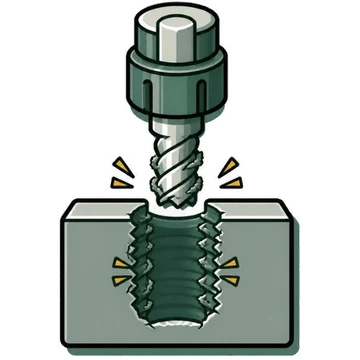
Check first
- Poor chip evacuation or clogging
- Adhesion to the tap
- Insufficient sharpness, or rake angle unsuited to the workpiece material
Try first
- In a synchronized feed setup, evacuate chips with step machining
- Reduce the cutting speed
- Use a sharp tap suited to the workpiece material (e.g. for aluminum)
 Likely causes
- Adhesion to the tapOne maker[1][2][3]
- Insufficient sharpness, or rake angle unsuited to the workpiece materialOne maker[3][2][1]
- Poor chip evacuation or cloggingAgreed by 2+ makers[1][2][3][4]
- Poor feed (lead) or axis runoutOne maker[1]
- Tap drill hole is work hardened, tilted, or too smallOne maker[1][2]
- Variation in workpiece material, hardness, or structureOne maker[1]
 Fixes
Cutting conditions
- In a synchronized feed setup, evacuate chips with step machiningOne maker[3]
- Reduce the cutting speedOne maker[1][2]
Tool
- Use a sharp tap suited to the workpiece material (e.g. for aluminum)One maker[3][1][2]
- Use a surface-treated tap such as TiNOne maker[1][2]
- For horizontal machining, use a low-helix spiral flute tap to prevent chips from wrapping around itOne maker[4]
Setup
Coolant
 Notes by material
- Aluminum castings (AC4CT6, etc.): Tearing is caused by one of insufficient sharpness, poor chip evacuation, or insufficient lubrication. Choose the countermeasure according to the cause[3]
 Related problems
Frequently asked questions
- What should I check first on the machine when "Thread is torn or galled" occurs?
- For Thread is torn or galled in Tapping, check these primary causes first: Poor chip evacuation or clogging Adhesion to the tap Insufficient sharpness, or rake angle unsuited to the workpiece material
- What is the fastest fix to try for "Thread is torn or galled" without tearing down the setup?
- Start with adjustments that can be made directly at the CNC control or tool holder: In a synchronized feed setup, evacuate chips with step machining Reduce the cutting speed Use a sharp tap suited to the workpiece material (e.g. for aluminum)
- Does the workpiece material change how "Thread is torn or galled" behaves and how to fix it?
- Yes. Material properties such as thermal conductivity, work hardening, and ductility strongly affect Thread is torn or galled. For example, in Aluminum castings (AC4CT6, etc.): Tearing is caused by one of insufficient sharpness, poor chip evacuation, or insufficient lubrication. Choose the countermeasure according to the cause
 Sources
Causes and fixes are summarized in our own words from cutting-tool makers’ troubleshooting guides and technical data. “Agreed by 2+ makers” means two or more makers say the same thing. The small notes under some items and the “how it works” sections add explanations from papers, company technical reviews, public research institutes, standards, patents and maker data (papers and the like are tagged).
- OSG — Tool Communication Series No.6 Taps, "12. Troubleshooting in tapping operations," pp. 59-62 osg.co.jp
- OSG — Series No.34 High-speed synchro taps, "8. Troubles and countermeasures," pp. 28-29 osg.co.jp
- OSG — Torn surface when machining aluminum faq.osg.co.jp
- Yamawa — Helpful Tips No.109: Chip control for SP taps in horizontal machining yamawa.com