Printed from Kezuriba (kezuriba.net/en/troubles/rolltap-entry-burr/)
Burr or raised material at the entrance with a form (roll) tap
Tapping Tapping
A form (roll) tap makes threads by displacing material rather than cutting it, so it produces no chips. The displaced material overflows at the hole mouth, so the end face may rise up or a burr may remain.[1][2]
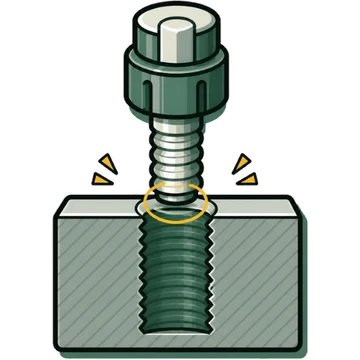
Check first
- Form tapping deforms the material plastically, so material rises toward the entrance
- The tap drill hole has no chamfer at the entrance, or the diameter of the chamfered end face is small
Try first
- Chamfer the tap drill hole entrance
- Use a smaller chamfer angle (e.g. 90° to 60°, recommended 60-70°) and a larger chamfer diameter (for 120°, tap outer diameter + 2P)
 How it works: where the displaced material goes
A form tap raises the thread ridges by making the material undergo plastic flow. Because nothing is cut away, the material moves into the surrounding area, so the tap drill hole is drilled larger than for a cutting tap by the amount that would have been chips.[2]
If the end face at the mouth has no chamfer, the displaced material overflows onto the end face and becomes a burr. A chamfer with an included angle of 60–70° prevents burrs on the end face.[2][1]
In parts such as nuts, where the tap drill hole is punched, if the fracture surface at the end of the hole differs from left to right, the tap drifts toward the side of lower resistance as it advances, and only the thread ridges on one side become high. Control the shape of the tap drill hole as well as its diameter.[3]
On the shop floorThe countermeasure for burrs that tool manufacturers' documents give is, in every case, a chamfer at the mouth of the tap drill hole. First check whether there is a chamfer, what its angle is, and what the end face diameter is.[1][4]
→ Article: Tap drill for form taps (hold it to about 1/3 of the width allowed for cutting taps)→ Tap drill sizes→ Thread will not go through (internal thread undersized)
 Likely causes
- Form tapping deforms the material plastically, so material rises toward the entranceAgreed by 2+ makers[1][4]In a cross-section of a nut tapped with a form tap (fluteless tap), burrs appeared at both the entrance and the exit. For a through hole, check the exit side as well.[3]
- The tap drill hole has no chamfer at the entrance, or the diameter of the chamfered end face is smallAgreed by 2+ makers[2][1][4]
 Fixes
Setup
- Chamfer the tap drill hole entranceAgreed by 2+ makers[1][4]The chamfer gives the displaced material somewhere to go. Yamawa says that even with a chamfer, it is difficult to eliminate burrs entirely.[1][4]
- Use a smaller chamfer angle (e.g. 90° to 60°, recommended 60-70°) and a larger chamfer diameter (for 120°, tap outer diameter + 2P)Agreed by 2+ makers[1][4]Example: for M6×1, 6 + 2 × 1 = 8 mm; for M10×1.5, 10 + 2 × 1.5 = 13 mm. OSG's technical document gives the same formula for a 118° chamfer.[2][1]
How to determine the chamfer dimensions
A chamfer with an included angle of 60–70° is recommended.[2][1]
When you chamfer at 118–120° because of the drill point angle, set the diameter of the chamfered end face to "tap outside diameter + 2P" (P is the pitch) and the burr will not rise up to the end face. OSG's technical document gives the same formula for 118°, and its FAQ gives it for around 120°.[2][1]
If burrs remain even with a chamfer, make the chamfer deeper to enlarge the entrance diameter, or reduce the chamfer angle (e.g., 90° to 60°).[4]
OSG's technical document says that a special design is also possible, with a tool attached that chamfers at the same time as tapping.[2]
How to diagnose, and the order to try fixes
How much the entrance rises depends greatly on whether there is a chamfer and on its dimensions. Check in this order.
- Look at the end face. If the area around the hole is raised above the end face and the mouth has no chamfer, it is a burr from the material displaced by forming.[1][4]
- If burrs appear even though there is a chamfer, measure the chamfer angle and the end face diameter. If the end face diameter of a 118–120° chamfer does not reach the tap outside diameter + 2P, fix that first.[2][1][4]
- For a through hole, check the exit side too. In the nut cross-section, burrs appeared at both the entrance and the exit.[3]
- Separately from burrs, also check the internal thread minor diameter. With form taps, in addition to the limit thread gauge, use a plug gauge for the internal thread minor diameter to see whether the raised material in the bore is within tolerance. The bore is determined by the tap drill diameter, so if the minor diameter is out of tolerance, review the tap drill diameter.[5][2]
- If the thread ridges are high or low on one side only, suspect the shape of the tap drill hole (such as the fracture surface from punching).[3]
On the shop floorThe order to try is: (1) add a chamfer with an included angle of 60–70° at the mouth; (2) if your tooling forces 118–120°, make the end face diameter the tap outside diameter + 2P; (3) if burrs still remain, make the chamfer deeper or its angle smaller. Start with a tap drill diameter larger than the calculated value, and fine-tune it while watching the internal thread minor diameter.[2][1][4][5]
 Related problems
Frequently asked questions
- What should I check first on the machine when "Burr or raised material at the entrance with a form (roll) tap" occurs?
- For Burr or raised material at the entrance with a form (roll) tap in Tapping, check these primary causes first: Form tapping deforms the material plastically, so material rises toward the entrance The tap drill hole has no chamfer at the entrance, or the diameter of the chamfered end face is small
- What is the fastest fix to try for "Burr or raised material at the entrance with a form (roll) tap" without tearing down the setup?
- Start with adjustments that can be made directly at the CNC control or tool holder: Chamfer the tap drill hole entrance Use a smaller chamfer angle (e.g. 90° to 60°, recommended 60-70°) and a larger chamfer diameter (for 120°, tap outer diameter + 2P)
- Does the workpiece material change how "Burr or raised material at the entrance with a form (roll) tap" behaves and how to fix it?
- Yes. Low-carbon and aluminum alloys tend to form built-up edge at low cutting speeds, stainless steels and superalloys work-harden and concentrate heat at the cutting edge if feed is too light, and hardened steels increase radial thrust and flank wear. Match the tool grade, rake angle, and cutting speed to the ISO material group.
 Sources
Causes and fixes are summarized in our own words from cutting-tool makers’ troubleshooting guides and technical data. “Agreed by 2+ makers” means two or more makers say the same thing. The small notes under some items and the “how it works” sections add explanations from papers, company technical reviews, public research institutes, standards, patents and maker data (papers and the like are tagged).
- OSG — How to suppress burrs at the hole entrance when using a form tap faq.osg.co.jp
- OSG — Tap technical data (Tool Communication Series No.6) osg.co.jp
- Public labTechnology Research Institute of Osaka Prefecture (Technical Sheet 98015, 1998) — Thread tapping with fluteless taps: controlling the blank tap drill hole shape orist.jp
- Yamawa — Helpful Tips No.170: Countermeasures for entrance burrs on internal threads made with form taps yamawa.com
- OSG — Procedure for machining with form taps (fluteless taps) faq.osg.co.jp