How a Metalworking Company Can Enter Aircraft Parts Machining: 4 Entry Routes, JIS Q 9100, First Article Inspection, Nadcap, Export Control, Hurdles
Start with JIS Q 9100 and first article inspection. Be a shop whose records do the talking!

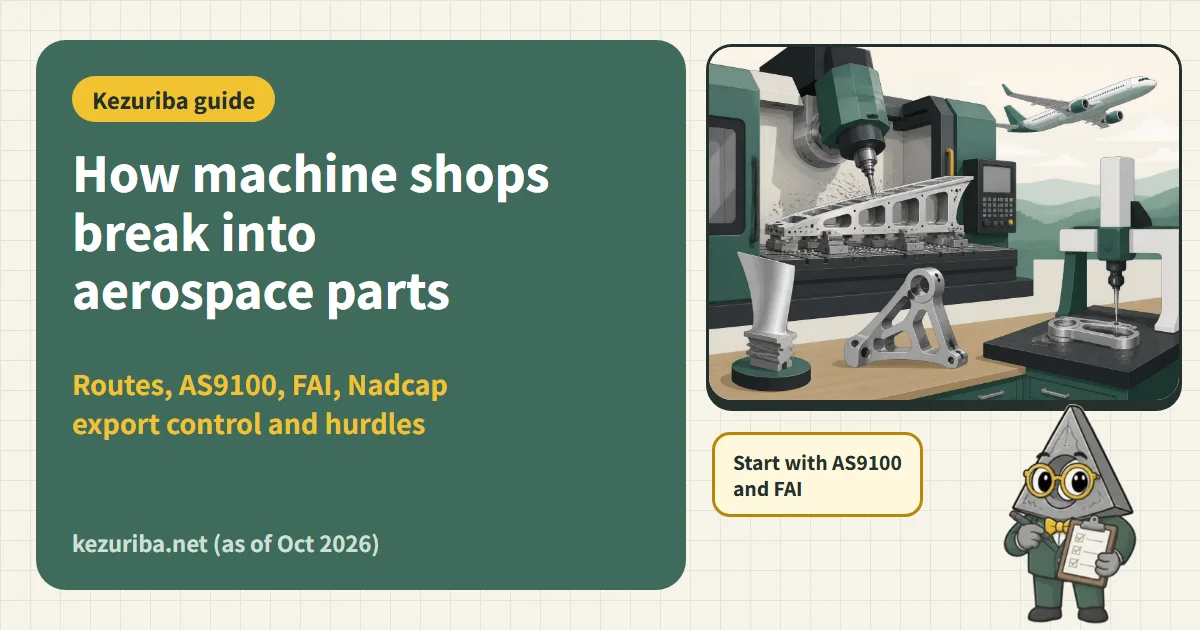
Aircraft production, which fell sharply during COVID, passed its pre-pandemic level in FY2024 and recovered to ¥2.4715 trillion in FY2025 (preliminary). Upcoming single-aisle aircraft are expected to be built at high rates of dozens per month, and the Japanese government says production capacity must grow all the way down to small and mid-sized suppliers that handle parts machining and special processes. Even so, aviation is a different world from automotive or general machinery when it comes to how you prove quality. This article walks through four entry routes, how to get JIS Q 9100 (Japan's AS9100) and what it costs, first article inspection (FAI), Nadcap and special processes, export control, national and prefectural support, the real hurdles in order, based on public documents from METI, the Society of Japanese Aerospace Companies (SJAC), IAQG, PRI and others (as of October 2026).
Why look at aircraft parts machining now
According to SJAC statistics, Japan's aircraft production (airframes, engines and other equipment) fell from ¥1.8689 trillion in FY2019 to ¥1.1554 trillion in FY2021 during COVID (down about 38%). It has since recovered: ¥2.0619 trillion in FY2024 and ¥2.4715 trillion in FY2025 (both preliminary). Since FY2022, engines have outpaced airframes in value[1]. Figures are nominal, so they include the effect of the weaker yen.
Japanese companies have taken part in the international joint development of large US airliners, with manufacturing shares of 15% on the 767, 21% on the 777, 35% on the 787 and 21% on the 777X.[3]. METI's Aircraft Industry Strategy, compiled in April 2024, puts Japan's aircraft industry at about ¥2 trillion a year as of 2019 (¥1.36 trillion for commercial aircraft) and cites an outlook that commercial aircraft alone will be an industry of about ¥6 trillion or more a year from 2035 onward. At the same time, it names as a challenge that Japan's participation in single-aisle aircraft (planes with one aisle) is limited, even though this is the segment set to grow most[2].
The next single-aisle aircraft is expected to be built at a high rate equivalent to 80 a month, and the government, saying that capacity must grow not only at heavy-industry companies but all the way down to suppliers that handle parts machining and special processes, has started subsidizing capital investment (see below)[7]. Regionally, the Chubu region is the center and is said to account for about half of Japan's domestic production of airframe parts[4].
Four entry routes: most start as a supplier to Tier 1 or Tier 2
| Route | What it looks like | What you need | Best suited to |
|---|---|---|---|
| A Subcontract (the most common) | Become a supplier to a Japanese heavy-industry company (Tier 1) or a parts maker (Tier 2) and deliver parts or processes to drawing | Customer audits (quality, equipment, finances). Most require JIS Q 9100 | Shops strong in a specific process such as machining, grinding or sheet metal that can manage records |
| B Joint orders | In a regional cluster, several companies split the work from material sourcing through machining, heat treatment, surface treatment and inspection, and take on parts "through to completion" (end-to-end, "one-stop" production) | Quality control by the group's lead company; partners with special processes | Small and mid-sized companies that can't cover every process alone |
| C Direct overseas | Sell parts to overseas Tier 1/2 companies or to new Asia-Pacific supply chains | JIS Q 9100 (registered in OASIS), English documents and audit handling, export control | Companies with aviation experience that can be audited in English |
| Getting started | Joint exhibits at trade shows, cluster study groups, business-matching events run by public bodies | A one-page summary of your strengths | A first step for every company |
The government has supported efforts to make small and mid-sized suppliers more cost-competitive and to set up end-to-end ("one-stop") production, where several companies take parts through to completion. There is also NAMAC, a nationwide network linking Japan's aircraft clusters, which helps local groups promote themselves and build end-to-end production[2][6]. The Aircraft Industry Strategy also covers suppliers that deliver parts to overseas manufacturers, and says small and mid-sized companies will be supported together with local governments, JETRO and the Organization for Small & Medium Enterprises and Regional Innovation, JAPAN (SMRJ)[2]. In the Chubu region, local governments and support organizations help companies exhibit at Aeromart Nagoya and the Paris and Singapore airshows[5].
How it differs from defenseDefense work has a single customer, Japan's Ministry of Defense (MOD), with its own bidding qualifications and security rules (see How to Enter Japan's Defense Industry). For commercial aircraft, the customers are overseas airframe and engine OEMs, and international industry standards (the 9100 series, Nadcap) and English documents are the common language. The quality systems overlap, so getting JIS Q 9100 helps with both routes.
Start with JIS Q 9100: how it differs from ISO 9001
The aviation, space and defense quality management standard "9100" adds industry requirements to ISO 9001 and is issued with identical content as JIS Q 9100 in Japan, AS9100 in the US and EN 9100 in Europe[8]. Certification becomes mandatory mainly when airframe and engine OEMs require it, but that requirement is spreading to their suppliers and on to their suppliers' suppliers[12].
| Requirements JIS Q 9100 adds (examples) | What it means on the shop floor |
|---|---|
| Configuration management | Write the drawing number and revision on work instructions so the part can be remade to the same revision years later[15] |
| Control of special processes | For processes whose quality can't be judged by inspecting the product afterward, such as heat treatment, plating and welding, validate and control the process itself[8] |
| First article inspection | For each new part, verify and record that every characteristic can be produced to drawing with the defined process (next section) |
| Key characteristics | Identify dimensions and other features whose variation affects function or life, and control them by process capability (Cp, Cpk)[15] |
| Prevention of counterfeit parts | Buy material through authorized channels and verify it with mill certificates and receiving inspection[15][8] |
| Product safety, human factors | Corrective actions that dig down to the causes of human error; identification of safety-critical parts[8] |
| Control of external providers | Approve subcontractors and material suppliers and register the scope of approval. Pass customer requirements on to subcontractors (flow-down)[8] |
| On-time delivery and quality performance | Measure and improve the share of deliveries made on time and to quality[15] |
Getting certified and what it costs
- Solidify your ISO 9001 system: If procedures, records, calibration, nonconformance handling and internal audits are already running, JIS Q 9100 can be built on top of them. Expanding step by step, without a big upfront investment, is the realistic approach.
- Build the added requirements into the system and run it: PRI, a US certification body, recommends running the system for about 6 months before the audit[32].
- Choose a certification body and get audited: In Japan, 4 certification bodies are accredited by JAB for JIS Q 9100[9]. The audit has Stage 1 and Stage 2, and the number of audit days is set under the 9104-1 standard from factors such as headcount and the share of aviation, space and defense in sales[14].
- Register in OASIS: Results are listed in IAQG's database OASIS , which overseas airframe and engine OEMs can also view, so customer audits may be skipped or reduced[9].
- Renew every 3 years: Within the 3-year cycle there is a surveillance audit every year[32].
| Cost item | Amount (where published) |
|---|---|
| Certification body audit fee | Set by audit days; no official guideline is published → get quotes from several certification bodies |
| OASIS registration fee | US$700 per initial or recertification audit (plus US$250 for audits started on or after May 15, 2025)[10] |
| Japanese certification scheme maintenance and improvement fee | ¥50,000 per audit for non-JAQG members (once per fiscal year per legal entity; all fees exclude consumption tax)[10] |
| JAQG membership fee | ¥50,000 a year for companies that are not SJAC members. Members are exempt from the fee above and can access materials such as Japanese–English Nadcap audit criteria[11] |
9100 is set to become "IA9100"The next revision will be named IA9100 under IAQG's new numbering scheme[17]. As of 2023, IAQG planned to publish it in 2026 to align with the revision of its base standard, ISO 9001[18]. ISO 9001:2026 was published on September 16, 2026, but[16] as of October 2026 we could not confirm any official announcement of the IA9100 publication date or transition deadline. Even after publication, current certificates do not become invalid right away; companies normally switch over at a regular audit within the transition period. So a company starting now can go ahead with the current JIS Q 9100:2016.
First article inspection (FAI) and the standards customers require
The most labor-intensive part of aircraft parts work is first article inspection (FAI). It goes beyond measuring dimensions: for every characteristic, you verify that "the defined process, material and tooling produce an item that conforms to the drawing" and record it on prescribed forms. The standard is IAQG 9102, and the latest is the 2023 revision (SJAC 9102C in Japan, AS9102C in the US). The revision requires FAI planning to follow a documented procedure[19][20].
Changed the NC program? Redo FAINot only when you change the production site, process, inspection method, tooling or material, but also when you change the NC program or transfer it to other media, you must redo FAI for the affected characteristics[19]. FAI is also required for characteristics that may be affected when production has stopped for 2 years or more[21]. Even "we switched machines and now it cuts faster" needs notification and FAI first. Some customers require FAI records to be kept until the aircraft is retired (around 30–40 years)[15].
| Standard | Details | When required |
|---|---|---|
| 9102 (SJAC 9102, AS9102) | FAI process and Forms 1–3 | Every new part and every change. In almost every contract |
| 9145 (AS9145) | Aerospace version of APQP (Advanced Product Quality Planning) and PPAP (Production Part Approval Process). Confirms you can keep producing at the customer's demand rate[22] | When the customer specifies it for a new part launch |
| 9103 (AS9103) | Variation management of key characteristics. Mainly for new parts, including cast and forged blanks[23] | When key characteristics are specified on the drawing or order |
| AS13100 | Additional requirements on top of 9100 and 9145 for aero engines. Revised to Rev. A in April 2025[26]. JAQG's engine quality working group has produced a Japanese pocket guide[27] | When specified on the purchase order for engine parts |
| 9146 (AS9146) | Foreign object damage (FOD) prevention. A system to keep chips, tools and rags out of the product[24] | When flowed down to suppliers by contract |
| 9131 (AS9131) | How to document a nonconformance when notifying the customer and requesting approval[25] | When specified by contract |
| AS6174 | Counterfeit prevention for all materiel (material traceability, testing). Rev. B in February 2026[28] | When required in material procurement |
Nadcap and special processes: does a machining-only shop need it?
Nadcap is an industry program launched in 1990, led mainly by airframe and engine OEMs, for special process accreditation. It is run by PRI, a US nonprofit. More than 4,500 suppliers are accredited, and more than 60 manufacturers take part[29]. The major participating manufacturers require their suppliers to obtain Nadcap accreditation[13].
| Example commodities | Relevance to machine shops |
|---|---|
| Heat treating, chemical processing (plating, anodizing), NDT, welding, surface enhancement (shot peening), coatings | If you have the process in-house, it is a candidate for accreditation. If not, use accredited subcontractors for those processes |
| Nonconventional machining (EDM, ECM, etc.) | May apply if you use wire or sinker EDM on aircraft parts |
| Conventional machining as a special process (audit criteria AC7126) | Drilling, broaching, turning, milling, grinding and edge finishing are audited when the customer designates them as special processes. Ordinary machining is not automatically covered |
| Measurement and inspection, materials testing, composites, additive manufacturing, etc. | Depends on your processes and customers |
Nadcap fields are based on PRI's list (PRI pages variously say 24 or 26 fields)[30][29].
- Prerequisite: You need certification such as JIS Q 9100 (AS9100), or a system that meets Nadcap's quality system audit criteria AC7004; ISO 9001 alone is not enough[13].
- Timeline: A first accreditation takes roughly 6–12 months (preparation 2–4 months, on-site audit 2–5 days, correcting findings (NCRs) 1–3 months, Task Group review about 1 week). The audit is often held 3–6 months after you request a date, and after that reaccreditation audits usually come every 12–24 months[31].
- Cost: There is no published fee schedule; you get a quote for each audit scope through PRI's system[31]. You also need procedures and records in English, and must handle the audit in English.
- Separate from customer approval: Nadcap accreditation does not in itself mean customer approval; it is used as one part of the customer's approval process[32]. You can apply even before you have an aerospace customer[32].
- Benefits: In PRI's survey, accredited suppliers saw customer audits fall by 40% on average, and 85% felt their quality had improved (a survey by the operator itself)[33].
First steps for a machining shopIf you outsource heat treatment, surface treatment or NDT, use only subcontractors approved by your customer (holding Nadcap, etc.), flow down the customer's requirements in your purchase orders, and make sure the subcontractors' certificates can be entered on FAI Form 2. If few accredited processors are in your region, the longer transport adds lead time and logistics cost. Bringing processors into your joint orders (consortium) group is a real strength.
Do you need JCAB approval?
Companies that manufacture aircraft or aircraft equipment can obtain, under Japan's Civil Aeronautics Act, approved organization certification (JCAB) from the Minister of Land, Infrastructure, Transport and Tourism (standard processing period for a new application: 3 months)[34]. However, a JCAB circular states that when an approved organization outsources work, the ordering party bears responsibility under the Civil Aeronautics Act whether or not the subcontractor holds approval, and the ordering party is to select, audit and carry out receiving inspection of the subcontractor[35]. If you enter as a parts-machining subcontractor, what you face first is not JCAB but your customer's audits and JIS Q 9100.
What you machine: materials and equipment
In airframes, to reduce part count, more and more parts are machined in one piece from thick plate or large forgings, and 5-axis high-speed machining is the norm for aluminum alloys (such as 7050)[49]. For aluminum structural parts, the material removal rate is proportional to spindle power, so the keys are making full use of high-speed, high-power spindles and avoiding chatter with stability lobe diagrams[50]. As CFRP (carbon fiber reinforced plastic) use grows, titanium alloys also increase to avoid galvanic corrosion with aluminum, and both CFRP and titanium alloys are expensive, difficult-to-cut materials. In drilling CFRP, separation of the layers (delamination) is a problem[48].
| Materials | Where used (examples) | Machining points |
|---|---|---|
| Aluminum alloys (7050, 7075, etc.) | Airframe structure, ribs | Monolithic machining from thick plate; chatter and distortion in thin walls[49][50] |
| Titanium alloy (Ti-6Al-4V) | Fittings mated with CFRP, landing gear area | Short tool life. Keep the cutting force normal to the flank face low[52] |
| Nickel-based superalloy (Inconel 718) | Engine hot section | In interrupted cutting the coating peels off and wear accelerates. Keep the uncut chip thickness small at tool exit[51] |
| CFRP | Wing and fuselage skins | Delamination in drilling, cutting-edge wear[48] |
For cutting conditions for difficult-to-cut materials, see the Materials database; for tool wear, the tool life article; and for 5-axis, the 5-axis machining page. As for equipment, once you have a 5-axis machining center and a CMM in a temperature-controlled room, you can complete FAI Form 3 in-house.
Export control: before you accept drawings
Aircraft parts can involve technology with military uses, so both Japanese and US rules apply.
- Japan's Foreign Exchange and Foreign Trade Act (FEFTA): Checking whether the goods you export or the technology you provide fall on the control lists requires an export classification. “Providing technology” covers not only sending it abroad but also providing it within Japan to non-residents or to persons under strong influence of a foreign government or entity (the “specified category”); examples given include taking data out by email or USB and giving technical guidance to trainees from overseas[47].
- US EAR (Export Administration Regulations): Outside the US, for example in a factory in Japan, showing or releasing controlled technology to a third-country national is a deemed reexport to that person's country of nationality[44][45].
- US ITAR (International Traffic in Arms Regulations): Defense technical data released to a person is deemed reexported to every country where that person holds citizenship or permanent residency, and releasing it to anyone not covered by the authorization requires written approval from the US Department of State[46].
Companies with foreign employees or trainees: check firstThe customer classifies, item by item, which regulations a drawing falls under. Before receiving drawings, confirm with the customer, decide who may view them, and keep the drawing data on separate PCs or folders.
Support from the government, the special zone and prefectures
- National capital investment subsidy: METI's “Supply Chain Modernization Investment Support” (FY2025) subsidized capital investment, production demonstrations and certification for new processes by suppliers handling parts machining or special processes, at up to 1/2 for SMEs (up to 1/3 for large companies). The lower limit was ¥25 million, and conditions included cutting production time by 15% or more by the end of the project. The cost of obtaining certification was eligible, but maintenance and periodic audit costs after certification were not[7][43].
- Asia No.1 Aerospace Industrial Cluster Special Zone: A Comprehensive Special Zone for International Competitiveness spanning Aichi, Gifu, Mie, Nagano and Shizuoka Prefectures, among others[37]. It aims to raise aerospace production in the Chubu region from ¥870 billion in FY2024 to ¥1.23 trillion in FY2030, and measures such as corporate tax reductions (111 cases) and interest subsidies (85 cases) have been used (as of end of March 2026)[36]. To use the special measures, each business must be designated within the zone, and designations are still being added[38].
- Chubu support directory: The Chubu Bureau of Economy, Trade and Industry compiles the programs of prefectures, cities and support organizations as the “Chubu Aerospace Support Action,” so you can look up support for market development, training, obtaining and maintaining certification, and R&D in one list[5].
| Prefecture | What's covered | Subsidy rate and cap (FY2026) |
|---|---|---|
| Shizuoka Prefecture | Obtaining JIS Q 9100, Nadcap and other certifications | 1/2. Up to ¥3 million for JIS Q 9100 and ¥5 million for Nadcap (this fiscal year's call has closed)[39] |
| Fukushima Prefecture | JIS Q 9100 and Nadcap certification costs | 1/2 (2/3 for businesses in the Hamadori area, etc.), up to ¥1 million each. Until Dec 25, 2026[40] |
| Yamanashi Prefecture | JIS Q 9100, Nadcap and other certifications; acquiring special technologies | 1/2, up to ¥1 million for certification and ¥1.5 million for special technologies. Until Mar 12, 2027[41] |
| Nagano Prefecture | Attending training; in-house training and technical guidance | 1/2, up to ¥100,000 per person and ¥500,000 per company[42] |
Other prefectures and cities (such as Komaki City) also support certification and dispatch experts[5]. Application periods and conditions change every fiscal year, so check each prefecture's page before applying.
Order of steps to entry (guideline)
- Write down your strengths that matter in aerospace: difficult-to-cut materials (titanium, Inconel), monolithic machining of thin-walled or large parts, 5-axis, hole position accuracy, high-mix low-volume work, record keeping, and so on.
- Gather information at clusters and trade shows: Attend study sessions of regional clusters and support organizations, and ask which Tiers are looking for what[6][5].
- ISO 9001 → JIS Q 9100: Check prefectural subsidies, get quotes from certification bodies, and run the system for about 6 months before the certification audit[32].
- Prototypes and FAI: Undergo the customer's audit and submit prototypes and FAI records. Decide your special-process subcontractors at this stage.
- Production and growth: Build a track record on delivery and quality; get Nadcap if you bring special processes in-house, team up with partners for end-to-end ("one-stop") production orders, and move on to overseas Tiers.
the real hurdles
| Hurdle | Details | Example countermeasures |
|---|---|---|
| Long road to entry | Safety certification is strict, and replacing an established supplier takes major cost and years of time[2] | The flip side: once you are in, the business lasts. Plan cash flow for the first few years |
| Demand swings | During COVID-19, nearly 90% of aircraft suppliers in the Chubu region saw 2020 sales fall by 30% or more from the previous year[4]. The domestic supply chain is strongly affected by the production plans of specific companies[2] | Keep aerospace to part of your sales. Take the work on equipment you can share with other industries |
| Hard to pivot to other industries | Some report that promoting Nadcap or aerospace experience did little to impress buyers in other industries[4] | Restate the record keeping and process control honed in aerospace in terms that fit quotes for medical, semiconductor and other customers |
| Tough pricing | With high-mix, low-volume production[2], Japan's manufacturing cost per individual part is thought to be higher than other countries', and on the 777X some sections moved to other countries for cost reasons[3] | Raise added value with shorter setups, automation and end-to-end orders |
| Material costs and exchange rates | Materials account for roughly 60–70% of domestic manufacturing cost for engine parts, and the main materials depend on purchases from overseas[2] | Confirm in the contract whether material is customer-supplied or purchased, and the rules for price revisions |
| Certification upkeep and staff | JIS Q 9100 requires annual surveillance audits, and Nadcap reaccreditation every 12–24 months. You need English documents, audit handling and quality staff[32][31] | Use prefectural subsidies and expert dispatch. Train internal auditors in-house |
Companies that fit, and those that should think twice
- You have taken on jobs others turned down: difficult-to-cut materials, thin-walled or large machined parts
- You already manage inspection reports, mill certificates and drawing revisions
- Your culture does not allow changing NC programs or fixtures without authorization
- You are prepared to spend years getting in, then make the same parts for 20–30 years
- You have heat-treatment and surface-treatment partners in your region
- You need sales right away, or want a quick payback on equipment
- You have improved by freely changing processes and conditions at the shop floor's discretion
- You plan to make aerospace most of your sales (exposed to demand swings)
- No one can handle English documents or audits
FAQ
- Can I do aerospace work without JIS Q 9100?
- It becomes mandatory when airframe and engine makers require it, and that requirement is spreading to their suppliers[12]. At what stage certification is required depends on the customer, so check before you start selling. Note that Nadcap requires JIS Q 9100 or similar certification as a prerequisite[13].
- Does a machining-only shop need Nadcap?
- Ordinary machining is not automatically in scope. Drilling, turning, milling, grinding and similar operations that the customer designates as special processes are audited under “Conventional Machining as a Special Process”[30]. In most cases, the question you will face first is whether you send heat treatment and surface treatment to accredited subcontractors.
- How much does certification cost?
- Certification body audit fees depend on audit man-days, and no official benchmark is published. The published fixed costs are the OASIS registration fees (US$700 for each initial registration or renewal, among others) and the ¥50,000 (excl. tax) maintenance and improvement fee for JAQG non-members[10]. Shizuoka Prefecture's subsidy cap (¥3 million for JIS Q 9100 at a 1/2 rate) gives a sense of the cost scale[39].
- Do I need JCAB approval?
- For a parts-machining subcontractor, what you need first is your customer's audit and JIS Q 9100. Under the Civil Aeronautics Act, the ordering party bears responsibility whether or not the subcontractor holds approval[35].
- Can I target defense work at the same time?
- The quality systems overlap. Japan's Ministry of Defense specifications require a JIS Q 9100 system for items such as aircraft and missiles, so JIS Q 9100 works for both. Bidding qualifications and protection of classified information are unique to defense, so please read How to Enter Japan's Defense Industry as well.
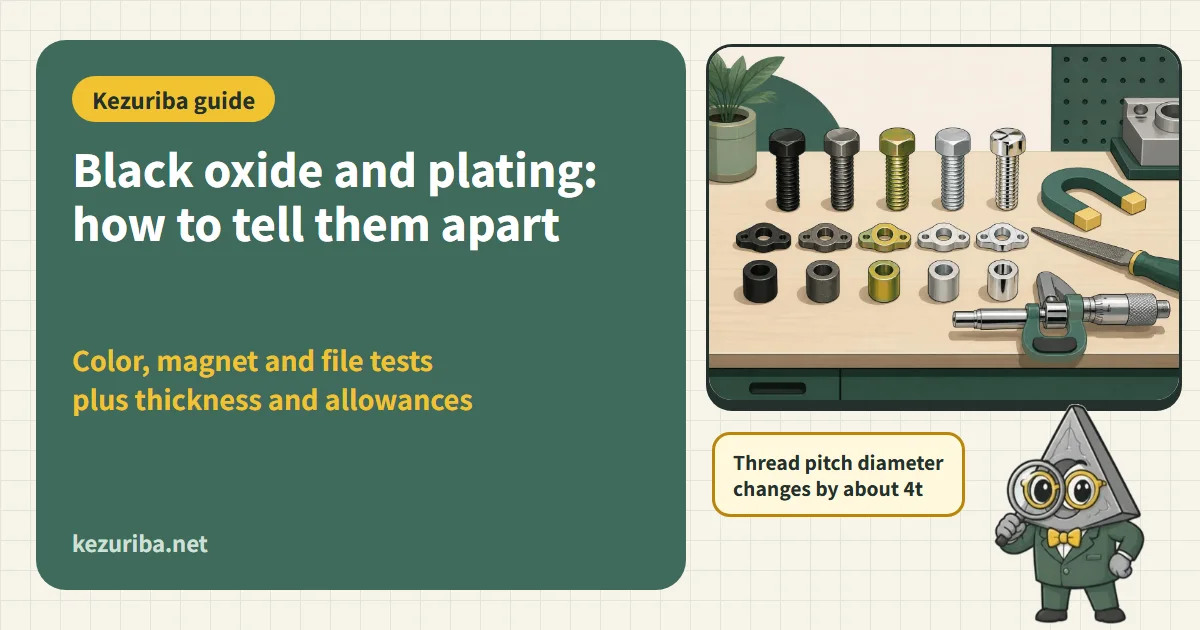
Hole and fit data: Fits and Tolerances, and dimensional change from surface treatment: How to tell black oxide from plating, and how dimensions change; rising tool prices: Tungsten Price Surge and Carbide Tools.
Sources
- Society of Japanese Aerospace Companies (SJAC), "Aerospace Industry Database" (Aug 2026 edition, PDF), 1-2 Long-term trend of Japan's aerospace industry production (sales)
- Industrial Structure Council, Manufacturing Industry Subcommittee, Aircraft Industry Working Group, "Aircraft Industry Strategy" (Apr 2024, PDF)
- Japan Aircraft Development Corporation (JADC), "The Airframe Business and Its Future Development" (material for the Industrial Structure Council Aircraft Industry Working Group, PDF)
- Chubu Bureau of Economy, Trade and Industry, "FY2021 SME Survey Project (Survey on the Potential of the Aircraft Industry to Expand into Other Industries) Report" (PDF)
- Chubu Bureau of Economy, Trade and Industry, "Chubu Aerospace Support Action 2025" (PDF)
- National Aircraft Cluster Network (NAMAC)
- Green Investment Promotion Organization (GIO), "FY2025 Next-Generation Aircraft Development Support Program: Supply Chain Modernization Investment Support"
- SJAC Japan Aerospace Quality Group (JAQG), "Current Status of JIS Q 9100-Related Standards"
- JAQG, "JIS Q 9100 Certification Scheme"
- JAQG, "IAQG-OASIS Registration Fee Schedule" (revised May 27, 2025)
- JAQG, "Member Benefits and Fees"
- JAQG, "FAQ / 9100 Series Standards"
- JAQG, "FAQ / Special Processes (Nadcap)"
- JAQG, "FAQ 9101E, Japanese Translation, Rev.2.0" (PDF)
- Japan Quality Assurance Organization (JQA), "Introduction to JIS Q 9100," ISO NETWORK Vol.31 (PDF)
- ISO, "ISO 9001:2026 Quality management systems — Requirements"
- NASA Office of Safety and Mission Assurance, "Status of the Development of IA9100" (Apr 2024)
- IAQG, "9100 Key Change Summary (IA9100)" (PDF)
- JAQG, "SJAC 9102C Aerospace First Article Inspection Requirement" (PDF)
- IAQG, "9102 Key Changes from Rev B to Rev C" (PDF)
- IAQG, "First Article Inspection 9102B Updated FAQs" (PDF)
- IAQG, "9145 Advanced Product Quality Planning and Production Part Approval Process"
- IAQG, "9103 Variation Management of Key Characteristics"
- IAQG, "9146 Foreign Object Damage (FOD) Prevention Program"
- IAQG, "9131 Nonconformance Data Definition and Documentation"
- SAE, "AS13100A AESQ Quality Management System Requirements for Aero Engine Design and Production Organizations"
- JAQG, "AS13100"
- SAE, "AS6174B Counterfeit Materiel; Assuring Acquisition of Authentic and Conforming Materiel"
- Performance Review Institute (PRI), "The Nadcap Program"
- PRI, "Nadcap Accreditation"
- PRI, "Getting Started with a Nadcap Accreditation"
- PRI, "Frequently Asked Questions"
- PRI, "Nadcap Program Suppliers"
- Ministry of Land, Infrastructure, Transport and Tourism (MLIT), "Approved Organization Certification" procedure guide (PDF)
- Japan Civil Aviation Bureau (JCAB), Circular No.2-001, "General Policy on Approved Organization Certification" (PDF)
- Cabinet Office, "[Comprehensive Special Zone for International Competitiveness] Asia No.1 Aerospace Industrial Cluster Special Zone" overview (2026, PDF)
- Cabinet Office, Secretariat for the Promotion of Regional Revitalization, "List of Comprehensive Special Zones"
- Mie Prefecture, "Additional Area Designation Received under the Comprehensive Special Zone for International Competitiveness 'Asia No.1 Aerospace Industrial Cluster Special Zone'"
- Shizuoka Prefecture, "Subsidies" (aircraft industry)
- Fukushima Prefecture, "FY2026 Subsidy for Certification Acquisition Support in Aerospace-Related Industries"
- Yamanashi Prefecture, "Subsidy for Certification and Special Technology Acquisition Support in Aerospace and Defense-Related Industries"
- Nagano Prefecture, "Call for Applications Opens: Subsidies for Human Resource Development and In-House Systems in the Aircraft Equipment Industry" (May 2026, PDF)
- Green Investment Promotion Organization (GIO), "Application Guidelines: Next-Generation Aircraft Development Support Program (Supply Chain Modernization Investment Support)" (PDF)
- U.S. Department of Commerce, Bureau of Industry and Security (BIS), "Deemed Exports"
- eCFR 15 CFR §734.14 Reexport (EAR)
- eCFR 22 CFR §120.51 Reexport (ITAR)
- METI, "Introduction to Security Export Control" (FY2026, PDF)
- Masanori Nakajima, "Manufacturing Technology for Aircraft Airframes", Journal of the Japan Society for Precision Engineering, Vol.75, No.8 (2009)
- Takayuki Takahashi, "Aluminum Materials and Their Machining Technology in Aerospace Equipment", Journal of Japan Institute of Light Metals, Vol.65, No.9, pp.455-459 (2015)
- Masaaki Miyazaki, "High-Efficiency Machining of Aircraft Structural Parts", Journal of the Japan Society for Precision Engineering, Vol.75, No.8 (2009)
- "Wear Mechanism of Coated Carbide Tools in Cutting of Inconel 718 Superalloy", Journal of the Japan Society for Precision Engineering, Vol.65, No.7
- "A Study on Predicting Tool Flank Wear in End Milling of Titanium Alloy", Journal of the Japan Society for Precision Engineering, Vol.83, No.5
More articles
 Industry
How a Metalworking Company Can Enter Japan's Defense Industry: 3 Entry Routes, Qualifications and Certifications, Information Control, State Support, Hurdles
 News
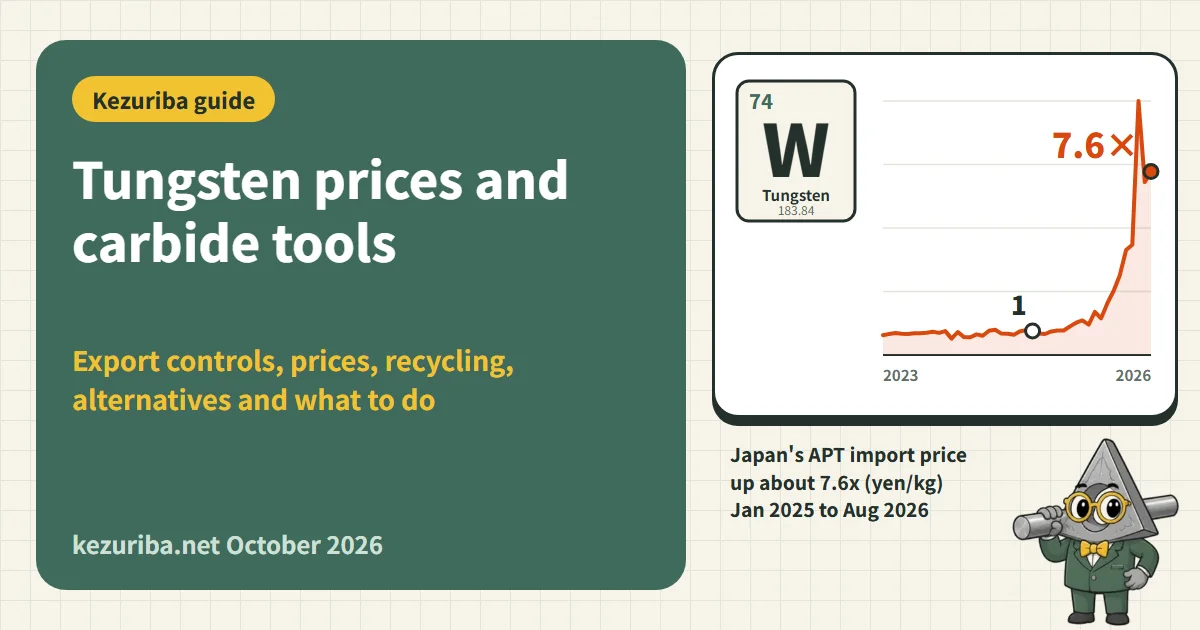
NewsTungsten Price Surge and Carbide Tools: China's Export Controls, Price Trends, Toolmakers' Price Increases, Recycling, Alternative Grades and Shop-Floor Countermeasures (2026 Edition)
 Surface treatment