How a Metalworking Company Can Enter Japan's Defense Industry: 3 Entry Routes, Qualifications and Certifications, Information Control, State Support, Hurdles
Build a track record as a subcontractor first! Get your quality and drawing control solid beforehand.

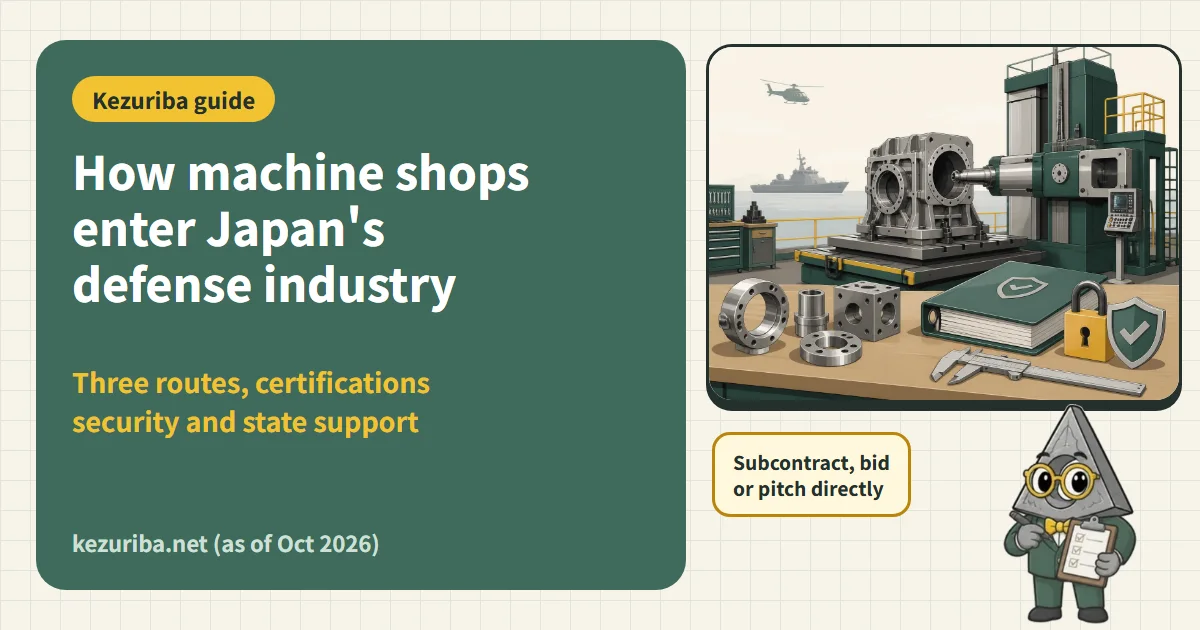
With rising defense budgets and a rebuilding of the supply chain, Japan's Ministry of Defense (MOD) and Acquisition, Technology & Logistics Agency (ATLA) now openly call for new entrants among small and medium-sized companies. Metalworking such as turning, machining, grinding, heat treatment and surface treatment is the foundation of the parts that support tanks, fighter jets and destroyers. Even so, it is hard to tell what qualifications you need, whom to approach, and whether it pays. This article covers the following, in order: the three entry routes, the qualifications and certifications to hold, information control (the cybersecurity standard and protection of secrets), state financial support, the real hurdles, based on public documents from the MOD and ATLA (as of October 2026).
Why the defense industry now needs new companies
Japan has no state-run arsenals for building defense equipment. Instead it relies on Prime contractors, which receive orders directly from the MOD, and on the many suppliers below them that make the parts. The 2026 edition of the Defense of Japan white paper says that more than 1,000 companies are involved in tanks and fighter jets and more than 8,000 in destroyers. It also acknowledges that production is high-mix, low-volume. The MOD is the only customer, so investment is hard to recover, and companies keep deciding, one after another, to withdraw or scale back[1].
In response, the government put into effect the Act on Strengthening the Defense Production Base in 2023, creating a mechanism in which the state itself surveys the supply chain and supports its weak points[8][9]. In April 2026 the government told the House of Representatives' Committee on Security that it had surveyed about 13,000 companies in total under this law, and that since FY2024 its staff have gone to factories to check manufacturing-process risks and have visited about 130 companies so far[10]. In short, the current situation is that “companies that can make the parts instead” are in demand.
On funding, there is a plan to build up defense capability at about 43 trillion yen over the five years FY2023–FY2027. The FY2026 (Reiwa 8) defense-related budget is 8.8093 trillion yen for the items covered by this plan, and 9.0353 trillion yen including U.S. force realignment and other items[5][4].
Three entry routes: start with subcontracting
| Route | What it looks like | What you need | Best suited to |
|---|---|---|---|
| A Subcontract (the most common) | Become a supplier to a prime contractor or a Tier-1 supplier and deliver parts, machining or treatment to the drawing | The higher-tier company's supplier audit (quality, equipment, finances). Quality-management and information-control rules come with the contract | Companies strong in a specific process: turning, machining, grinding, heat treatment, surface treatment, etc. |
| B Bidding | Bid on MOD and Self-Defense Force tender notices and contract directly | Unified Qualification for All Ministries and Agencies (manufacture of goods, etc.) plus the conditions of each tender notice | Companies that can take on complete products, spare parts or repairs on their own |
| C Pitching | Propose your technology to ATLA's New Entrant Consultation Desk / exhibit at the Defense Industry Participation Promotion Expo (DIPEX) | A proposal (company outline, technology, track record). Exhibiting is free | Companies with machining technology, materials or inspection that others lack |
Submitting to the desk can also open a subcontracting routeWhen you submit a proposal to ATLA's New Entrant Consultation Desk, its content is first shared within the MOD and the Self-Defense Forces. If the company wishes, defense-related companies looking for suppliers will see it too[2]. Route C can therefore be a shortcut to Route A. Proposals unrelated to defense equipment, such as daily goods or construction work, are outside the desk's scope.
Route C: How to use the consultation desk and DIPEX
- New Entrant Consultation Desk: Defense Industrial Policy Office, Equipment Policy Division, Equipment Policy Department, ATLA. Fill in the “Inquiry / Technology Proposal Form (Excel)” with your company name and business outline, the technology or product you want to propose, your defense equipment track record, contact details, and whether you wish your information to be passed on to the defense industry, and send it by email. You can also just ask how the entry system works[2].
- Defense Industry Participation Promotion Expo (DIPEX): An expo that brings small and medium-sized companies and startups together with the MOD and defense-related companies. DIPEX2026 will be held on Nov 12–13, 2026, at Bellesalle Shiodome. The exhibitor fee is Free (travel and transport costs are paid by the exhibitor). Exhibitor applications ran from Jul 31 to Sep 4, 2026 and have closed, but visitor registration is still open. Exhibitor eligibility also includes “second-tier and lower contractors” and “domestic companies newly interested in the defense field”[3][2]. A handy first step is to visit and talk with the prime contractors' procurement staff and the exhibitors at the booths.
Route B: How to obtain the Unified Qualification
To take part in tenders for the manufacture and sale of goods or for services for the MOD and the Self-Defense Forces, you need the Unified Qualification for All Ministries and Agencies that is common to government bodies. ATLA's central procurement uses the same qualification. For example, a September 2026 notice for “manufacture of air compressor parts” required “Grades A, B and C for manufacture of goods, Kanto-Koshinetsu region”[15][16].
- Apply on the Procurement Portal: The current qualification is for FY2025–FY2027 (Reiwa 7–9) and, although the regular review has ended, the rolling (off-cycle) review is open until Mar 10, 2028. The qualification is valid from the date it is granted until Mar 31, 2028. New applicants can apply via “Apply without logging in” on the Procurement Portal (mail or hand delivery is also possible). Apply at one place and it is usable at all ministries and agencies, including the MOD[18][17].
- Your grade (A–D) and region are decided: For “manufacture of goods,” the grade is decided by a total of 100 points: average annual production/sales (10–60 points), net worth (2–10), current ratio (4–10), years in business (3–5) and equipment value (3–15). You choose from 8 regions, from Hokkaido to Kyushu/Okinawa, and the qualification is valid only in the regions you choose[19][17].
- Find tender notices: ATLA (central procurement) and each Self-Defense Force's regional district headquarters, supply depots, camps and bases (local procurement) issue notices separately.
| Grade (manufacture of goods) | Points | Estimated contract price (guide) |
|---|---|---|
| A | 90 points or more | 30 million yen or more |
| B | 80 to under 90 points | 20–30 million yen |
| C | 55 to under 80 points | 4–20 million yen |
| D | Under 55 points | Under 4 million yen |
Grades of the Unified Qualification and guide to estimated contract prices (manufacture of goods)[19]. Some tenders also allow other grades to take part; the actual conditions are set by each notice.
Some small contracts need no qualificationThe Ground Self-Defense Force's open counter (small quotation competition) does not, in principle, require the Unified Qualification[22]. The Procurement Portal's open counter also covers only goods under 3 million yen and services under 2 million yen, and logging in with gBizID is generally enough, with no Unified Qualification needed[21]. Some notices, such as parts-replacement maintenance at a camp, list the qualification as “none.” Starting with a small job at a nearby camp or base, to get used to defense paperwork and inspection flow, is one option.
The qualification is renewed every 3 yearsThe Unified Qualification is reviewed for renewal every 3 years. It takes about a week from completion of the review at the counter until the notice arrives, but right after the regular review it can take several months, so apply well before the tender you are aiming at[15][20].
Quality system: DSP Z 9008 application categories, JIS Q 9100 and Nadcap
For contracts in which the MOD requires quality management, the specification DSP Z 9008 “Common Specification for Quality Management” (revised September 2024) is cited. It sets out “the requirements for the quality management system the contractor builds,” and one of application category a, b or c is specified for each item[14].
| Application category | Base standard | Examples of items listed in the commentary (guide) |
|---|---|---|
| a | All of JIS Q 9100 (or SJAC 9110) plus additional MOD requirements | Missiles, aircraft, aircraft engines, aviation electronics and navigation equipment, rocket motors |
| b | Equivalent to JIS Q 9001 (JIS Q 9100 minus the aerospace additions) plus additional requirements | Firearms, tanks, ships, non-aviation electronics and navigation equipment, life-saving equipment |
| c | Category b minus operational planning, design and development, control of externally provided items, etc., plus some additional requirements | Vehicles, shipboard auxiliary machinery, maintenance test equipment, special tools, training equipment |
Application categories of DSP Z 9008. The examples of items come from the specification's commentary and are not requirements; the category for a given item is set in each specification[14].
Additional MOD requirements include a procedure for deciding whether a nonconforming item may be “used as is”: three people take part, the company's quality representative and technical representative, and the MOD government inspector. This procedure is called material review. The additional requirements also cover a compliance system, and nonconformities in items sent out to subcontractors must be brought into this material-review procedure as well[14].
Certification is a “condition of business,” not a “specification obligation”The body of Z 9008 contains no rule saying “you must obtain certification”; what it requires is to build and operate the system matching the category[14]. In practice, however, higher-tier companies often require ISO 9001 or JIS Q 9100 certification as a condition of doing business, and JIS Q 9100 is especially often required for aviation work.
| Certification | What it checks | When you need it | How it works |
|---|---|---|---|
| ISO 9001 (JIS Q 9001) | Basics of quality management: procedures, records, training, handling of nonconformities, internal audits | Parts for category b and c items. For land-vehicle and ship subcontracting, start here | Audited by an accredited certification body |
| JIS Q 9100 (equivalent to AS9100 and EN9100) | ISO 9001 plus aerospace and defense requirements: configuration management, first article inspection, prevention of counterfeit parts, product safety, etc. | Parts for category a items (aircraft, missiles, engines) | Audited by a certification body qualified for aerospace audits; certified companies are registered in the international OASIS database |
| Nadcap | Process-by-process accreditation: heat treatment, non-destructive testing, welding, chemical processing (plating, anodizing), shot peening, EDM, etc. “Machining as a special process” (turning, milling, grinding, drilling) also exists | When an airframe or engine maker requires it as a purchasing condition (Z 9008 itself does not require it) | Run by the US non-profit PRI. More than 4,500 companies are accredited across 24 processes. Certification such as JIS Q 9100 is a prerequisite |
In Japan, the Japan Aerospace Quality Group (JAQG) of the Society of Japanese Aerospace Companies (SJAC) drafts JIS Q 9100, serves as the contact for OASIS, and provides information on Nadcap. For JIS Q 9100 audits, besides the certification body's audit fee, companies that are not JAQG members pay a domestic scheme maintenance fee at every audit (55,000 yen including tax, for audits from April 2025)[24][25][26]. The time and total cost vary greatly with the company's situation, so get quotes from several certification bodies and compare.
MOD government inspectors also visit subcontractors' factoriesIn ATLA's central procurement, government inspectors and examiners carry out supervision and inspection to check the evidence of process and quality, and supervision extends to the factories of subcontractors and sub-subcontractors too. Quality audits also include a “quality reliability check” that verifies whether inspection records have been falsified and whether the inspection procedures are appropriate[23]. For processes where the quality of a product cannot be judged afterward, such as heat treatment, plating, welding and non-destructive testing, be ready to show it through records, down to furnace temperatures, bath control and operator qualifications.
Information control: the cybersecurity standard and “defense equipment secrets”
What puzzles metalworking companies most is how to handle drawings. Some drawings and specifications for defense equipment are designated by the MOD as “information requiring protection,” and contracts that handle them carry the Defense Industry Cybersecurity Standard (formally the “Information Security Standard for the Procurement of Defense Equipment and Services”)[11].
- Details: The controls are at the same level as the standard the US Department of Defense requires of its contractors, and ATLA's FAQ explains it as equivalent to NIST SP 800-171. It applies to contracts from April 1, 2023, and also applies to subcontractors and sub-subcontractors. The latest revision has applied since Jul 1, 2025[11][12][27].
- Documents to submit: An information security basic policy, rules and implementation procedures, and, if you handle protected information electronically, a “System Security Implementation Plan.” The MOD's review takes up to about 2 months, so prepare before you win the order[12].
- If you cannot comply right away: If you agree a business plan toward compliance with the MOD, a transitional measure lets you perform under the old standard. However, the plan cannot run beyond Mar 31, 2028 (Reiwa 10), and many companies plan to switch within 1–2 years[27][12].
- You can consult before a contract: ATLA's information security standard consultation desk also takes advance consultations from companies that have no contract[12].
In addition, under the Act on Strengthening the Defense Production Base, information that used to be covered only by contractual confidentiality, such as “Chui (Caution)” and “Bunai-kagiri (internal use only)” information, became a statutory category called defense equipment secrets (since April 2024). A business decides which employees will handle them, with their consent, reports their names and positions to the MOD, and lets no one else handle them. Employees must not disclose them even after leaving, and a leak is punishable by up to 1 year of imprisonment or a fine of up to 500,000 yen. This applies to the employees of subcontractors as well[28][9]. The security rules are compiled in ATLA's “Defense Industry Security Manual”[13].
| Rule | What it protects | Where it affects a metalworking company |
|---|---|---|
| Defense Industry Cybersecurity Standard | “Information requiring protection” designated by the MOD (drawings, specifications, etc.) | Handling drawing data in CAD/CAM and NC, receiving it by email |
| Defense equipment secrets (Act on Strengthening the Defense Production Base) | Information provided by the MOD that corresponds to “Chui” and “Bunai-kagiri” | Employees on the authorized-handler list owe a confidentiality duty backed by penalties |
| Specially Designated Secrets (Act on the Protection of Specially Designated Secrets) | Defense information that needs particularly strict secrecy | Rarely handled by parts-machining subcontractors |
| Critical Economic Security Information (Act on the Protection and Use of Critical Economic Security Information) | Important information for economic security (in force May 2025; security clearance) | Requires a “qualified business” and individual “suitability assessments” for R&D and similar work in which the government provides information. Often not required for ordinary parts machining. Defense Specially Designated Secrets are outside its scope[30][29] |
A realistic first step for a small companyDisconnect the PCs that handle defense drawings from the internet, do not use USB drives, decide who the handlers are and keep a list, and record entry to and exit from rooms — these are steps you can take right away, in line with the thinking of the standard. The cost may be eligible for the base-strengthening measures described later (cybersecurity strengthening)[7].
State financial support: base-strengthening measures (“Kimi Shika Oran”)
Under the Act on Strengthening the Defense Production Base, when a business that makes equipment designated by the Minister of Defense (designated defense equipment) submits a “Plan for Ensuring Stable Production of Defense Equipment” and is certified, the state concludes a specified-initiative contract and pays the necessary costs. Because this is not a subsidy, there is no concept of a subsidy rate; the amount approved in the plan is paid as the contract price after delivery of the linked equipment is complete (advance payment is possible in some cases). Legally it is a measure “within the scope of the budget.” Even a supplier without a direct contract with the MOD can be certified if it supplies parts directly or indirectly[7][28][9]. ATLA publicizes its consultation desk under the slogan “Kimi Shika Oran” (ATLA's mascot slogan for the program).
| Four initiatives | Examples |
|---|---|
| Supply chain resilience | Domestic sourcing and stockpiling of raw materials; R&D on substitute materials and parts |
| Manufacturing process efficiency | Replacing old machine tools with the latest machines, introducing coordinate measuring machines, automating inspection with AI, metal 3D printers |
| Cybersecurity strengthening | Vulnerability assessments, multi-factor authentication, in-house training, surveillance cameras, etc. (only those meeting the standard) |
| Business succession, etc. | Facilities, license acquisition and skills training for taking over the work of companies that are withdrawing |
Applies only to initiatives involving “designated defense equipment”Eligible are businesses involved in manufacturing, etc. of equipment designated by the Minister of Defense (including parts and components). Check with your higher-tier company which equipment your parts go into before you consult. Also, cybersecurity strengthening is not available to companies under the cost-accounting method for which the MOD calculates an overhead rate[7].
On profit, from FY2023 procurement the MOD introduced a new profit-rate calculation: 5–10% for evaluated efforts on quality (Q), cost (C) and delivery (D), plus a cost-fluctuation adjustment rate of 1–5% depending on contract length, for a maximum of 15% in total[6]. However, this concerns the estimated contract price for companies contracting directly with the MOD; a subcontractor's unit price is decided by negotiation with the higher-tier company.
Order of steps to entry (guideline)
- Write down your own “strengths that count in defense”: difficult-to-cut materials (titanium, Inconel, high-tensile steel, maraging steel), deep holes, thin walls, large parts, micron-level accuracy, an end-to-end process through heat and surface treatment, ability to handle high-mix, low-volume work, and a setup that can keep making the same part for a long time.
- Consult the desk and visit DIPEX: Submit a proposal to the New Entrant Consultation Desk and select “wish to share” for information sharing with companies looking for suppliers[2].
- Build the quality and information-control system first: ISO 9001 and drawing-handling rules (on the premise that you will handle information requiring protection). Supplier audits always check them.
- Prototypes and first articles as a subcontractor: What counts is whether you can produce first article inspection records, material mill sheets and inspection certificates.
- Expand once you have a track record: JIS Q 9100 for aviation work, Nadcap if you hold special processes in-house, and bidding with the Unified Qualification if you want to take complete products or spare parts directly.
the real hurdles
| Hurdle | Details | Example countermeasures |
|---|---|---|
| Low volume, with swings | The customer is basically only the MOD and output is limited, leaving little chance to recoup investment[1] | Take work on equipment that is shared with civilian use. Keep defense to a part of sales |
| Responsibility to keep making parts for years | Equipment has a long service life, so you are asked to supply and repair the same parts for decades[1] | Keep machining programs, fixtures and procedures. Plan for business succession too |
| Record and inspection workload | Material certificates, inspection records, traceability and handling of nonconformities must be kept for the specified period | Decide the formats for inspection certificates and records at the start |
| Information-control cost | Setting up PCs, network, room access and handler lists for information requiring protection[12] | Separate dedicated terminals for defense work. Consult on costs under the base-strengthening measures |
| Reputation concerns | Some companies worry about aversion to defense business and reputational risk[1] | Discuss the purpose in-house and get agreement (the DIPEX exhibitor requirements also include “internal agreement”[3]) |
| Export controls | Exporting goods or technology that count as defense equipment requires screening under the Three Principles on Transfer of Defense Equipment and Technology and permission from the Minister of Economy, Trade and Industry under the Foreign Exchange and Foreign Trade Act. The Three Principles were revised on April 21, 2026[31] | Do an export control classification before sending anything abroad. Even component parts can be controlled, and the exporter is responsible for the classification[32] |
Companies that fit, and those that should think twice
- You have taken on work that other shops turn down, involving difficult-to-cut materials or high accuracy
- You are used to high-mix, low-volume and one-off work
- You already manage inspection certificates and mill sheets
- You can handle heat treatment, surface treatment and inspection end to end, in-house or through controlled subcontractors
- You are ready, with the people to match, to keep making the same part for 10 years or more
- Companies that earn through mass-production unit prices and turnover
- Drawing data moves freely inside the company and is hard to separate
- You plan to make most of your sales from defense (more exposed to swings)
- You have no in-house agreement on defense work
FAQ
- Can a small machine shop enter?
- Yes. Most suppliers are small and medium-sized companies, and ATLA runs a desk and an expo to encourage new entry by SMEs and startups[1][2]. It is more common to enter first as a subcontractor to a higher-tier company than to bid directly.
- If I get one “defense qualification,” will I get work?
- There is no such qualification. What you need for direct bidding is the Unified Qualification for All Ministries and Agencies, but it is a registration to take part in tenders, not proof of technical ability. What really counts is your quality system (ISO 9001, JIS Q 9100), your information-control setup, and a track record that passes the higher-tier company's audit.
- Is JIS Q 9100 mandatory?
- The MOD's DSP Z 9008 requires a system based on JIS Q 9100 for category a (aircraft, missiles, etc.) and one equivalent to JIS Q 9001 for category b (tanks, ships, etc.). The specification itself does not make certification mandatory, but higher-tier companies often require it as a condition of business, so check with your customer which one you need[14].
- Does every employee need a security clearance (suitability assessment)?
- The Critical Economic Security Information clearance that started in May 2025 applies only to the people who handle that information[30]. What parts-machining subcontractors most often face is the handling of the MOD's “information requiring protection” and defense equipment secrets, where a confidentiality duty is placed on the employees on the authorized-handler list[12][9].
- Does the state give money like a subsidy?
- The base-strengthening measures are not a subsidy; the state pays costs under a contract based on a certified plan. They cover initiatives related to designated defense equipment, and for equipment shared with civilian use, the amount is the defense-demand share[7].
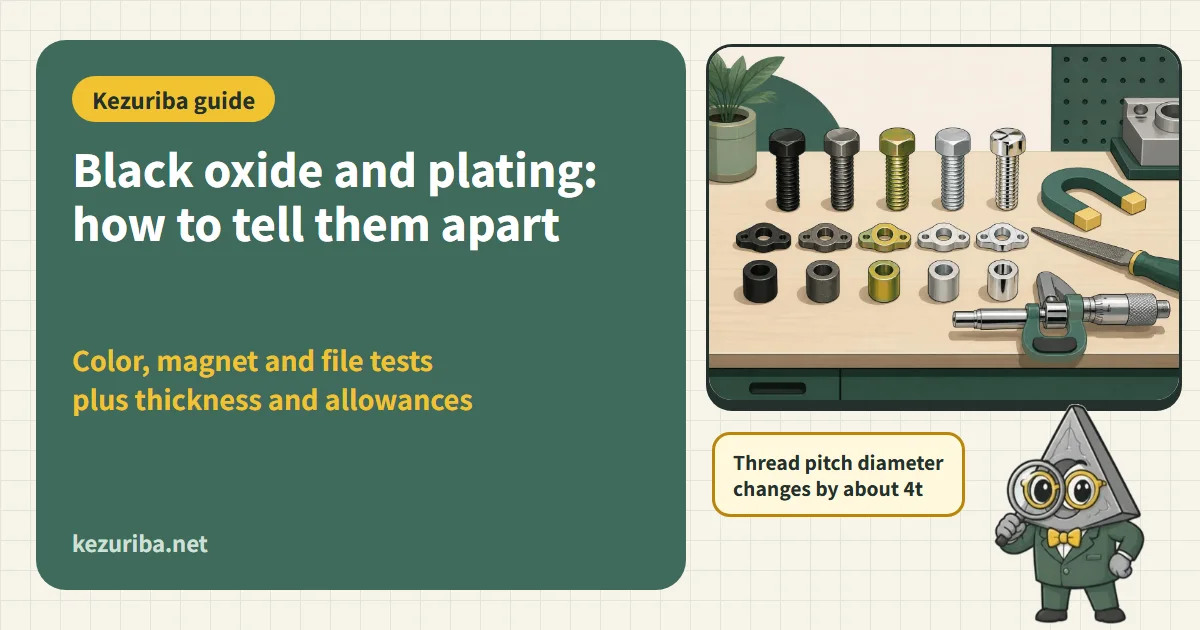
Cutting conditions for difficult-to-cut materials common in defense work: Materials database, hole and fit data: Fits and Tolerances, and dimensional change from surface treatment: How to tell black oxide from plating, and how dimensions change.
Sources
- Ministry of Defense, Defense of Japan 2026 (white paper), Part IV, Ch. 1, Sec. 2: The environment surrounding Japan's defense production and technology base
- ATLA, “Promoting entry into the defense industry” (New Entrant Consultation Desk, Defense Industry Participation Promotion Expo, Fast-Pass Procurement)
- ATLA, “Defense Industry Participation Promotion Expo DIPEX2026” exhibitor application guidelines
- Ministry of Finance, “FY2026 Defense-Related Expenses” (government draft, PDF)
- Ministry of Defense, “Defense Buildup Program,” XIII Required Expenses
- Ministry of Defense, Defense of Japan 2026 (white paper), Part IV, Ch. 2, Sec. 1: Strengthening the defense production base
- ATLA, “Introduction to the system in which the state pays necessary costs once a business plan for ensuring stable production of defense equipment is certified” (PDF)
- ATLA, “Measures under the Act on Strengthening the Defense Production Base”
- ATLA, “Overview of measures under the Act on Strengthening the Defense Production Base” (May 2026, PDF)
- House of Representatives, Committee on Security, 221st Diet session, No. 5 (Apr 24, 2026), minutes
- ATLA, “Establishment of the Defense Industry Cybersecurity Standard”
- ATLA, “Frequently asked questions on the information security standard” (Oct 2024, PDF)
- ATLA, “Establishment of the Defense Industry Security Manual”
- Ministry of Defense, Specification DSP Z 9008 “Common Specification for Quality Management” (revised Sep 25, 2024, PDF)
- Ministry of Defense, “Qualification to participate in tenders”
- ATLA, Public Notice No. 143 (Sep 11, 2026, PDF)
- Procurement Portal, “Qualification to participate in competitions (Unified Qualification for All Ministries and Agencies)”
- Procurement Portal, “Valid qualifications and review acceptance periods”
- Procurement Portal, “Scores and grades in qualification review” (Annex, PDF)
- Procurement Portal, “Unified qualification review application: instructions for completion” (PDF)
- Procurement Portal, “Open counter”
- Ground Self-Defense Force, “Implementation guidelines for the open counter method” (PDF)
- ATLA Directive No. 39, “Directive on supervision and inspection of goods procured through central procurement” (PDF)
- Society of Japanese Aerospace Companies (SJAC), Japan Aerospace Quality Group (JAQG), “JIS Q 9100 certification scheme”
- JAQG, “On the costs of maintaining and improving the Japanese domestic certification scheme” (PDF)
- Performance Review Institute, "Nadcap"
- ATLA, “Special contract clauses on ensuring information security in the procurement of defense equipment and services” (2025 edition, PDF)
- e-Gov Law Search, “Act on Strengthening the Defense Production Base” (Act on the Foundation for the Development and Production of Defense Equipment Procured by the Ministry of Defense; Act No. 54 of 2023)
- e-Gov Law Search, “Act on the Protection and Use of Critical Economic Security Information” (Act No. 27 of 2024)
- Cabinet Office, “Act on the Protection and Use of Critical Economic Security Information”
- Ministry of Economy, Trade and Industry, “Three Principles on Transfer of Defense Equipment and Technology”
- Ministry of Economy, Trade and Industry, “Export control classification”
More articles
 Industry
How a Metalworking Company Can Enter Aircraft Parts Machining: 4 Entry Routes, JIS Q 9100, First Article Inspection, Nadcap, Export Control, Hurdles
 News
NewsTungsten Price Surge and Carbide Tools: China's Export Controls, Price Trends, Toolmakers' Price Increases, Recycling, Alternative Grades and Shop-Floor Countermeasures (2026 Edition)
 Surface treatment