Two New Fixes for Gear Skiving's Weak Points: Nachi-Fujikoshi's Air Skiving and Liebherr's SkiveFinishing, Illustrated
Cooling too much can crack the edge! The key is how you handle heat and chips.

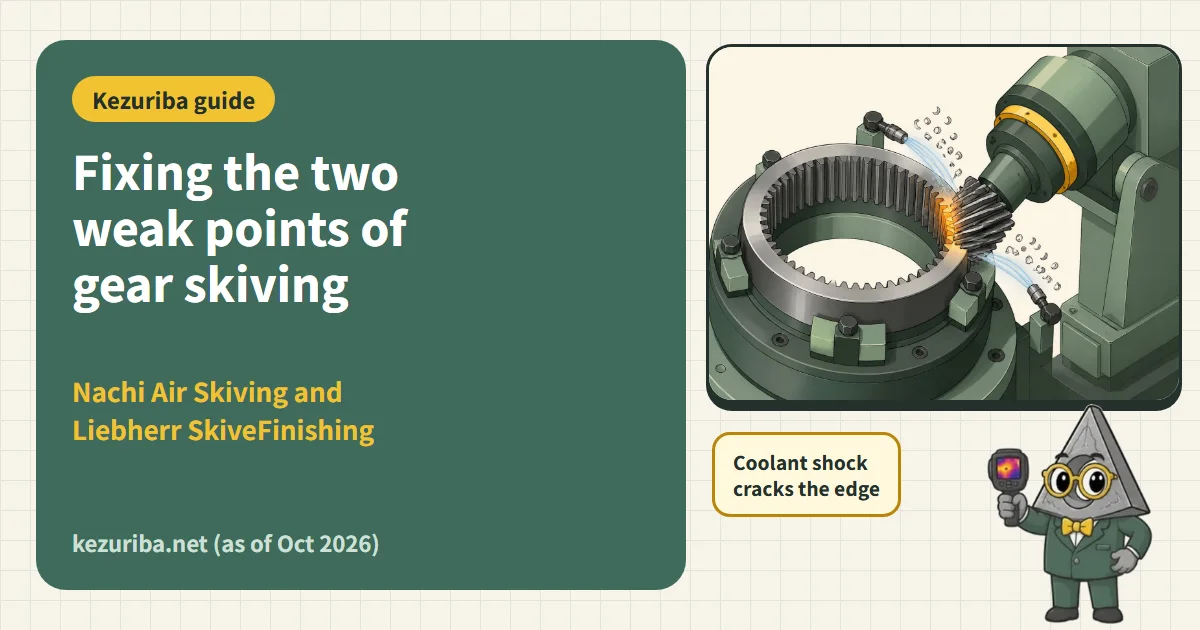
Gear skiving has spread through automotive, construction machinery and reducer plants as a way to cut internal gears about 3 times faster than gear shaping. On the shop floor, though, two weak points are well known: "tools wear out fast", "it is hard to use on internal gears after hardening". In 2025, new technologies aimed at each of these two problems appeared in Japan and Germany. Nachi-Fujikoshi's "Air Skiving System", which drops cutting oil and blows chips away with air, and Liebherr's "SkiveFinishing", which finishes hardened tooth flanks with electroplated cBN abrasive grains instead of cutting edges. This article first checks with research why the weak points arise, then looks at how the two technologies work and their numbers in diagrams (as of October 2026).
A Quick Review of Gear Skiving
In gear skiving, a pinion-shaped cutter and the workpiece are set with their axes crossed at an angle. The two are rotated in sync at a fixed ratio while the cutter is fed along the axis to cut the teeth. Crossing the axes creates a sliding velocity between the cutting edge and the tooth flank, and that becomes the cutting speed[6]. Unlike hobbing, it can cut internal gears, and unlike gear shaping it does not reciprocate, so it is fast. Nachi-Fujikoshi says that replacing gear shaping with skiving, machining time is about one third of the original[2][3]. Machines that combine turning and drilling in one unit have also become more common.[3].
It is a tough job for the edge, however. Between entering and leaving the tooth space, the edge direction (working rake angle) changes a lot, and in a simulation example it swings to the negative side from −1.2° to −47°. At the start of the cut the clearance angle is also small, a condition that easily leads to wear and chipping[6]. The cutter shape changes the cutting force: in Saga University's measurements, a conical cutter gave a smaller cutting force than a cylindrical one[7]. JTEKT built a program that calculates the cutting state during machining to select tools and conditions, and confirmed that it matches how wear actually appears on real tools[8].
Weak Point 1: Short Tool Life: Thermal Shock and Chips
In skiving, the edge enters and leaves the tooth space, so it is interrupted cutting. The edge heats up while cutting and cools while it idles. If cutting oil is applied, the edge is cooled suddenly every cycle, and the large temperature difference pulls on the surface, creating comb cracks that eventually lead to chipping. Nachi-Fujikoshi also explains that thermal shock from interrupted cutting with coolant shortened tool life and made running cost a problem[2].
Research Shows Dry Lasts Longer
A research group at Karlsruhe Institute of Technology (KIT) in Germany skived quenched and tempered 31CrMoV9 internal gears with AlCrN-coated carbide single-edge tools and compared dry cutting with cutting oil (tool life was defined as a flank wear width of 60 µm)[5].
- Material with 1,200 MPa tensile strength: In dry cutting, wear progressed evenly and slowly with no chipping or cracks, and tool life was 1.5 to 3 times that with oil[5]
- Harder material at 1,400 MPa: The tool chips easily and fails suddenly from a crater on the rake face, but dry cutting delayed failure and extended tool life by 50 to 150% in this test[5]
- Raising cutting speed from 100 to 140 m/min did not cut tool life much[5]
- However, as wear progresses, dry cutting leaves a rougher surface finish[5]
So should everything go dry? For internal gears, another problem appears. Cutting oil no longer washes chips away, so chips stick to the inside of the gear and the cutter catches them, wearing out even faster[1][4].
Nachi-Fujikoshi's "Air Skiving System"
The Air Skiving System that Nachi-Fujikoshi launched in August 2025 keeps the benefits of dry cutting and solves the chip problem with air. It can be fitted to the company's GMS series skiving multitasking machines, and the company says it works for external gears, internal gears, stepped gears and blind-hole shapes[1].
- Air unit: An external nozzle and an air cap together create the airflow[1]
- Dry skiving cutter: A highly wear-resistant tool material (FAXG1) with the new, more heat-resistant coating Hyper DS1 (AlCrXN-based multilayer film, with a surface smoothing treatment)[2][4]
Cutter life goes from 50 parts in skiving with water-soluble cutting oil to 330 parts dry, more than 5 times, and more than 2.5 times oil-based gear shaping (120 parts). Even after adding the electricity for air, the pump, oil temperature controller and oil disposal are no longer needed, so whole-plant CO2 falls from 6.0 t to 3.5 t a year, a 41% reduction, according to Nachi[2]. The sales target is 15 units a year[1]. All figures are manufacturer test values.
Weak Point 2: Internal Gears After Hardening
Internal gears distort in hardening, so to raise accuracy they must be finished after hardening. Cutting hard teeth of around 60 HRC with cutting edges is hard skiving. It can remove distortion in a short time, but the edge wears fast and it has been seen as limited in accuracy and surface finish[11][9].
Recent examples of hard skiving
- A trial that sharply cut the reject rate: According to Liebherr's customer magazine, in a trial on an internal gear, hard skiving after hardening brought the reject rate, which had been up to 30%, to almost zero (a trial with Eaton)[10]
- A PCBN tool in series production: A 2026 Gear Solutions article reports an electric-vehicle internal gear (module 1 to 2, diameter 120 to 250 mm) at 81 seconds per part, with Ra under 0.1 µm and Rz under 0.6 µm, and runout of 80 to 160 µm after hardening brought under 20 µm for ISO grade 5. For a plug-in hybrid gear, with an average stock allowance of 55 µm, it takes 36 seconds per part, averages 2,700 parts per resharpening, and has a tool cost of 1.5 dollars per part[9]
Liebherr's "SkiveFinishing"
Liebherr describes finishing hardened internal gears as a choice between "hard skiving, which is fast but limited in accuracy" and "profile grinding, which gives the best accuracy but takes time and money", and fills the gap between them with SkiveFinishing. It keeps the same motion as skiving but swaps the tool for an electroplated cBN tool that needs no dressing. It was first shown in September 2025 at the EMO trade fair in Hanover, Germany[11].
- Tools): The tool is ball-shaped and has several usable positions (shift positions). It is fed axially along the contact line, and when one position wears, it shifts to the next. Roughness can be adjusted by the cBN grain size[11]
- Flank modification: Tip relief, crowning and lead modification can be applied directly to internal gears too (before, this needed time-consuming profile grinding or special dressing)[11]
- Strength: High residual stress remains in the tooth flank, which the company says raises flank strength[11]
- Tool reconditioning: Fully worn tools are reconditioned at its Ettlingen plant in Germany[11]
- Accuracy: In first tests on the company's LK 280 and LK 500 skiving machines, ISO 1328 grade 5 and Ra under 0.4 µm[13]
The 2026 customer magazine says Liebherr has finished confirming what is achievable and is now optimizing with a major customer under series-production conditions[12]. Aircraft, quiet transmissions for electric vehicles, and planetary gears for trucks and tractors are listed as the main applications[11].
Comparing the Two Technologies
| Air Skiving System (Nachi-Fujikoshi) | SkiveFinishing (Liebherr) | |
|---|---|---|
| Weak point it solves | Tool life (thermal shock, chip jamming) | Accuracy and surface finish after hardening |
| Gear being cut | Before hardening (e.g., SCM420) | Internal gears after hardening |
| Tools | Cutter in highly wear-resistant material (FAXG1) + Hyper DS1 coating | Electroplated cBN tool (ball-shaped, with shift positions) |
| Cutting fluid | Not used (dry + air) | (Not stated in the material) |
| Numbers | Cutter life over 5 times, machining time about 1/3 of gear shaping, 41% less CO2 | ISO grade 5, Ra under 0.4 µm (early tests) |
| Tool care | Regrind and reuse | No dressing; reconditioned at the plant when worn |
| Status | On sale since August 2025, fitted to the GMS series | First shown September 2025, being optimized for series-production conditions |
Sources: Nachi-Fujikoshi's materials[1][2], Liebherr's materials[11][12][13]. All figures are the manufacturers' announcements.
What it means on the shop floor
- If a tool chips, first suspect thermal shock from cutting oil. Research also confirms that dry cutting extends tool life
- If you go dry, plan chip escape paths and air direction together for internal gears
- Dry cutting leaves a rougher surface as wear progresses, so set the replacement point by surface roughness too
- Dropping cutting oil cuts the cost and CO2 of pumps, the oil temperature controller and waste oil
- The options now include profile grinding, honing, generating grinding with polishing, hard skiving and SkiveFinishing
- Choose by the amount of heat-treatment distortion (stock allowance), the required grade and roughness, and the quantity
- With SkiveFinishing, tool reconditioning is done at an overseas plant, so count that in running cost and lead time
- Both are new technologies, so confirm with test cuts on your own gears
FAQ
- Should skiving go fully dry?
- The results are favorable for tool life[5][2]. With internal gears, however, chips tend to stick, and surface finish tends to get rougher as wear progresses, so you need to decide chip handling and the tool replacement point together[5][4].
- Can Air Skiving be added to a skiving machine I already have?
- The announcement says it can be fitted to Nachi-Fujikoshi's GMS series skiving multitasking machines[1]. Fitting it to other machines is not described in the material, so check with the manufacturer.
- How is SkiveFinishing different from grinding?
- It is like grinding in that abrasive grains do the cutting, but instead of one tooth at a time as in profile grinding, it finishes the teeth continuously with the skiving motion. The tool is not dressed; when it wears, the position is shifted, and in the end it is reconditioned at the plant[11].
- How do I choose between hard skiving and SkiveFinishing?
- Hard skiving cuts with cutting edges (carbide or PCBN) and is fast and economical. SkiveFinishing is described as a method that aims for higher accuracy and a finer surface than that[11][9].
For a way to polish hardened internal gears to a mirror finish by generating grinding, see the article on polishing internal gears. For gear machining methods including skiving, see Gear machining methods. For how to think about tool life, see the tool life article.
Sources
- Nachi-Fujikoshi, "Air Skiving System launched: longer skiving tool life in a dry environment" (2025-07-31, PDF; Japanese)
- Nachi-Fujikoshi, "Air Skiving System: lower machining cost and environmental load" (January 2026, PDF; Japanese)
- Nachi-Fujikoshi, "GMS series skiving gear shaping center" (PDF; Japanese)
- MONOist, "Longer life for dry gear machining, with chip jamming suppressed" (2025-09-03; Japanese)
- T. Arndt, J. Klose, M. Gerstenmeyer, V. Schulze (KIT wbk), "Tool wear development in gear skiving process of quenched and tempered internal gears", Forschung im Ingenieurwesen (2021, doi:10.1007/s10010-021-00544-0)
- "The Simulation Analysis of Cutting Characteristics and Chip Formation Mechanism in Gear Skiving", Applied Sciences 14(24) 11635 (MDPI, 2024)
- "A study on cutting force measurement in gear skiving", Proceedings of the 2023 Autumn Meeting of the Japan Society for Precision Engineering (J-STAGE; Japanese)
- JTEKT Engineering Journal No. 1021, "Development of cutting state analysis technology during gear skiving" (Japanese)
- A. Hilligardt, C. Leonhardt, M. Zimmer, "Hard gear skiving with high-performance tools: An innovative technology for future drivetrains", Gear Solutions (2026-03-14)
- Liebherr, "Hard-fine machining – a cost effective process for internal gears and splines" (customer magazine Evotion 25)
- Liebherr, "SkiveFinishing®: precision hard machining of internal gears with innovative CBN tools" (Japanese)
- Liebherr, "SkiveFinishing®: Innovative Hard Finishing of Internal Gears" (customer magazine Evotion 26)
- Motion + Power Manufacturers Alliance, "SkiveFinishing® – Introduction of a new hard finishing process for internal gears" (webinar abstract, 2026)
More articles
 Industry
Machining for the Semiconductor Industry: Types of Machining, Large to Small Parts, Major Japanese Companies, Machine Tools and Cutting Tools, New Technologies, How to Enter
 Gears
GearsPolishing Internal Gears: A Mass-Production Method Using Generating Grinding Kinematics (Nidec Machine Tool x RWTH Aachen), Explained with Figures
 Industry