Gear cutting methods compared
Ten ways to make gear teeth, compared by which gears they can produce, accuracy, before or after hardening, and productivity. Each item cites the machine-tool and tool makers’ published technical data and journals.
▦At a glance
| Method | External | Internal | Shoulder | Helical |
|---|---|---|---|---|
| Gear hobbing | ○ | × | △ | ○ |
| Gear shaping | ○ | ○ | ○ | ○ |
| Power skiving | ○ | ○ | △ | ○ |
| Gear shaving | ○ | △ | △ | ○ |
| Threaded wheel (generating) gear grinding | ○ | △ | △ | ○ |
| Profile (form) gear grinding | ○ | ? | ? | ? |
| Broaching | △ | ○ | △ | △ |
| Rack-type gear planing | ○ | ? | ? | ○ |
| Gear honing | ○ | ? | △ | ? |
| Gear / spline rolling | ○ | ? | ? | ? |
○ yes △ with conditions / partly × no ? not confirmed in public sources. The marks are a rough guide taken from the descriptions below; see each method for the reasons and conditions.
Printed from Kezuriba (kezuriba.net/en/gears/methods/)
⚙Gear hobbing
- Principle
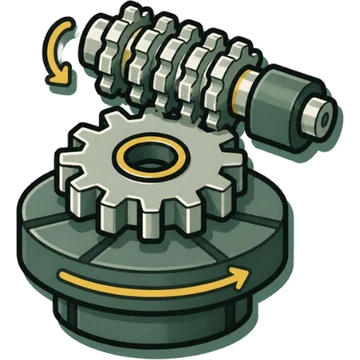
- Continuous cutting in which a threaded hob (virtual rack) and the workpiece rotate in sync and the hob is fed along the face width of the workpiece to generate the tooth profile. For each hob revolution the workpiece advances by as many teeth as the number of hob starts.[1][2][3]
- External gears
- Yes (spur and helical gears. Hobs also exist for splines, sprockets, worm wheels and non-involute profiles)[1][4][5][6]
- Internal gears
- No (the tool interferes). Internal gears are cut by gear shaping, broaching or skiving[7][8]One source / reference
- Shoulder gears
- Not possible for stepped gears where the tool interferes. Cut with a gear shaper[7]One source / reference
- Helical gears
- Yes (swivel the hob head. For helical gears the feed is applied axially, and the actual feed is feed ÷ cos(helix angle))[9][7]
- Accuracy
- Economic guideline (old JIS B 1702): old grades 4–8 for cutting non-hardened gears, old grades 6–8 for gears cut after hardening (guide: new JIS ≈ old JIS + 4 grades). On high-accuracy machines, an example of pitch accuracy equivalent to ISO grade 0 with the GE15FR Plus. AA-class hobs are for finishing at DIN grades 6–7, A class for pre-grinding[10][11][12][9]One source / reference
- Before / after hardening
- Usually before hardening (soft machining). For small gears after hardening, finishing with carbide hobs (skive hobs) is used[7][13][5]
- Productivity
- Because the cutting is continuous, it is the most efficient of the gear cutting methods and is widely used in mass production. Multi-start hobs raise efficiency but increase polygonal error[1][14][7]
- Tools
- Hobs (solid, assembled/brazed, multi-start; HSS, PM-HSS, carbide)[1][13][6]
- Machines
- Hobbing machines (vertical, horizontal; dry-cut capable). Examples: Nidec GE/G series, Kashifuji KN/KE/KA/KL, Gleason Genesis H[15][16][17][18]
⚙Gear shaping

- Principle
- A gear-shaped pinion cutter meshes with the workpiece and both rotate in sync while the cutter reciprocates along the helix direction to generate the teeth. No cutting on the return stroke[19][2][7]
- External gears
- Yes[2][20]
- Internal gears
- Yes (the main method for internal gears that cannot be hobbed)[7][8][2][20]
- Shoulder gears
- Yes (stepped gears, shouldered gears)[7][8]One source / reference
- Helical gears
- Yes. Normally a helical guide matching the cutter lead is required. Some machines are guideless through NC[19][21][7]
- Accuracy
- Examples: profile new JIS N6, helix N4 (SE25A; the same after 4000 pieces with the pinion cutter). A figure in an internal gear comparison shows about ISO grade 6. High-accuracy SE25FR gives pitch equivalent to ISO grades 2–3[7][19][8][22]
- Before / after hardening
- Before hardening (soft machining)[7][8]One source / reference
- Productivity
- Machining time is long because of the reciprocating motion, so productivity is lower than hobbing and skiving. In the internal gear comparison, cycle 180 s (super skiving 90 s)[19][8]
- Tools
- Pinion cutters (disk type, bell/hub type, shank type, deep counterbore type)[20][4][23]
- Machines
- Gear shapers. Examples: Nidec SE/ST/S/SE25FR, Gleason GP/P series, Liebherr LS[21][24][25][23]
⚙Power skiving

- Principle
- A continuous rotary machining process in which a pinion-type cutter and the workpiece are set at an axis crossing angle and rotated in sync; cutting results from sliding at the contact point[8][26][27][23]
- External gears
- Yes[23][28][29]
- Internal gears
- Yes (adopted especially for high-efficiency machining of internal gears)[8][27][23]
- Shoulder gears
- Possible even for stepped and blind-hole shapes (avoiding interference is a condition)[27][28][23]
- Helical gears
- Yes (example: internal gear, helix angle 20°)[8][27]
- Accuracy
- Pinion skiving is described as ISO grades 4–5. Machining example: profile deviation 7 µm (new JIS grade 6). Some sources say 1–2 grades better than gear shaping[8][27][23]One source / reference
- Before / after hardening
- Mainly before hardening. Hard skiving after hardening is also presented by several makers[29][30]
- Productivity
- 2–5 times faster than gear shaping (Liebherr), 2 times or more (Nachi-Fujikoshi). Tool life is cited as an issue; improved in some cases with multi-edge, barrel-shaped super skiving cutters[23][27][8]
- Tools
- Skiving cutters (conical, cylindrical; disk, bell, shank types; PM-HSS, carbide, indexable)[23][4][27]
- Machines
- Skiving machines. Examples: Nidec MSS300, Nachi-Fujikoshi GMS450, Kashifuji KPS21/30, Liebherr LK, Gleason 100PS–800PS[31][30][32][33][29]
⚙Gear shaving
- Principle
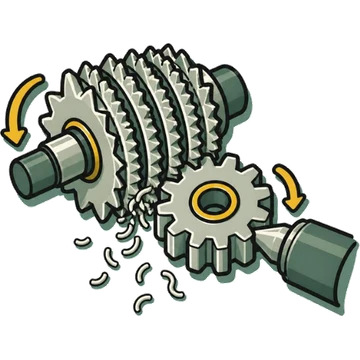
- A finishing process in which a shaving cutter with fine serrations on the tooth flanks meshes with the workpiece at an axis crossing angle (5°–15°) and both rotate, removing a small amount by sliding on the flanks[34][10]
- External gears
- Yes (methods: conventional, diagonal, underpass, plunge)[34][4][35]
- Internal gears
- Yes with a dedicated cutter (Nachi-Fujikoshi internal shaving, Gleason internal gear cutters)[36][35]
- Shoulder gears
- Where an adjacent step prevents an axis crossing angle, handled with the underpass method, etc.[34]One source / reference
- Helical gears
- Yes (example products with a cutter helix angle up to 45°)[23][34]
- Accuracy
- Guideline (old JIS): old grades 1–6 for non-hardened gears; after hardening, old grades 3–7 because of heat treatment distortion. Synchronized shaving also improves pitch accuracy[10][7]One source / reference
- Before / after hardening
- Before hardening only (after hardening, use gear grinding). Profile modification that allows for heat treatment distortion is applied beforehand[34][7]
- Productivity
- Can be mass-produced at relatively low cost; used for finishing automotive and construction machinery gears. The plunge method offers high efficiency and long life and is common on mass production lines[34]One source / reference
- Tools
- Shaving cutters (for external and internal gears; HSS, PM-HSS, fine-grain carbide)[34][35][23]
- Machines
- Shaving machines. Examples: Nidec FE30A, synchronized shaving machine FS30A, Gleason 200SVP, ZS(E)150T[37][7][35]
⚙Threaded wheel (generating) gear grinding
- Principle
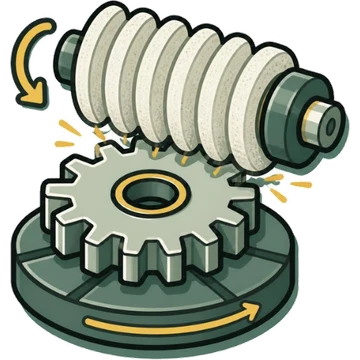
- A threaded wheel and the workpiece rotate in sync for generating grinding (shift grinding)[7][38][10]
- External gears
- Yes[38][39]
- Internal gears
- For internal gears, a dedicated machine with a barrel-shaped threaded wheel (Nidec ZI25A, modules 1–3)[40][8]
- Shoulder gears
- Difficult for small-diameter gears where the wheel interferes; finishing with carbide hobs after hardening is used[7]One source / reference
- Helical gears
- Yes (wheel head swivel ±45°)[38]One source / reference
- Accuracy
- Examples: profile JIS N1, helix N0 (ZE16C/26C); profile and helix new JIS grade 1 (ZE15A). Guideline for grinding in general: old grades 0–5[38][7][10]
- Before / after hardening
- Finishing after hardening (removes heat treatment distortion)[7][11]
- Productivity
- High accuracy, but more processes and higher cost. An example of non-cutting time of 6 s on a production machine[7][38]One source / reference
- Tools
- Threaded wheels (conventional abrasive, CBN), dressers[38][7][23]
- Machines
- Generating gear grinding machines. Examples: Nidec ZE16C/26C/40A, Gleason Genesis GX[38][39]
⚙Profile (form) gear grinding
- Principle
- Grinds one tooth space at a time with a disk-shaped wheel dressed to the tooth space profile (form grinding method)[10][7]
- External gears
- Yes (up to large gears)[41][42]
- Internal gears
- Could not be confirmed in public sourcesNot confirmed in public sources
- Shoulder gears
- Could not be confirmed in public sourcesNot confirmed in public sources
- Helical gears
- Could not be confirmed in public sourcesNot confirmed in public sources
- Accuracy
- Guideline for grinding in general: old grades 0–5 (no distinction between form and generating)[10]One source / reference
- Before / after hardening
- Finishing after hardening[10][7]
- Productivity
- No specific value could be confirmed in public sourcesNot confirmed in public sources
- Tools
- Form wheels (such as CBN electroplated form discs)[23]One source / reference
- Machines
- Form gear grinding machines. Examples: Nidec ZG1000/ZGA1200–2000 (max module 35), Gleason P400G–P6000G, TITAN[41][7][42]
⚙Broaching
- Principle
- A long tool (broach) with a rise per tooth is pulled (or pushed) through a pilot hole to finish the form in a single pass. Internal broaches are for inner surfaces and surface broaches for outer surfaces[43][44][45]
- External gears
- Outer forms (gears, turbine blade slots, etc.) with surface broaches[43][46]
- Internal gears
- Yes (spline holes, internal gears; internal helical gears with helical broaches)[43][8][47]
- Shoulder gears
- No for stepped internal gears and large internal gears[8]One source / reference
- Helical gears
- Yes with helical broaches[8][47]
- Accuracy
- Ratings differ in comparison tables: "medium, accuracy hard to adjust" (Mitsubishi) versus "◎" (Nachi-Fujikoshi)[8][30]One source / reference
- Before / after hardening
- Before hardening[30]One source / reference
- Productivity
- Very high (the workpiece only moves up and down). Equipment cost and initial tooling cost are high[8][30]
- Tools
- Internal broaches (round, spline, serration, square, helical), surface broaches, fir-tree broaches[43][47][46]
- Machines
- Broaching machines (vertical, etc.). Examples: Nachi-Fujikoshi broaching machines, KHK vertical broaching machine VPD208M[48][49]
⚙Rack-type gear planing
- Principle
- A rack-type cutter reciprocates while the blank is rolled to generate the teeth. The cutter shape is a simple straight line[2][50]
- External gears
- Yes (spur and helical gears)[10][50]
- Internal gears
- Could not be confirmed in public sourcesNot confirmed in public sources
- Shoulder gears
- Could not be confirmed in public sourcesNot confirmed in public sources
- Helical gears
- Yes (the helix angle can be set directly)[50]One source / reference
- Accuracy
- No accuracy grade guideline could be confirmed in public sourcesNot confirmed in public sources
- Before / after hardening
- Before hardening[50]One source / reference
- Productivity
- Could not be confirmed in public sourcesNot confirmed in public sources
- Tools
- Rack cutters (JIS has two types: Maag and Sunderland)[50]One source / reference
- Machines
- Gear planers (rack-type gear cutting machines)[2][10]
⚙Gear honing
- Principle
- A gear-shaped abrasive (honing ring) meshes with the workpiece to finish the tooth flanks[51][7]
- External gears
- Yes (gears and shafts; the two gears of a stepped pinion in one chucking)[51]One source / reference
- Internal gears
- Could not be confirmed in public sourcesNot confirmed in public sources
- Shoulder gears
- An example of finishing a stepped pinion in one operation with two honing rings[51]One source / reference
- Helical gears
- Could not be confirmed in public sourcesNot confirmed in public sources
- Accuracy
- No accuracy grade guideline could be confirmed in public sourcesNot confirmed in public sources
- Before / after hardening
- After hardening (to improve surface roughness after gear grinding, or as finishing after shaving)[7]One source / reference
- Productivity
- No specific value could be confirmed in public sourcesNot confirmed in public sources
- Tools
- Honing wheels (honing rings), dressing gears[51][4]
- Machines
- Gear honing machines. Examples: Gleason 260HMS (max diameter 270 mm, module 6), Mitsubishi synchronized honing machine ZS25A[51][7]
⚙Gear / spline rolling
- Principle
- Plastic forming in which a die or rack presses the blank and raises the teeth (no chips are produced)[10][52]
- External gears
- Yes (splines, small-module worms, etc.)[10][52][23]
- Internal gears
- Could not be confirmed in public sourcesNot confirmed in public sources
- Shoulder gears
- Could not be confirmed in public sourcesNot confirmed in public sources
- Helical gears
- Could not be confirmed in public sourcesNot confirmed in public sources
- Accuracy
- An example of cumulative pitch at JIS B 1603 grade 5 with a forming rack for high-precision splines. The tooth flanks are mirror-finished[52][10]One source / reference
- Before / after hardening
- Before hardening (formed in the blank state)[52]One source / reference
- Productivity
- An example of cost reduction by replacing other processes[52]One source / reference
- Tools
- Forming racks (flat dies), rolling rolls, rolling racks and rolling dies[52][10][23]
- Machines
- Rolling machines (Nachi-Fujikoshi, etc.)[48]One source / reference
⚙Related
📚Sources
Values without a mark agree in at least two sources from different publishers. Where sources disagree, both views are given rather than choosing one.
- Nidec Machine Tool — Precision cutting tools | Hobs (product page)
- Kohara Gear Industry (KHK) — Generation of involute gears (gear technical data)
- Seimitsu Kikai (Journal of the Japan Society of Precision Engineering) Vol. 29, No. 1 (1963) — Morozumi: Effect of errors during hobbing on gear accuracy (J-STAGE)
- Kyushu Seimitsu Kogyo — Products
- DTR — 공구사업 HOB
- Gleason — Hobs & Milling Cutters
- Mitsubishi Heavy Industries — Mitsubishi Heavy Industries Technical Review Vol.43 No.3 (2006) Gear machining machines and precision cutting tools supporting the production of automotive transmission gears
- Mitsubishi Heavy Industries — MHI Technical Review Vol.52 No.1 (2015) MHI Super-Skiving System for Longer Tool Life and Enhanced Efficiency in Internal Gear Cutting
- Gear Technology India — V. Kothari, Guiding Principles for Defining Gear Hobbing Processes in New Part Development
- Kyoiku Gear Industry (KG) — Technical data (PDF, 176 pages: gear basics, profile shift, contact ratio, tooth thickness measurement, accuracy, calculations for various gears)
- Kohara Gear Industry (KHK) — Accuracy of spur and helical gears
- Nidec Machine Tool — High-accuracy hobbing machines, GE15FR series
- Kyushu Seimitsu Kogyo — KSK precision cutting tools general catalog (PDF)
- Nidec Machine Tool — Cutting Tool News: Design tips for hobbing cutter starts and flutes (PDF)
- Nidec Machine Tool — Dry-cut hobbing machines, GE series
- Nidec Machine Tool — Hobbing machines, G series
- Kashifuji — Top page (product information)
- Gleason — Machines – Cylindrical gears (category list): hobbing machines (Genesis H series)
- Nidec Machine Tool — Precision cutting tools | Pinion cutters (product page)
- DTR — 공구사업 PINION
- Nidec Machine Tool — Helical-guideless gear shapers, ST series
- Nidec Machine Tool — High-accuracy gear shapers SE25FR/FR Plus, SC40FR
- Liebherr-Verzahntechnik — Precise and productive. Gear tools (brochure PDF)
- Nidec Machine Tool — Dry-cut gear shapers, SE series
- Gleason — Machines – Cylindrical gears (category list): gear shaping machines (GP series)
- Mitsubishi Heavy Industries — Press release: "Mitsubishi Super Skiving System" developed to machine internal gears with a barrel-shaped multi-edge tool (2014)
- Nachi-Fujikoshi (NACHI) — Skiving cutters (product page, Catalog No.2306-2)
- Nachi-Fujikoshi (NACHI) — Air skiving system (dry skiving cutters) (product page)
- Gleason — The Gleason Power Skiving Approach
- Nachi-Fujikoshi (NACHI) — Precision tools: gear cutting tools and broaches, Catalog No.2305 (2016)
- Nidec Machine Tool — Super skiving machine MSS300
- Kashifuji — Product list: gear skiving machines, etc.
- Liebherr-Verzahntechnik — Gear skiving machines (LK series)
- Nidec Machine Tool — Precision cutting tools | Shaving cutters (product page)
- Gleason — Shaving Tools
- Nachi-Fujikoshi (NACHI) — Internal shaving (product page)
- Nidec Machine Tool — Shaving machines, FE series
- Nidec Machine Tool — Gear grinding machines (external teeth), ZE series
- Gleason — Machines – Cylindrical gears (category list): threaded wheel gear grinding machines (Genesis GX)
- Nidec Machine Tool — Internal gear grinding machine ZI25A
- Nidec Machine Tool — Large gear machine tools
- Gleason — Machines – Cylindrical gears (category list): form gear grinding machines (P400G–P6000G, Titan)
- Nidec Machine Tool — Precision cutting tools | Broaches (product page)
- Nachi-Fujikoshi (NACHI) — Group company Nachi Seiko Co., Ltd.
- Nidec Machine Tool — Cutting Tool News: BROACH TOOL / Types and Applications
- DTR — 공구사업 브로치
- Nachi-Fujikoshi (NACHI) — Off-normal helical broaches (product page)
- Nachi-Fujikoshi (NACHI) — List of gear cutting tools (product information)
- Kohara Gear Industry (KHK) — Production system guide (equipment)
- Bulletin of Hokkaido University of Education (Part II-A) Vol. 19, No. 2 (1969) — Torao Kosaka: On the accuracy of rack-type gear cutting
- Gleason — 260HMS gear honing machine
- Nachi-Fujikoshi (NACHI) — Forming racks for EV component machining, Catalog No.2307