How a Metalworking Company Can Enter U.S. Aircraft Parts Machining: Entry Routes, AS9100D and IA9100, FAA Part 21, First Article Inspection, Nadcap, Export Control, Hurdles
The FAA doesn't approve parts shops directly. Earn trust with AS9100D and your records!

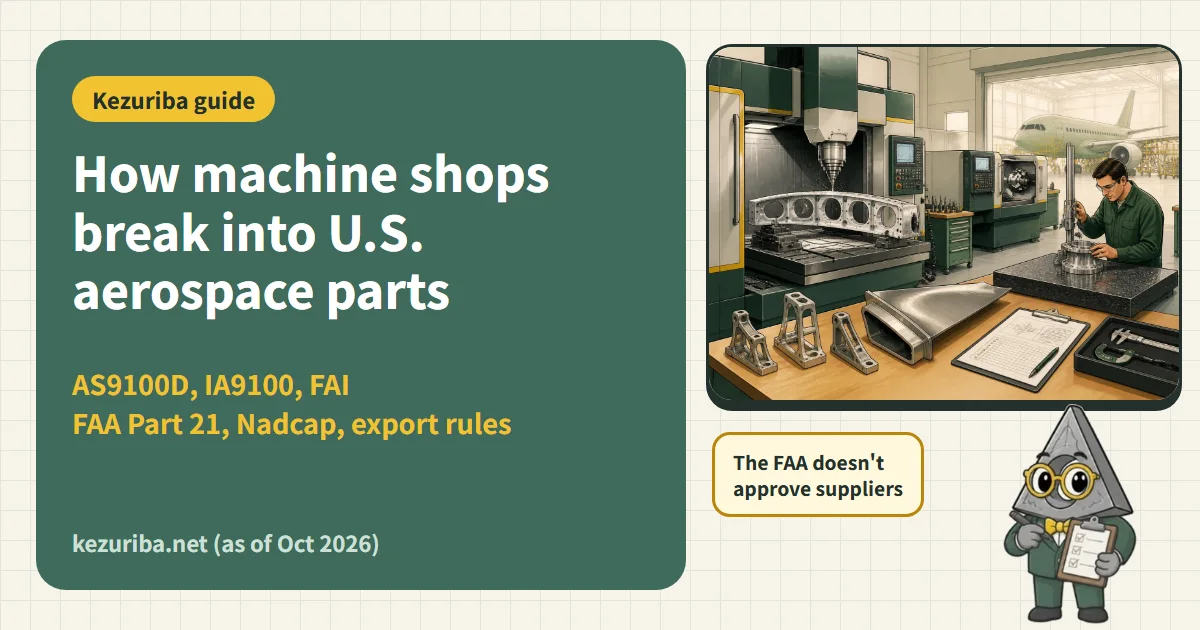
U.S. aerospace and defense industry sales reached $988.6 billion in 2025, and roughly half of that was generated in the domestic supply chain. Aircraft production dropped sharply during COVID and has since come back, but the FAA sees parts supply constraints holding back aircraft deliveries. Still, aerospace is a world where the way you prove quality is completely different from automotive or general machinery. This article walks through entry routes through Tier 2 and 3, special processes and MRO, how to get AS9100D and the move to IA9100, what FAA rules require of parts makers, first article inspection (AS9102), Nadcap, ITAR, EAR and the added requirements for defense work, MEP Centers and state support, the real hurdles in order, based on public materials from AIA, BLS, FAA, IAQG, PRI and others and the text of federal regulations (as of October 2026).
Why look at U.S. aircraft parts now
According to the Facts & Figures report released by the Aerospace Industries Association (AIA) in June 2026, U.S. aerospace and defense industry sales in 2025 totaled $988.6 billion, including $506 billion in direct output and about $483 billion in domestic supply chain activity. Exports were $172.7 billion (up 25% year over year), and the industry supports about 2.1 million jobs, 1.1 million of them in the supply chain[1]. These are trade association figures covering commercial aviation and defense combined.
For data closer to the shop floor, the Bureau of Labor Statistics (BLS) industry productivity program publishes annual output and employment for aerospace product and parts manufacturing (NAICS 3364). Nominal output went from $218.4 billion in 2018 to $158.4 billion in 2021, a drop of about 27%, then recovered to $214.1 billion in 2025. Employment bottomed out at 483,000 in 2021 and stood at 576,000 in 2025[2][3].
On the demand side, the FAA's FY2026–2046 forecast expects domestic passengers on U.S. airlines to grow 2.4% a year on average over the next 20 years, while pointing to supply chain constraints holding back aircraft manufacturers' deliveries as a factor that may persist for the next few years[5]. The Commerce Department's SelectUSA lists MRO (maintenance, repair and overhaul), composites, metalworking, avionics, test equipment and coatings as strengths of the U.S. supply chain[4].
On trade, the Commerce Department opened a Section 232 investigation (Trade Expansion Act) into imports of commercial aircraft, jet engines and parts in May 2025[6], and Presidential Proclamation 11040 of July 9, 2026, while finding that imports threaten to impair national security, decided to hold off on tariffs for now and pursue negotiations with trading partners. It says tariffs or other additional measures remain possible if negotiations fail[7]. This could be a tailwind for domestic parts makers, but the outlook is not settled.
Where to start: Tier 2 and 3, special processes, MRO and PMA
| Route | What it looks like | What you need | Best suited to |
|---|---|---|---|
| A. Subcontract machining (the most common) | Become a supplier to a Tier 1 or 2 and deliver parts and processes to print | Customer audit (quality, equipment, finances). Most require AS9100D | Shops strong in a specific process such as machining, grinding or sheet metal that can manage records |
| B. Special processes | Take on heat treating, chemical processing, NDT, welding, shot peening, etc. | AS9100D (or a Nadcap quality system audit) plus Nadcap accreditation for each process[35] | Shops with processing equipment that can keep process records and run tests |
| C. MRO and PMA | Machine repair and replacement parts under repair stations or companies holding replacement-part approval (PMA) | Controls that follow the customer's quality system (set by FAA rules). Getting your own PMA is a much bigger undertaking | Shops strong in high-mix, low-volume turning and milling and in reverse engineering |
| Getting started | MEP Centers, state economic development offices, industry trade shows and procurement events | A one-page summary of your strengths | A first step for every company |
The “PMA” in Route C (Parts Manufacturer Approval) is one of the FAA's production approvals: a combined design and production approval for replacement and modification parts. It allows you to make and sell parts for installation on type-certificated aircraft, and approved parts can be looked up in the FAA's database (DRS)[8][9]. To get a PMA, you must submit drawings, materials and processes, plus tests and computations showing airworthiness (or proof that the part is identical to the original design), and have a quality system meeting 14 CFR 21.137[10]. Becoming a supplier to a PMA holder first is the realistic path.
How this relates to defense workAerospace and defense are grouped as a single industry, and AIA's figures cover both[1]. The quality system (AS9100D, AS9102) is the same, but if you make military aircraft parts, ITAR registration, cybersecurity (CMMC), DFARS specialty metals restrictions and more come into play (covered later).
AS9100D first: how to get it, what it costs, and the move to IA9100
The aviation, space and defense quality management standard “9100” is ISO 9001 plus industry requirements, published in the U.S. by SAE as AS9100D (revised September 20, 2016). Its content is the same as Europe's EN 9100 and Japan's JIS Q 9100[14][15]. In 2025, 1,792 initial 9100 certifications and 5,301 recertifications were issued worldwide[16].
- Solidify your ISO 9001 system: If your procedures, records, calibration, nonconformance handling and internal audits are already working, you can build AS9100D on top of them.
- Build the added requirements into the system and run it: configuration management, special process control, key characteristics, counterfeit prevention, control of external providers, on-time delivery and quality performance, and so on. PRI recommends running the system for about six months before the certification audit[24].
- Create an OASIS account and choose a certification body: Under IAQG's procedure, the organization sets up a user account in OASIS, IAQG's database, then gets quotes from and contracts with an accredited certification body participating in the IAQG certification scheme (listed in OASIS). Audits follow ISO/IEC 17021-1, 9104/1 and 9101[20]. ANAB, the U.S. accreditation body, is recognized by IAQG to accredit AS9100 certification bodies[21].
- Your certificate is listed in OASIS: Customers can check your certificate and audit results in OASIS, and responses to nonconformities are also handled in OASIS[20].
- Recertify every 3 years: Within the 3-year cycle there is a surveillance audit every year[24].
| Cost item | Amount (where published) |
|---|---|
| Certification body audit fee | Depends on audit days (set by company size and number of sites); no official benchmark → get quotes from several certification bodies |
| OASIS certificate fee | $700 per initial or recertification certificate, $300 for changes such as adding a site. Billed to the certification body[22] |
| IAQG digital fee | $250 per initial, recertification or surveillance audit starting on or after May 15, 2025. Expected to be passed on by the certification body to the certified company[23] |
AS9100D will become “IA9100”The next revision will be named IA9100 under IAQG's new numbering scheme[18]. The underlying ISO 9001:2026 was published on September 16, 2026[19], and IAQG's annual report released in April 2026 shows publication of the revised 9100 scheduled for Q1 2027 in its timeline[16]. As of October 2026, we found no official announcement of a transition deadline in IAQG's news[17]. Publication won't instantly invalidate current certificates; companies normally switch over at a regular audit during a transition period, so if you're just starting, go ahead with AS9100D.
FAA rules: do parts makers need approval?
Legal responsibility for the quality of aircraft parts rests with companies that hold an FAA production approval (airframe and engine manufacturers, PMA holders, etc.). There are three kinds of production approval: production certificate (PC), PMA and TSO authorization[8]. 14 CFR 21.137 requires the holder's quality system to include procedures to ensure that products, parts and services from suppliers conform to the holder's requirements, plus, for nonconformities found after release, procedures for suppliers to report them to the holder[12].
- The FAA does not approve suppliers: FAA Advisory Circular AC 21-43A says “the FAA does not approve suppliers,” but also that it may visit the facilities of the holder and the supplier alike to monitor supplier control[13].
- Responsibility can't be delegated: The holder flows requirements down through all supplier tiers, is responsible for compliance, and cannot delegate its production approval responsibilities to suppliers[13]. That's why audits are strict and purchase terms are detailed.
- Direct shipment only with authorization: Direct shipment from a supplier to the customer is allowed only when the holder authorizes it. The industry guidance is SAE ARP9114[13].
- Record retention: The holder must keep quality records for at least 5 years, or 10 years for critical parts, as required by the rule[12]. Your inspection records and material certs are part of them, and some customers require even longer retention.
- You can't just sell them as replacement parts: Replacement parts for type-certificated aircraft may only be produced under a production approval, as standard parts (bolts, nuts, etc.), by a repair station for use in its own repairs, or under similar exceptions; nothing else may be sold as a part eligible for installation[11].
No making extras from the same drawing to sellIf you make extra parts from a customer's drawing without the customer's direction and sell them to third parties, they are not parts produced under a production approval. If you want to sell replacement parts yourself, the proper route is to get a PMA[11][9].
First article inspection (AS9102) and the standards customers specify
The most labor-intensive part of aircraft parts work is first article inspection (FAI). It goes beyond measuring dimensions: you verify for every characteristic that the planned processes, materials and tooling produce parts to print, and record it on set forms. The standard is 9102; the latest edition is the 2023 revision, AS9102C . There are three forms[25].
| Form | What to record (main items) |
|---|---|
| Form 1: Part number accountability | Part number, drawing revision and work order number; full or partial FAI; for assemblies, a list of detail parts; who verified and who approved |
| Form 2: Materials, special processes, functional tests | Material and process spec numbers, supplier (is it approved?), certificate of conformance (CoC) number, functional test results |
| Form 3: Characteristic accountability | Number (balloon) every characteristic on the drawing; requirement and actual result, gauges used, nonconformance report numbers |
Changed the NC program? Redo FAIOn top of design changes and changes in manufacturing source, process, inspection method, tooling, material or manufacturing location, even when you change the NC program or transfer it to other media, you must redo FAI for the affected characteristics[26]. FAI is also required for characteristics that may be affected when production has stopped for 2 years or more[27]. Even “we switched machines and now it cuts faster” requires notifying the customer and doing FAI first.
| Standard | Details | When required |
|---|---|---|
| AS9145 | Aerospace APQP (Advanced Product Quality Planning) and PPAP (Production Part Approval Process). Confirms you can keep producing conforming parts at the customer's demand rate[28] | When the customer specifies it for a new part launch |
| AS9103 | Variation management of key characteristics[29] | When key characteristics are specified on the drawing or order |
| AS13100 | Aero-engine requirements on top of 9100, 9145, etc. Revised to Rev. A in April 2025[30] | When specified on the purchase order for engine parts |
| AS9146 | Foreign object damage (FOD) prevention. A system to keep chips, tools and rags out of the product[31] | When flowed down by contract |
| AS6174 | Counterfeit prevention for all materiel (material traceability, testing). Rev. B in February 2026[32] | When required in material procurement |
Nadcap and special processes: does a machining-only shop need it?
Nadcap is the industry accreditation program for critical (special) processes, launched by major aerospace manufacturers in 1990 and run by the nonprofit Performance Review Institute (PRI). It covers 24 process areas, with more than 4,500 accredited suppliers and over 60 participating OEMs[33]. Before it, a supplier could face 3–4 audits of the same process, one per OEM; Nadcap was created to consolidate them into one[33].
| Example commodities | Relevance to machine shops |
|---|---|
| Heat treating, chemical processing (plating, anodizing), NDT, welding, surface enhancement (shot peening), coatings | If you have the process in-house, it is a candidate for accreditation. If not, use accredited subcontractors for those processes |
| Nonconventional machining (EDM, etc.) | May apply if you use wire or sinker EDM on aircraft parts |
| Conventional machining as a special process (audit criteria AC7126) | Drilling, broaching, turning, milling, grinding and edge finishing are audited when the customer designates them as special processes. Ordinary machining is not automatically covered |
| Measurement and inspection, materials testing, composites, additive manufacturing, etc. | Depends on your processes and customers |
Nadcap commodities are based on PRI's list[34][33].
- Prerequisite: Use AS9100 as your quality system, or undergo a Nadcap quality system audit (AC7004)[35].
- Timeline: First-time accreditation takes about 6–12 months (2–4 months of preparation, a 2–5 day on-site audit, 1–3 months to close out findings (NCRs), etc.). Audits are usually held 3–6 months after you request a date, and reaccreditation audits typically follow every 12–24 months[35].
- Cost: There is no published fee schedule; you get a quote for each audit scope through PRI's system[35]. For first-timers, the Supplier Support Committee offers free mentoring[35].
- Separate from customer approval: Nadcap accreditation is not customer approval in itself; it is used as one part of the customer's approval process. You can get it even before you have aerospace customers[24].
- Benefits: In PRI's survey, accredited suppliers saw customer audits fall by 40% on average, and 85% felt their quality had improved (a survey by the operator itself)[36].
First steps for a machining shopIf you outsource heat treatment, surface treatment or NDT, use only subcontractors approved by your customer (holding Nadcap, etc.), flow the customer's requirements down in your purchase orders, and make sure the subcontractor's certs can go on FAI Form 2. If there are few accredited processors nearby, shipping farther adds lead time and freight cost, so check candidate subcontractors before you quote.
Export control and the added requirements for defense work
Export controls apply even to parts you sell only domestically, because showing technical data to foreign persons on your staff can count as an “export.”
- Deemed exports (EAR): Releasing controlled technology to a foreign person in the U.S. is deemed an export to that person's most recent country of citizenship or permanent residency[40]. Many commercial aircraft parts fall under the lightly controlled ECCN 9A991 (anti-terrorism controls only), but technology for developing and producing engine hot-section parts (blades, vanes, combustors, etc.) is 9E003 and is controlled for national security reasons[41]. The customer determines the classification of each item, so confirm it when you receive the drawings.
- Deemed exports (ITAR): Releasing military technical data to a foreign person in the U.S. is deemed an export to every country in which that person holds citizenship or permanent residency[39].
- ITAR registration: U.S. businesses that manufactures defense articles must register with the State Department's Directorate of Defense Trade Controls (DDTC) even if they don't export. Even a single production run counts[37]. The fee for a new registration is $3,000 a year.[38].
- CMMC (cybersecurity): The DFARS rule making cybersecurity certification (CMMC) a condition of DoD contracts took effect on November 10, 2025[42]. Requirements also flow down to subcontractors that handle controlled information such as drawings.
- DFARS specialty metals restrictions: Titanium alloys, nickel alloys, steels with alloying elements above set thresholds, and other specialty metals used in items for DoD must be melted in the U.S. or a qualifying country. Mill products such as bar and plate, as well as forgings and castings, are not exempt from this restriction[43]. Make sure you can verify the melt country from mill certs.
If you employ foreign nationals, check firstBefore receiving drawings, ask the customer which controls apply, decide who may view them, and keep the drawing data on separate PCs or folders. If a license is needed, get it before showing them.
MEP Centers and state support
- MEP Centers: NIST's Manufacturing Extension Partnership (MEP) is a public-private partnership supporting small and medium-sized manufacturers. State-designated MEP Centers operate in all 50 states and Puerto Rico, with nearly 1,400 advisors and experts at more than 450 service locations[44]. Federal funding covers half the cost; the rest comes from state and local governments, the private sector and client fees[44].
- An AS9100 assistance example: In a case highlighted by NIST, Indiana's MEP Center used grant funding to support AS9100D internal auditor training and CNC skills training, and the company earned AS9100D in August 2023, meeting its customer's deadline[45].
- A state example (Kansas): Kansas offers aviation tax credits: up to $5,000 a year for qualified new hires, and for employers, 10% of the compensation paid to newly hired qualified employees (up to $15,000 per employee per year for the first five years) and up to 50% of employee tuition reimbursement[46]. A bill extending them through the end of 2036 passed in the 2026 legislative session[47].
State programs differ in name and terms from state to state, and application windows change every year. Check with your state economic development office or local MEP Center before applying.
Order of steps to entry (guideline)
- Write down your strengths that matter in aerospace: Difficult-to-cut materials (titanium, Inconel), thin-wall and large monolithic parts, 5-axis, hole position accuracy, high-mix low-volume work, recordkeeping, and so on.
- Gather information from MEP Centers and state offices: Talk with your local MEP Center about state support and which tiers are looking for what[44].
- ISO 9001 → AS9100D: Get quotes from certification bodies, and run the system for about six months before the audit[24].
- Prototypes and FAI: Undergo the customer's audit and submit prototypes and AS9102 records. Decide your special-process subcontractors and how you will handle export control at this stage.
- Production and growth: Build a delivery and quality track record; then Nadcap if you bring special processes in-house, supplying PMA holders for replacement parts, or ITAR registration for defense.
The real hurdles and how to deal with them
| Hurdle | Details | Example countermeasures |
|---|---|---|
| Demand swings | Aerospace product and parts output fell about 27% from 2018 to 2021, and employment fell about 10% from 2019 to 2021[2][3] | Keep aerospace to part of your sales. Take the work on equipment you can share with other industries |
| Production rate swings | Aircraft deliveries hinge on supply chain constraints[5], and when upstream production plans change, subcontractor orders can rise or fall abruptly | Before signing, ask about the customer's production plan (rate) and how increases and cuts are handled |
| Long road to entry | AS9100D is audited after 6 months of operation[24], and Nadcap takes 6–12 months[35]. Each part needs audits and FAI | Plan cash flow for the first few years. Once in, you can make the same parts for a long time |
| Certification cost and staff | Audit fees are by quote. OASIS charges $700 per certificate, plus $250 per audit[22][23]. Nadcap is also quoted, with reaccreditation every 12–24 months[35] | Use MEP Center training and state assistance. Develop internal auditors in-house[45] |
| High mix and the burden of changes | Every change to an NC program, fixture or machine means redoing FAI[26] | Standardize setups. Plan improvements and submit changes in batches |
| Payment terms and pricing | Payment periods and price adjustment rules depend on each customer's purchase terms (we found no official statistics on industry averages) | At the quoting stage, confirm payment terms, material cost pass-through and volume commitments |
| Trade outlook | Section 232 action on aircraft and parts is still under negotiation; tariffs or other measures remain possible[7] | For processes that rely on imported materials or parts, line up alternative sources |
| Export control and added defense requirements | Deemed exports to foreign-national employees, ITAR registration (from $3,000/yr), CMMC, specialty metals[40][38][42][43] | Start with commercial aircraft; take on defense once your systems are in place |
Companies that fit, and those that should think twice
- You have taken on jobs others turned down: difficult-to-cut materials, thin-walled or large machined parts
- You already manage inspection reports, mill certificates and drawing revisions
- Your culture does not allow changing NC programs or fixtures without authorization
- Willing to spend years getting in, then make the same parts for the long haul
- Have Nadcap-accredited heat treaters and finishers nearby
- You need sales right away, or want a quick payback on equipment
- You have improved by freely changing processes and conditions at the shop floor's discretion
- You plan to make aerospace most of your sales (exposed to demand swings)
- Many foreign-national employees, and no way to restrict drawing access
FAQ
- Can I do aerospace work without AS9100?
- It's not required by law, but because production approval holders are responsible for controlling their suppliers[12], many customers require AS9100D. When they require it varies by customer, so check before you start selling. Nadcap also requires AS9100 or an AC7004 audit[35].
- Do I need FAA approval?
- Not if you machine parts as a subcontractor. The FAA does not approve suppliers; responsibility rests with the production approval holder. However, the FAA may come to monitor a supplier's facility[13]. If you want to sell replacement parts under your own name, you need a PMA[10][9].
- Does a machining-only shop need Nadcap?
- Ordinary machining is not automatically covered. Drilling, turning, milling, grinding and similar operations that a customer designates as special processes are audited under “Conventional Machining as a Special Process” (AC7126)[34]. In most cases, the question you will face first is whether you send heat treatment and surface treatment to accredited subcontractors.
- How much does certification cost?
- Certification body audit fees depend on the number of audit days, and there's no official benchmark. The published fixed costs are the OASIS certificate fee ($700 per initial or recertification certificate) and the $250 digital fee per audit[22][23]. For training, you can consult your local MEP Center[44].
- Can I go after military aircraft parts at the same time?
- The quality system is the same, but manufacturing defense articles requires ITAR registration ($3,000 a year for new registrants) even if you don't export[37][38], and DoD contracts add CMMC[42] and specialty metals restrictions[43]. It's more realistic to build a track record in commercial aviation first.
For cutting conditions for difficult-to-cut materials, see the Materials database; for tool wear, the tool life article; and for 5-axis, the 5-axis machining page, hole and fit data: Fits and Tolerances, and dimensional change from surface treatment: How to tell black oxide from plating, and how dimensions change.
Sources
- Aerospace Industries Association (AIA), “2026 AIA Facts & Figures: U.S. Aerospace & Defense Industry Leads the World with $1 Trillion in Sales” (Jun 25, 2026)
- U.S. Bureau of Labor Statistics (BLS), “Sectoral Output for Manufacturing: Aerospace Product and Parts Manufacturing (NAICS 3364)” (industry productivity statistics, via FRED)
- BLS, “Employment for Manufacturing: Aerospace Product and Parts Manufacturing (NAICS 3364)” (via FRED)
- U.S. Department of Commerce, International Trade Administration, “SelectUSA: Aerospace Industry”
- FAA, “Forecast Overview (2026–2046)”, FAA Aerospace Forecast (PDF)
- Federal Register, “Notice of Request for Public Comments on Section 232 National Security Investigation of Imports of Commercial Aircraft and Jet Engines and Parts for Commercial Aircraft and Jet Engines” (May 13, 2025)
- Presidential Proclamation 11040, “Adjusting Imports of Commercial Aircraft, Jet Engines, and Aircraft and Engine Parts Into the United States” (Jul 9, 2026)
- FAA, "Production Approvals"
- FAA, "Parts Manufacturer Approval (PMA)"
- eCFR 14 CFR Part 21 Subpart K (§21.303, §21.307, Parts Manufacturer Approvals)
- eCFR 14 CFR §21.9 Replacement and modification articles
- eCFR 14 CFR §21.137 Quality system
- FAA Advisory Circular AC 21-43A, “Production Under 14 CFR Part 21, Subparts F, G, K, and O” (PDF)
- SAE, "AS9100D Quality Management Systems - Requirements for Aviation, Space, and Defense Organizations"
- International Aerospace Quality Group (IAQG), “9100 Quality Management Systems”
- IAQG, “2025 Annual Report” (Apr 2026, PDF)
- IAQG, "News"
- NASA Office of Safety and Mission Assurance, “Status of the Development of IA9100” (Apr 2024)
- ISO, "ISO 9001:2026 Quality management systems — Requirements"
- IAQG, “Certification” (the IAQG certification scheme and how to get certified)
- ANSI National Accreditation Board (ANAB), “International Recognition”
- IAQG, “OASIS Fee Schedule - Details & Clarification” (updated Nov 25, 2024, PDF)
- IAQG, “IAQG Digital Innovations” (digital fee)
- Performance Review Institute (PRI), “Frequently Asked Questions”
- IAQG, "9102 Key Changes from Rev B to Rev C" (PDF)
- Society of Japanese Aerospace Companies (SJAC), “SJAC 9102C Aerospace First Article Inspection Requirements” (Japanese edition with the same content as AS9102C, PDF)
- IAQG, “First Article Inspection 9102 FAQs” (PDF)
- IAQG, "9145 Advanced Product Quality Planning and Production Part Approval Process"
- IAQG, "9103 Variation Management of Key Characteristics"
- SAE, "AS13100A AESQ Quality Management System Requirements for Aero Engine Design and Production Organizations"
- IAQG, "9146 Foreign Object Damage (FOD) Prevention Program"
- SAE, "AS6174B Counterfeit Materiel; Assuring Acquisition of Authentic and Conforming Materiel"
- PRI, "The Nadcap Program"
- PRI, "Nadcap Accreditation"
- PRI, "Getting Started with a Nadcap Accreditation"
- PRI, "Nadcap Program Suppliers"
- eCFR 22 CFR §122.1 Registration (ITAR registration)
- eCFR 22 CFR §122.3 Registration fees (ITAR registration fees)
- eCFR 22 CFR §120.50 Export (ITAR deemed exports)
- eCFR 15 CFR §734.13 Export (EAR deemed exports)
- eCFR 15 CFR Part 774 Supplement No. 1, Commerce Control List (ECCN 9A991, 9E003)
- Federal Register, “DFARS: Assessing Contractor Implementation of Cybersecurity Requirements” (CMMC) (Sep 10, 2025)
- eCFR 48 CFR 252.225-7009 Restriction on Acquisition of Certain Articles Containing Specialty Metals
- National Institute of Standards and Technology (NIST), “About NIST MEP”
- NIST MEP success story, “AS9100 Certification Assistance by Purdue MEP Leads to Acquisition of New Client”
- Kansas Department of Commerce, “Kansas Aviation Tax Credits”
- Kansas Legislature, “HB 2464” (extension of the aviation and aerospace tax credits)
More articles
 Gears
GearsPolishing Internal Gears: A Mass-Production Method Using Generating Grinding Kinematics (Nidec Machine Tool x RWTH Aachen), Explained with Figures
 Industry
How a Metalworking Company Can Enter the U.S. Defense Industry: Entry Points, SAM.gov and JCP, ITAR, CMMC, Specialty Metals, Hurdles
 Industry