How a Metalworking Company Can Enter U.S. Medical Device Parts Machining: Market Trends and Hubs, Major OEMs and Contract Manufacturers, FDA Registration and QMSR, ISO 13485, Hurdles
If you only make parts, you don't need FDA registration. But OEM purchasing controls will definitely reach you!

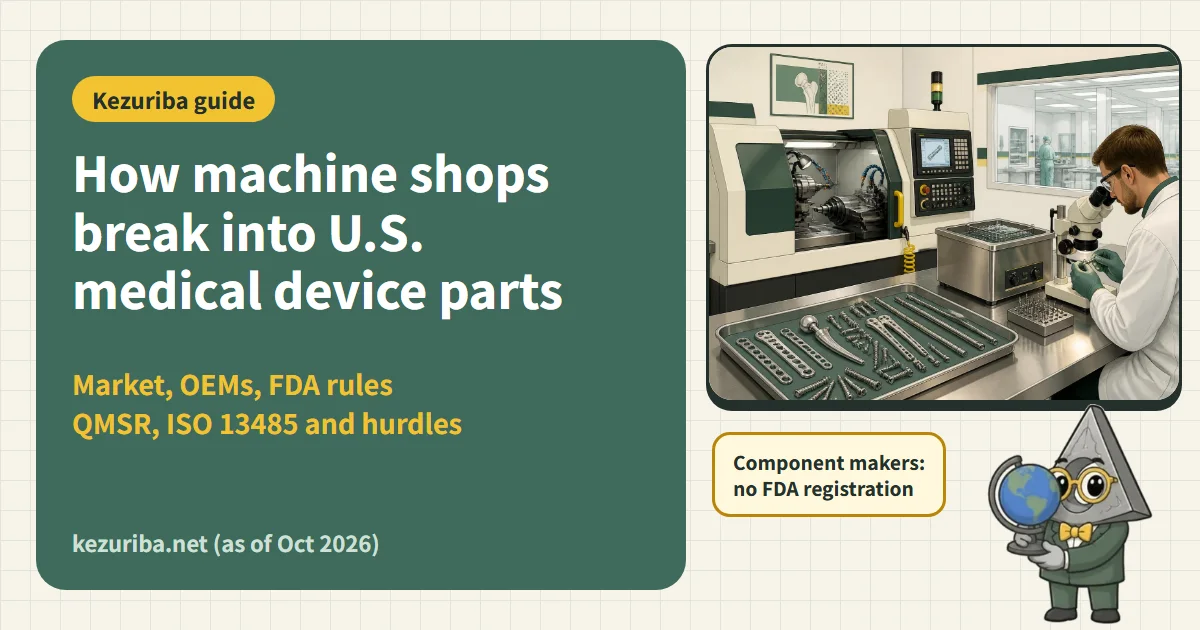
The U.S. is the world's largest market, accounting for nearly half of the global medical device market. Plants making medical instruments alone ship about $80 billion a year. Artificial joints, bone screws and plates, and surgical instruments are built largely from turned and milled precision parts in titanium, cobalt-chromium and stainless steel. What’s more, shops that supply only components to finished-device manufacturers are exempt from FDA registration and not subject to the quality regulation (QMSR). This article covers market trends and manufacturing hubs, the major OEMs and contract manufacturers, common parts and material specs, requirements that reach you through OEM purchasing controls, ISO 13485, cleaning, passivation and validation, product liability for parts suppliers, trade shows and MEP, and the real-world hurdles, drawing on public sources such as the Census Bureau, FDA, federal regulations, standards bodies and company financial filings (as of October 2026).
Market: about half the world, about $80 billion in annual shipments
The global medical device market was about $517 billion in 2023, and the U.S. accounted for 47% of it, far ahead of second-place Germany (7%) (private research data cited in a report by Japan’s Ministry of Health, Labour and Welfare)[1].
On the manufacturing side, the U.S. Census Bureau's industry statistics show the scale. The two industries with the most metal parts are Surgical and Medical Instrument Manufacturing (NAICS 339112) (syringes, catheters, surgical clamps, etc.) and Surgical Appliance and Supplies Manufacturing (NAICS 339113) (orthopedic appliances, artificial limbs, surgical tables, etc.)[7]. Combined shipments grew from $73.1 billion in 2017 to $81.9 billion in 2024 (339112: $43.8 billion; 339113: $38.2 billion)[2][6].
In the 2022 Economic Census, 339112 had 1,033 firms, 1,227 establishments and 121,079 employees, and 339113 had 1,546 firms, 1,767 establishments and 86,017 employees[4]. 339112 fell to $34.9 billion in 2020 but has recovered since 2021, and 2024 is the highest value in the years we checked[3][6].
Notes on reading the figures① From 2023, the annual survey switched from the ASM to the new AIES, so the data are not strictly continuous with 2022 and earlier[6]. ② 339113 also includes industrial safety equipment (except protective eyewear)[7]. ③ Machine shops that only make parts aren't counted in these two industries (they are counted mainly under machine shops). What you see here is the size of your customers. ④ Figures are nominal and not adjusted for inflation.
CT, MRI and similar equipment fall under other industries. Electromedical apparatus (334510), which covers MRI, ultrasound, pacemakers and more, shipped $45.7 billion in 2024, and irradiation apparatus such as X-ray (334517, including industrial) shipped $7.7 billion[7][6]. Shops with large lathes and mills can also go after structural parts for this equipment.
Which states lead
The largest is California ($12.8 billion). Indiana has $4.7 billion in 339113 (which includes orthopedic appliances) alone and ranks second after California. Minnesota stands out for its large 339112 output (instruments such as catheters) of $4.0 billion[4]. Warsaw, Indiana, is where Zimmer Biomet's predecessor was founded in 1927, and it is still home to the company's main R&D site[16]. The area also has OrthoWorx, a nonprofit formed in 2009 to sustain the local orthopedic industry[19]. A plant near your customers makes it easier to attend prototype meetings, witnessed inspections and audits.
Major OEMs and contract manufacturers
Below are major medical device makers (OEMs) you could sell parts to, with revenue for their latest fiscal year. Some figures are company-wide and some cover only the medical device segment, so check the "Scope" column.
| Company | Sales (fiscal year) | Scope | Products with many machined metal parts (examples) |
|---|---|---|---|
| Medtronic | $36.4 billion (FY ended Apr 2026)[8] | Company-wide | Spinal implants, surgical instruments, cardiac devices |
| Johnson & Johnson MedTech | $33.8 billion (2025)[9] | MedTech segment (orthopedics $9.3 billion) | Artificial joints, bone fixation, spine (DePuy Synthes) |
| Stryker | $25.1 billion (2025)[10] | Company-wide (orthopedics $9.5 billion) | Hip and knee prostheses, trauma plates and intramedullary nails, surgical power tools |
| BD | About $21.8 billion (FY ended Sep 2025)[11] | Company-wide | Syringes, injection needles, catheters, surgical instruments |
| Abbott | About $21.4 billion (2025)[12] | Medical devices segment | Stents, cardiac devices, glucose monitors |
| GE HealthCare | About $20.6 billion (2025)[13] | Company-wide (Imaging $9.2 billion) | CT, MRI and ultrasound systems |
| Boston Scientific | About $20.1 billion (2025)[14] | Company-wide | Catheters, stents, endoscopic treatment devices |
| Zimmer Biomet | About $8.2 billion (2025)[15] | Company-wide | Knee and hip prostheses, bone fixation devices |
Fiscal years and accounting standards differ by company, so these figures are not suited to ranking.
The contract manufacturing (CMO/CDMO) tier
Between OEMs and parts suppliers sit contract manufacturers that build finished devices and subassemblies. Publicly traded Integer Holdings calls itself one of the world's largest medical device contract development and manufacturing organizations (CDMOs); its 2025 sales were $1.854 billion (up 8% year over year)[17]. In orthopedics, contract manufacturers Tecomet and Orchid Orthopedic Solutions completed their combination on May 14, 2026, creating one company that handles precision machining, additive manufacturing, forging, casting and finishing (24 sites combined; privately held, revenue not disclosed)[18]. Contract manufacturers are also "manufacturers" under QMSR and select suppliers through purchasing controls[26], so for parts suppliers they can be customers on a par with OEMs.
OEMs, for their part, keep reviewing how they make things. In its annual report (10-K), Zimmer Biomet says it continually compares in-house production with outsourcing and has pursued insourcing of core products and processes and cost-reduction negotiations with outside suppliers. It buys all of its raw materials and some components from outside suppliers[16].
Which metal parts are common
FDA classifies medical devices by type and assigns them to Class I–III by risk. Most metal orthopedic implants are Class II, and the classification regulations themselves give examples of component makeup and materials.
| Field | Typical parts | Example materials in the regulation | Class / machining notes |
|---|---|---|---|
| Bone screws, pins | Smooth or threaded bone fixation fasteners[31] | Co-Cr-Mo, stainless steel | Class II. Long, slender screws are typically made on Swiss-type lathes with thread whirling[43] |
| Bone plates | Plates, nail/plate combinations, screws, bolts, nuts[32] | Co-Cr-Mo, stainless steel, titanium | Bending, drilling and chamfering of thin plate; deburring |
| Hip prosthesis | Femoral stem and head; acetabular metal shell[33] | Co-Cr-Mo or Ti-6Al-4V (UHMWPE liner inside the shell) | Class II. Some have porous coatings |
| Knee prosthesis | Femoral and tibial components[34] | Alloys such as Co-Cr-Mo | Class II. Mirror finish on articulating surfaces |
| Spine | Pedicle screws, rods, plates, transverse connectors, other connectors[35] | (the regulation says "a variety of materials") | Class II (special controls) depending on use. Threads, spherical surfaces, rod bending |
| Dental implants | Root-form fixtures[36] | Titanium, titanium alloys | Class II (special controls). Surface treatment and threads |
| Surgical instruments | Manual surgical instruments for general use[37] | Mainly stainless steel (ASTM F899)[41] | Class I, 510(k)-exempt. Reusable instruments need UDI direct marking[30] |
Where lathe and machining center shops can best put their skills to use is in bone screws, plates and intramedullary nails, spinal screws and rods, machining and finishing of joint replacements, and surgical instruments. Stents and guidewires (nitinol, etc.) belong to the specialized world of wire drawing and laser cutting, so they are a stretch for machining shops[42].
Materials and standards
| Materials | ASTM | ISO |
|---|---|---|
| Implant-grade stainless steel (316L equivalent, UNS S31673) | F138 | 5832-1 |
| Commercially pure titanium | F67 (Grade 1–4) | 5832-2 |
| Ti-6Al-4V | F136 (ELI), F1472 (non-ELI) | 5832-3 |
| Ti-6Al-7Nb | F1295 | 5832-11 |
| Co-Cr-Mo | F75 (cast), F1537 (wrought), F799 (forged) | 5832-4 (cast), 5832-12 (wrought) |
| Nitinol | F2063 | ― |
| Stainless steel for surgical instruments | F899 | 7153-1 |
Titles checked on the ASTM and ISO pages[38][39][40][41][42]. Drawings often specify material by ASTM number, so also see the ASTM quick reference and Materials database (Ti-6Al-4V, 17-4PH, etc.).
FDA rules: do parts suppliers need to register?
With FDA, establishment registration and device listing are required of anyone who manufactures, assembles or processes medical devices[21]. However, manufacturers of raw materials or components used to make or assemble medical devices are exempt from registration (21 CFR 807.65(a))[20]. FDA's table likewise says that a component manufacturer supplying only finished-device manufacturers needs "no registration, listing or fee"[22].
| Your position | FDA registration | QMSR | Basis |
|---|---|---|---|
| Shop machining parts to drawing for finished-device manufacturers | Not required | Not covered (but encouraged to use it as guidance) | 807.65(a)[20], 820.1(a)(2)[26]. No 510(k) either[24] |
| Contract manufacturer building finished devices to another firm's specs (incl. contract packagers) | Required (registration, listing, fee) | Covered (counts as a "manufacturer") | 807.20(a)(2)[21], FDA table[22], 820.1[26]. No 510(k) needed[24] |
| Contract sterilizer | Required | Covered | 807.20(a)(2)[21], 820.1[26] |
| Parts packaged and labeled ready for medical use (e.g., replacement parts) | Required | May be covered | 807.20(a)(6)[21]. Parts sold to end users as replacement parts may need a 510(k)[24] |
| A company that sells its own instruments as medical devices (Route D) | Required | Covered | Class I general surgical instruments are 510(k)-exempt[37]. Most Class II devices need a 510(k)[24] |
Once you need to register, you face annual renewal and a registration fee. For FY2027 (October 2026 – September 2027), the establishment registration fee is $13,785, with no small business discount. FDA based the calculation on a three-year average of 30,380 registered establishments[23].
"Not covered" doesn't mean FDA will never comeComponent manufacturers are outside the QMSR, but FDA has the authority under the Federal Food, Drug, and Cosmetic Act (FD&C Act) to inspect component manufacturers when necessary, as FDA states in the preamble to the QMSR final rule[25].
What the QMSR and purchasing controls require of you
FDA's quality regulation (21 CFR 820) has been amended to incorporate ISO 13485:2016 by reference, becoming the QMSR (Quality Management System Regulation), effective February 2, 2026 and now in force[25]. OEMs and contract manufacturers must document a quality management system in line with ISO 13485 and also comply with FDA rules such as UDI and reporting[27]. Requirements reach parts suppliers through one part of that system: purchasing controls (ISO 13485 clause 7.4).
- Selected by risk, then monitored: In the preamble, FDA explains that 7.4 requires evaluating suppliers on their ability and performance, according to the effect and risk of the purchased product on final product quality, and monitoring and re-evaluating them[25].
- Notify changes in advance: The OEM sets up a written agreement for you to notify it, before implementation, of any change that affects the purchased product’s ability to meet requirements (7.4.2)[29].
- FDA reads audit reports: Under the QMSR, management review, internal audit and supplier audit reports are now open to review in FDA inspections. Since February 2, 2026, inspections have also followed the new Compliance Program 7382.850[28]. In other words, an FDA investigator may read the audit report your OEM wrote about your shop.
- Traceability: For life-supporting devices, traceability for implantable devices (ISO 13485 clause 7.5.9.2) is also required[27]. Keep material mill certs linked to production lot records.
- UDI: Putting the UDI (Unique Device Identifier) on labels and packaging is the OEM’s obligation[27]. But devices reprocessed between uses also need a permanent marking on the device itself[30], so surgical instrument laser marking sometimes ends up with the machine shop.
As a real-world example, the purchase order quality clauses Medtronic publishes on its website (D00006149 Rev D) include items like these[49].
| Item | What it says (summary) |
|---|---|
| Subcontracting | Do not subcontract work on the order without prior written approval |
| Records | Retain quality records for 15 years as a rule (longer if the law requires) and make them available to authorities (FDA, certification bodies, etc.) |
| Traceability | Maintain identification and traceability of raw materials, components and product from receiving through shipping |
| Process control | Approval and qualification of processes and equipment, plus validation where needed. The buyer may review and approve plans and reports |
| Changes | Submit process or design changes and deviations (including at sub-tier suppliers) for review in advance through a dedicated portal |
| Audits | Accept audits by the buyer and regulators, including possible unannounced audits under an EU recommendation |
| Certificates of conformance | On request, provide a certificate of conformance and a certificate of analysis with each lot |
Clauses vary by company. At the quoting stage, always get and read the quality agreement or quality clauses.
Product liability and contracts
Product liability in the U.S. is mainly a matter of state law, but for suppliers of materials and components for implants there is a federal law, the Biomaterials Access Assurance Act of 1998 (BAAA)[50]. Under this law, an "implant" is a device placed in the body for 30 days or more, or one that contacts body fluids or internal tissue through a surgical incision. Suppliers that directly or indirectly furnish components or raw materials for implants are generally not liable for harm caused by the implant[50][51].
| When the protection is lost | What parts suppliers should do |
|---|---|
| You are the manufacturer of the implant[51] | Make clear in the contract whether you only supply parts or also make the finished device |
| You are the seller, e.g., you hold title and sell the product[51] | Check how you handle distribution and hold inventory |
| Not meeting contract requirements or specs: you supplied parts or materials that failed to meet them and that actually caused the harm (shown by the claimant by a preponderance of the evidence)[51] | Get drawing, material spec and inspection requirements in writing; keep inspection records and mill certs |
Only implant components and materials are coveredThe law protects suppliers of components and materials for devices that qualify as "implants"[50]. Parts for equipment that doesn't contact the body are not covered. Indemnification, insurance and liability caps are set in your contract with the OEM. Have a lawyer review the contract.
ISO 13485: whether and when to get certified
- FDA doesn't require it: FDA neither requires nor issues ISO 13485 certificates, and having one doesn't exempt you from FDA inspection[28]. Parts suppliers have no obligation to be certified.
- Customers may require it: ISO says the standard is useful not only for organizations that make medical devices but also for suppliers that provide products to them[29]. Because OEMs and contract manufacturers evaluate suppliers through purchasing controls (see the previous section), certification is a shortcut through that evaluation. Whether it is required depends on the customer.
- Timeline: An Indiana sheet metal fabricator (100 employees) engaged Purdue University's MEP for a gap analysis, risk management training and internal auditor training, completed in 3 months an implementation it had expected to take 6, and was certified in October 2014[55]. If you already have an ISO 9001 system, it is a matter of closing the gaps.
- Edition: ISO 13485:2016 (3rd edition) was reviewed in 2025 and confirmed without change[29]. This is also the edition the QMSR incorporates[25].
The machining work: validation and what happens "after cutting"
In medical parts, even if the dimensions are in tolerance, a part left with burrs, cutting oil or iron particles is a reject. And processes whose results cannot be fully verified by later inspection require validation, which confirms that the process itself is sound.
| Topic | What is known |
|---|---|
| IQ/OQ/PQ | International guidance on process validation for medical devices proceeds in three stages: confirming that equipment is installed to specification (IQ), establishing control limits that yield product meeting requirements (OQ), and confirming consistent output of good product under normal conditions (PQ)[44] |
| Which processes need it | The same guidance lists heat treating and plating as examples of processes that should be validated and manual cutting as one where verification suffices, and treats NC machining and some cleaning processes as examples to be decided with its decision model[44]. Even in machining, dimensions or surface conditions that cannot be 100% inspected may require validation |
| Cleaning | ASTM F3127-22 is the guide for validating cleaning processes during manufacturing[45]. Cleanliness of orthopedic implants is covered by ISO 19227, which also addresses evaluation of residues and the like[48] |
| Passivation | Chemical passivation of stainless steel parts is covered by ASTM A967 (nitric acid, citric acid and electrochemical methods, plus tests for removal of free iron; current edition A967/A967M-25)[46] |
| Surface preparation and marking | Surface preparation and marking of metallic implants is covered by ASTM F86[47] |
What changes on the shop floor is "after cutting"Your cutting fluid brand, washer settings, deburring method and marking method become conditions of the business. If you clean or passivate in-house, that includes IQ/OQ/PQ records; if you outsource, team up with a processor with a medical track record and treat managing them as your own responsibility (buyers require control of sub-tier suppliers too[49]). For cutting conditions, see the cutting conditions calculator; for tool wear, the tool life article.
Entry routes and where to get support
| Route | What it looks like | Best suited to |
|---|---|---|
| A Contract machining of parts | Deliver parts made to drawing to OEM purchasing or R&D. No FDA registration needed[20] | Companies with a clear specialty such as difficult-to-cut materials, micro parts or long, slender parts |
| B Supplier to CMOs | Become a subcontractor to contract manufacturers that build finished devices[18] | Companies that first want to get used to the medical rules |
| C From early development | Start with prototypes for companies developing new devices and become an approved supplier for production | Shops good at prototyping and making proposals. If you co-develop specs, agree on the split of responsibility in the contract first |
| D Own products / finished-device contract manufacturing | Requires FDA registration and QMSR compliance[21][26] | Companies that can put the quality system and people in place |
- Trade shows: MD&M West, for medical device design and manufacturing, runs February 9–11, 2027, in Anaheim, California, with 1,700+ exhibitors and 13,800+ attendees (organizer figures)[52]. Focused on orthopedic manufacturing, OMTEC runs June 8–10, 2027, at the Donald E. Stephens Convention Center in Illinois, a smaller event with 215+ exhibitors and 1,500+ attendees[53]. Orthopedic OEM engineers and buyers attend, so it is the closer fit for shops that machine bone screws and plates.
- MEP (Manufacturing Extension Partnership): A NIST network of state-designated centers in all 50 states and Puerto Rico, with about 1,400 experts at more than 450 locations. Half the funding is federal; the rest comes from states, private sources and client fees[54]. See the previous section for an example of ISO 13485 implementation support[55].
- Regional industry groups: In orthopedics, for example, there is OrthoWorx in Warsaw, Indiana[19] and similar groups that support regional industries. The top states in the Census state data (California, Indiana, Minnesota, etc.)[4] are where such groups and customers are concentrated.
- OEM supplier portals: Some OEMs publish supplier quality clauses and change-request portals. Read them before you pitch[49].
Order of steps to entry (guideline)
- Choose your target field: Equipment parts, surgical instruments and implants have very different requirements. Start close to your strengths (difficult materials, micro parts, long parts, mirror finishes). At OMTEC or MD&M, see which OEMs and contract manufacturers are outsourcing which parts[53][52].
- Add the systems: Build lot traceability, change control, procedures for cleaning, burrs and foreign matter, and subcontractor control on top of ISO 9001. Your local MEP Center can help[54].
- Prototypes and audits: Pass site audits by OEMs or contract manufacturers and submit first articles and inspection reports. Cleaning and passivation may require IQ/OQ/PQ records[44].
- Production and ISO 13485: Get on the approved supplier list and earn certification while shipping. Certification also helps you sell to the next OEM or contract manufacturer.
The real hurdles and how to deal with them
| Hurdle | Details | Example countermeasures |
|---|---|---|
| Long ramp-up | Production comes only after audits, first articles and validation. No official statistics on time to approval | Build a track record with less demanding work such as equipment parts, or as a subcontractor to contract manufacturers |
| No changes without notice | Written commitment to notify changes before making them[29]. Subcontracting also needs prior approval[49] | Set an internal rule that treats replacing machines, changing tools or cutting fluid, and changing subcontractors as "changes" |
| Validation and records | IQ/OQ/PQ[44], long-term record retention (15 years in one example)[49] | Set up digital records and a retention system up front |
| Cleaning and passivation | Cleanliness requirements and cleaning validation[45][48], passivation testing[46] | Team up with a processor with medical experience. If in-house, keep full records |
| Price pressure | Hospitals negotiate through GPOs, and OEMs push cost reductions onto suppliers. Some are bringing core processes back in-house[16] | Cut unit costs with shorter setups, automation and on-machine probing, and compete on work that's hard to insource (difficult materials, micro features) |
| Consolidation of large contract manufacturers | Mergers among contract manufacturers are creating one-stop shops from machining to finishing (2026 example)[18] | Get in as a subcontractor to a large contract manufacturer on your strongest processes |
| Tariff developments | In September 2025, the Commerce Department opened a Section 232 investigation into imports of medical devices and related products[56]. As of October 2026, no outcome (proclamation) had been issued, as far as we could confirm[57] | Watch for OEMs looking for domestic sources. Diversify sources for imported materials |
How this compares with Japan
| USA | Japan | |
|---|---|---|
| Registration for parts-only suppliers | Not required (21 CFR 807.65(a))[20] | Generally not required (PMD Act)[58] |
| Quality regulation | QMSR (incorporates ISO 13485; effective Feb 2026)[25] | QMS Ordinance (equivalent to ISO 13485)[59] |
| Law protecting parts suppliers | BAAA (implant components and materials)[51] | Component-manufacturer defense under the Product Liability Act[60] |
| Share of the world market | About 47%[1] | About 5%[1] |
FAQ
- Do I need to register with FDA if I only machine parts?
- Not if you only supply components to finished-device manufacturers (21 CFR 807.65(a))[20]. Contract manufacturers that build finished devices to another firm's specs, and parts packaged and labeled ready for medical use, must register[21][22]. If in doubt, check with your customer.
- Does the QMSR apply to parts suppliers?
- No. The regulation excludes component manufacturers and encourages them to use it as guidance[26]. However, requirements based on the same principles reach you through OEM purchasing controls, and FDA says it can inspect component manufacturers if necessary[25].
- Can I do business without ISO 13485?
- FDA doesn't require certification[28]. Whether you need it depends on the customer. A realistic path is to start your first jobs with ISO 9001 plus medical-specific procedures (traceability, change control, cleaning) and pursue certification in parallel. One shop completed implementation in 3 months with MEP support[55].
- If an implant causes harm, can the parts supplier be sued too?
- Under the Biomaterials Access Assurance Act, suppliers of implant components and materials are generally not liable. The exceptions are when you are the manufacturer or seller, or when you supplied parts that did not meet the contract specifications and they caused the harm[51]. Keep your specifications and inspection records.
- Where can I buy material?
- Drawings call out materials by standards such as ASTM F136 or F138[38][39], so buy material with mill certs to that standard from distributors your customer has approved. Material is sometimes customer-supplied, so check before quoting.
Hole and fit data: Fits and Tolerances, and dimensional change from surface treatment: How to tell black oxide from plating, and how dimensions change; rising tool prices: Tungsten Price Surge and Carbide Tools.
Sources
- Japan Ministry of Health, Labour and Welfare (MHLW), “Research project on the Basic Plan for Medical Devices”: preliminary survey results (Material 2-3, PDF; world market and country shares are Fitch Solutions data)
- U.S. Census Bureau, “2017 Economic Census: Manufacturing Summary Statistics” (EC1731BASIC)
- U.S. Census Bureau, "Annual Survey of Manufactures, Benchmarked to the 2022 Economic Census"
- U.S. Census Bureau, “2022 Economic Census: Manufacturing Summary Statistics” (EC2231BASIC, national and state)
- U.S. Census Bureau, “Annual Integrated Economic Survey 2023, Manufacturing” (AIES31BASIC01)
- U.S. Census Bureau, “Annual Integrated Economic Survey 2024, Manufacturing” (AIES31BASIC01)
- U.S. Census Bureau, “North American Industry Classification System 2022” (PDF; definitions of 339112, 339113, 334510, 334517)
- Medtronic, "Fourth quarter and full year fiscal 2026 results"
- Johnson & Johnson, “Form 10-K (FY2025)”
- Stryker, “Full-year 2025 results materials” (PDF)
- BD, “Fourth Quarter and Full Year Fiscal 2025 Results” (Form 8-K Exhibit 99.1)
- Abbott, "Fourth-Quarter and Full-Year 2025 Results"
- GE HealthCare, "Fourth quarter and full year 2025 financial results"
- Boston Scientific, "Results for fourth quarter and full year 2025"
- Zimmer Biomet, "Fourth quarter and full-year 2025 results"
- Zimmer Biomet Holdings, Form 10-K (FY2025)
- Integer Holdings, “Results for Fourth Quarter and Full Year 2025” (Form 8-K Exhibit 99.1)
- Orchid Orthopedic Solutions, “Tecomet and Orchid Complete Transaction” (May 2026)
- OrthoWorx, "About"
- eCFR 21 CFR 807.65, "Exemptions for device establishments"
- eCFR 21 CFR 807.20, "Who must register and submit a device list?"
- FDA, "Who Must Register, List and Pay the Fee"
- FDA, “Medical Device User Fee Rates for Fiscal Year 2027” (Federal Register, PDF)
- FDA, "Premarket Notification 510(k)"
- Federal Register, “Medical Devices; Quality System Regulation Amendments” (89 FR 7496, including preamble)
- eCFR 21 CFR 820.1, "Scope"
- eCFR 21 CFR 820.10, "Requirements for a quality management system"
- FDA, "Quality Management System Regulation: Frequently Asked Questions"
- ISO, "ISO 13485:2016 Medical devices — Quality management systems — Requirements for regulatory purposes"
- eCFR 21 CFR 801.45, "Devices that must be directly marked with a unique device identifier"
- eCFR 21 CFR 888.3040, "Smooth or threaded metallic bone fixation fastener"
- eCFR 21 CFR 888.3030, "Single/multiple component metallic bone fixation appliances and accessories"
- eCFR 21 CFR 888.3358, "Hip joint metal/polymer/metal semi-constrained porous-coated uncemented prosthesis"
- eCFR 21 CFR 888.3560, "Knee joint patellofemorotibial polymer/metal/polymer semi-constrained cemented prosthesis"
- eCFR 21 CFR 888.3070, "Thoracolumbosacral pedicle screw system"
- eCFR 21 CFR 872.3640, "Endosseous dental implant"
- eCFR 21 CFR 878.4800, "Manual surgical instrument for general use"
- ASTM F136, "Wrought Titanium-6Aluminum-4Vanadium ELI Alloy for Surgical Implant Applications"
- ISO, “ISO 5832-1:2024 Implants for surgery — Metallic materials — Part 1: Wrought stainless steel” and other parts of the 5832 series
- ASTM F75-23, "Cobalt-28 Chromium-6 Molybdenum Alloy Castings"
- ASTM F899-23, "Wrought Stainless Steels for Surgical Instruments"
- ASTM F2063-18, "Wrought Nickel-Titanium Shape Memory Alloys for Medical Devices"
- A tool maker's technical resource, “Bone screw machining”
- GHTF Study Group 3, “Quality Management Systems – Process Validation Guidance” (GHTF/SG3/N99-10:2004, hosted by IMDRF)
- ASTM F3127-22, "Standard Guide for Validating Cleaning Processes Used During the Manufacture of Medical Devices"
- ASTM A967/A967M, “Chemical Passivation Treatments for Stainless Steel Parts” (current edition: -25)
- ASTM F86-21, "Surface Preparation and Marking of Metallic Surgical Implants"
- ISO 19227:2018, "Implants for surgery — Cleanliness of orthopedic implants"
- Medtronic, “Purchase Order Terms and Conditions Quality Clauses” (D00006149 Rev D, PDF)
- 21 U.S.C. § 1602 (definitions, Biomaterials Access Assurance Act of 1998, Pub. L. 105-230)
- 21 U.S.C. § 1604, "Liability of biomaterials suppliers"
- MD&M West official website
- OMTEC (Orthopaedic Manufacturing & Technology Exposition and Conference) official website
- NIST, “About NIST MEP” (updated January 2026)
- Purdue MEP, “Estes Design and Manufacturing” success story (PDF)
- Federal Register, “Section 232 National Security Investigation of Imports of PPE, Medical Consumables, and Medical Equipment, Including Devices” (90 FR 46383, PDF)
- BIS, "Section 232 Investigations"
- e-Gov Japanese Law Search, Act on Securing Quality, Efficacy and Safety of Products Including Pharmaceuticals and Medical Devices (PMD Act)
- e-Gov Law Search, “Ministerial Ordinance on Standards for Manufacturing Control and Quality Control of Medical Devices and In Vitro Diagnostics” (QMS Ordinance)
- e-Gov Law Search, “Product Liability Act”, Article 4
More articles
 Gears
GearsPolishing Internal Gears: A Mass-Production Method Using Generating Grinding Kinematics (Nidec Machine Tool x RWTH Aachen), Explained with Figures
 Industry
How a Metalworking Company Can Enter the U.S. Defense Industry: Entry Points, SAM.gov and JCP, ITAR, CMMC, Specialty Metals, Hurdles
 Industry