Printed from Kezuriba (kezuriba.net/en/troubles/chip-jamming-milling/)
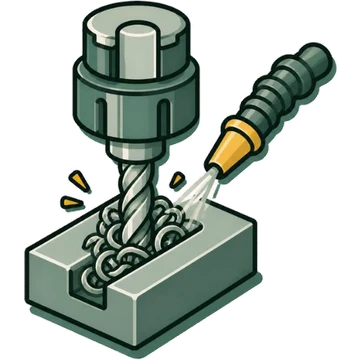
Chips clog or jam (milling, end milling)
Turning and milling Milling
Check first
- Chip pocket is small or there are too many teeth
- Chip evacuation by coolant or air is insufficient
- Chips have no escape route, as in slotting
Try first
- Divide deep slots into multiple passes with a smaller depth of cut
- In deep slotting, reduce the feed (Sandvik); if chips are too thin, increase the feed (Mitsubishi)
- Use a tool with fewer teeth and a larger chip pocket
 Likely causes
- Chips have no escape route, as in slottingOne maker[1]
- Chip pocket is small or there are too many teethAgreed by 2+ makers[2][3][4][5][6]
- Depth of cut (cutting volume) is largeOne maker[2][3]
- Adhesion is occurringOne maker[4][5]
- Chips are too thin (feed is small)One maker[4][5]
- Chip evacuation by coolant or air is insufficientAgreed by 2+ makers[1][4][5][7]
 Fixes
Cutting conditions
- Divide deep slots into multiple passes with a smaller depth of cutAgreed by 2+ makers[1][3][2]
- In deep slotting, reduce the feed (Sandvik); if chips are too thin, increase the feed (Mitsubishi)Agreed by 2+ makers[1][4]
- Use climb milling (down milling) to avoid recutting chipsOne maker[8]
Tool
- Use a tool with fewer teeth and a larger chip pocketAgreed by 2+ makers[1][2][3][4][6]
- Use a roughing end mill or a nicked end millAgreed by 2+ makers[2][8]
Coolant
 Notes by material
- Titanium alloy: Chip recutting tends to occur in slotting and pocketing, leading to chipped cutting edges[1]
 Related problems
Frequently asked questions
- What should I check first on the machine when "Chips clog or jam (milling, end milling)" occurs?
- For Chips clog or jam (milling, end milling) in Milling, check these primary causes first: Chip pocket is small or there are too many teeth Chip evacuation by coolant or air is insufficient Chips have no escape route, as in slotting
- What is the fastest fix to try for "Chips clog or jam (milling, end milling)" without tearing down the setup?
- Start with adjustments that can be made directly at the CNC control or tool holder: Divide deep slots into multiple passes with a smaller depth of cut In deep slotting, reduce the feed (Sandvik); if chips are too thin, increase the feed (Mitsubishi) Use a tool with fewer teeth and a larger chip pocket
- Does the workpiece material change how "Chips clog or jam (milling, end milling)" behaves and how to fix it?
- Yes. Material properties such as thermal conductivity, work hardening, and ductility strongly affect Chips clog or jam (milling, end milling). For example, in Titanium alloy: Chip recutting tends to occur in slotting and pocketing, leading to chipped cutting edges
 Sources
Causes and fixes are summarized in our own words from cutting-tool makers’ troubleshooting guides and technical data. “Agreed by 2+ makers” means two or more makers say the same thing. The small notes under some items and the “how it works” sections add explanations from papers, company technical reviews, public research institutes, standards, patents and maker data (papers and the like are tagged).
- Sandvik Coromant — Milling troubleshooting sandvik.coromant.com
- Mitsubishi Materials — End mills: troubleshooting mmc-carbide.com
- Mitsubishi Materials — End milling troubleshooting mmc-carbide.com
- Mitsubishi Materials — Face milling: Troubleshooting mmc-carbide.com
- Mitsubishi Materials — Face milling troubleshooting mmc-carbide.com
- Tungaloy tungaloy.com
- Tungaloy tungaloy.com
- OSG — Series No.8 End mills, Table 7.1 Troubleshooting, pp. 61-62 osg.co.jp