Printed from Kezuriba (kezuriba.net/en/troubles/chatter/)
Chatter (vibration)
Turning and milling TurningMilling
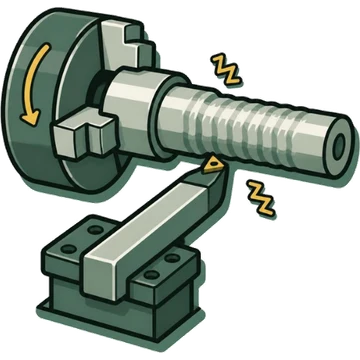
Check first
- Long tool overhang
- Insufficient rigidity of workpiece or tool mounting (weak clamping, thin-walled part with poor support)
- Play or insufficient rigidity in the machine or spindle
Try first
- Change the rotation speed to move out of the resonance range
- Reduce the depth of cut
- If the feed is too small, increase the feed per tooth
?Likely causes
- Long tool overhangAgreed by 2+ makers[1][2][3][4][5][6]
- Insufficient rigidity of workpiece or tool mounting (weak clamping, thin-walled part with poor support)Agreed by 2+ makers[1][2][3][7][8][5]
- Play or insufficient rigidity in the machine or spindleAgreed by 2+ makers[3][9][5][2]
- Cutting conditions (speed, feed, depth of cut) are not suitableAgreed by 2+ makers[8][9][10][5][6]
- Cutting speed is too highAgreed by 2+ makers[5][6][11]
- Feed or depth of cut is too small, so cutting force is unstableAgreed by 2+ makers[1][5][6]
- Rotation speed coincides with the natural frequency of the machine and tool system, causing resonanceOne maker[5][6]
- Insert geometry with high thrust force (radial force), such as a large corner radius or small lead angleAgreed by 2+ makers[1][3]
- Too many teeth cutting at the same time (regenerative chatter)Agreed by 2+ makers[7][5][6]
- Dull cutting edge (negative geometry, large honing, progressing flank wear) causes high cutting forceAgreed by 2+ makers[1][3][5]
- Rake angle or clearance angle is too large, so the edge is weakOne maker[5][6]
✓Fixes
Cutting conditions
- Change the rotation speed to move out of the resonance rangeAgreed by 2+ makers[5][6][4][8]
- Reduce the depth of cutAgreed by 2+ makers[2][3][9][5][6]
- If the feed is too small, increase the feed per toothAgreed by 2+ makers[2][5][6][4]
- Reduce the cutting speedAgreed by 2+ makers[5][6][9][10]
- For end mill finishing, try up millingAgreed by 2+ makers[2][4]
Tool
- Use a tool with fewer teeth, or an unequal pitch or unequal lead toolAgreed by 2+ makers[2][8][7][5][12]
- In turning, reduce thrust force by using a smaller corner radius and a 90° lead angle (smaller side cutting edge angle)Agreed by 2+ makers[1][3]
- Use a sharp positive geometry with small honingAgreed by 2+ makers[1][2][3][12]
- Use a larger tool diameter or shank diameter, a carbide tool, or a tool with a large core thicknessAgreed by 2+ makers[5][8][10]
- Replace the worn cutting edgeOne maker[1][2]
Setup
- Shorten the tool overhang (use a thicker boring bar and a longer gripping length)Agreed by 2+ makers[1][2][3][4][8][5][6]
- Increase workpiece clamping rigidity and add supportAgreed by 2+ makers[2][3][7][8][5]
- Check runout, and replace or retighten the chuck or colletAgreed by 2+ makers[2][4][5]
- Use a holder with high gripping rigidity, such as a shrink-fit holderOne maker[5][6]
- For long internal bores, use an anti-vibration bar or a carbide barOne maker[1]
▦Notes by material
- Titanium alloy: Young's modulus is about half that of steel, so it deflects easily, and chatter and loss of accuracy tend to occur on thin parts[13]
↔Related problems
📚Sources
Causes and fixes are summarized in our own words from cutting-tool makers’ troubleshooting guides and technical data. “Agreed by 2+ makers” means two or more makers say the same thing.
- Sandvik Coromant — Troubleshooting in turning sandvik.coromant.com
- Sandvik Coromant — Milling troubleshooting sandvik.coromant.com
- Tungaloy tungaloy.com
- Tungaloy tungaloy.com
- OSG — Series No.8 End mills, Table 7.1 Troubleshooting, pp. 61-62 osg.co.jp
- OSG — What are effective measures against chatter? faq.osg.co.jp
- Tungaloy tungaloy.com
- Mitsubishi Materials — End mills: troubleshooting mmc-carbide.com
- Mitsubishi Materials — Turning troubleshooting mmc-carbide.com
- Mitsubishi Materials — End milling troubleshooting mmc-carbide.com
- Sandvik Coromant — Drilling wear and troubleshooting sandvik.coromant.com
- Mitsubishi Materials — Face milling troubleshooting mmc-carbide.com
- Nippon Steel — Is titanium hard to machine? Typical machining methods and precautions nipponsteel.com