Printed from Kezuriba (kezuriba.net/en/troubles/drill-chip-jam/)
Chips clog (drilling)
Drilling Drilling
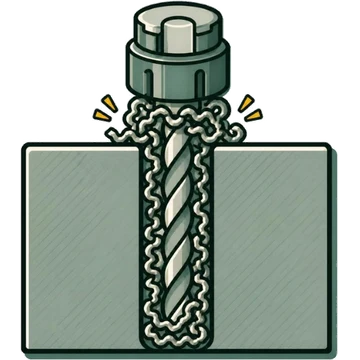
Check first
- Cutting conditions (speed, feed) are unsuitable, so chips are long
- Insufficient coolant or external supply
- Edge geometry unsuited to the workpiece material
Try first
- Use step feed, or break chips with a dwell
- Increase the feed to break chips
- Use through-coolant and increase the pressure (guideline for indexable: 1.5 MPa or more)
 How it works: chips are carried by the flute and the coolant
Drill chips are carried out of the hole by the twist of the flute and the flow of cutting fluid. With external coolant, once the hole depth exceeds 2D (D is the drill diameter), the fluid no longer reaches the edge, and the hot chips stretch and set, clogging the flute more easily. Tool maker material gives a guideline of adding 1–3 mm steps beyond 2D with external coolant.[1]
If the feed is too low, the chips become thin, long spirals and wind around the drill. In an example cutting S50C at 0.05 mm/rev with a standard φ10 drill, long chips came out and fine step feed was needed. Conversely, if the feed is raised too far, the chips get hot enough to turn blue.[2]
A study of non-step drilling with small-diameter drills found that a high feed that keeps a long pitch evacuated chips better than a low feed that cuts the chips fine, and also confirmed the phenomenon in which the chips leaving the flute make negative pressure inside the hole and draw in cutting fluid.[3]
Pecking (step feed) breaks the chips into sections and brings them out, but on a vertical machining center, if you pull all the way out of the hole, the chips fall to the bottom of the hole the moment you pull out, and the edge can bite them when it goes back in.[1]
On the shop floorFor a deep hole with external coolant, add steps or a dwell (stop the feed to let the chips out) once past 2D, and if a through-coolant drill can be used, use that. If long chips tangle, try the direction of raising the feed slightly rather than lowering it, to make the chips short and thick.[1][2]
→ Article: Canned cycles (how to decide the peck depth)→ Article: Canned cycles (through-coolant)
 Likely causes
 Fixes
Cutting conditions
- Use step feed, or break chips with a dwellAgreed by 2+ makers[7][6][8][9]
- Increase the feed to break chipsAgreed by 2+ makers[7][9][10][8]
Tool
- Use a drill with a small web thickness (large chip pockets)One maker[5]
Coolant
 Related problems
Frequently asked questions
- What should I check first on the machine when "Chips clog (drilling)" occurs?
- For Chips clog (drilling) in Drilling, check these primary causes first: Cutting conditions (speed, feed) are unsuitable, so chips are long Insufficient coolant or external supply Edge geometry unsuited to the workpiece material
- What is the fastest fix to try for "Chips clog (drilling)" without tearing down the setup?
- Start with adjustments that can be made directly at the CNC control or tool holder: Use step feed, or break chips with a dwell Increase the feed to break chips Use through-coolant and increase the pressure (guideline for indexable: 1.5 MPa or more)
- Does the workpiece material change how "Chips clog (drilling)" behaves and how to fix it?
- Yes. Low-carbon and aluminum alloys tend to form built-up edge at low cutting speeds, stainless steels and superalloys work-harden and concentrate heat at the cutting edge if feed is too light, and hardened steels increase radial thrust and flank wear. Match the tool grade, rake angle, and cutting speed to the ISO material group.
 Sources
Causes and fixes are summarized in our own words from cutting-tool makers’ troubleshooting guides and technical data. “Agreed by 2+ makers” means two or more makers say the same thing. The small notes under some items and the “how it works” sections add explanations from papers, company technical reviews, public research institutes, standards, patents and maker data (papers and the like are tagged).
- Tungaloy — DrillMeister: points for machining with external coolant tungaloy.com
- Nachi-Fujikoshi (NACHI cutting tool blog) — Drill feed rate and changes in chips nachi-tool.jp
- PaperUchiyama and Sakata (Journal of the Japan Society for Abrasive Technology 59(1), 2015) — Cutting performance of small-diameter drills in non-step feed drilling, Report 1: optimization of the cutting fluid supply method and feed rate jstage.jst.go.jp
- Sandvik Coromant — Drilling wear and troubleshooting sandvik.coromant.com
- Mitsubishi Materials — Hole making troubleshooting mmc-carbide.com
- Tungaloy tungaloy.com
- Mitsubishi Materials — Advanced Drilling: Trouble shooting mmc-carbide.com
- Tungaloy tungaloy.com
- OSG — Series No.8 End mills, Table 7.1 Troubleshooting, pp. 61-62 osg.co.jp
- OSG — Countermeasures for oversized holes faq.osg.co.jp