Printed from Kezuriba (kezuriba.net/en/troubles/drill-exit-burr/)
Burrs at the hole exit (breakthrough)
Drilling Drilling
Check first
- Feed is large at breakthrough
- Honing is large
- Mounting runout
Try first
- Reduce the feed before breakthrough (to about half, a 20-50% reduction)
- Reduce the honing
- Add a chamfer or radius to the drill shoulder, or increase the clearance angle
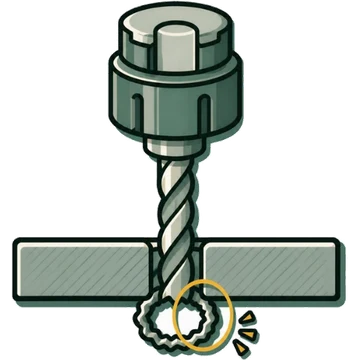
 How it works: the center pushes the sheet out at the exit
With a drill that cuts well, a Poisson burr is pushed out by the rubbing of the margin on the outer edge; with an ordinary or worn drill, a rollover burr is pushed out and folded over at the exit.[1]
About half of a drill's thrust (50–70% depending on the source) comes from the chisel edge at the center. Near the chisel the rake angle is large and negative, so it pushes rather than cuts. In a study drilling A6061-T6 with a φ0.5 mm micro drill, 70–90% of the thrust came from the chisel. At breakthrough, this thrust pushes out the thin remaining wall.[2][3][4]
In an experiment with a φ2 mm carbide drill, when adhesion occurred on the edge in SPCC, the thrust jumped from 30–90 N to 100–280 N and the burrs became larger. On A1050 (6 mm thick, 50 m/min), lowering the feed to 0.01 mm/rev from 0.4 mm before breakthrough and using 1 mm step feed kept the exit burr to 0.1 mm or less.[5]
On the shop floorThe countermeasure "lower the feed before breakthrough" is meant to weaken this pushing out. Using a drill with thinning to reduce the center thrust also works (in a CFRP example, a step drill reduced the maximum thrust by about 30%).[5][2]
→ Calculating cutting force and required power (drill thrust)→ Burrs
 Likely causes
 Fixes
Cutting conditions
- Reduce the feed before breakthrough (to about half, a 20-50% reduction)Agreed by 2+ makers[6][7][8][9][10]
Tool
- Reduce the honingOne maker[6][7]
- Add a chamfer or radius to the drill shoulder, or increase the clearance angleOne maker[9][10]
- For shallow holes (2D or less, or 3D or less with through-coolant), use a flat drillOne maker[9][10]
Setup
 Related problems
Frequently asked questions
- What should I check first on the machine when "Burrs at the hole exit (breakthrough)" occurs?
- For Burrs at the hole exit (breakthrough) in Drilling, check these primary causes first: Feed is large at breakthrough Honing is large Mounting runout
- What is the fastest fix to try for "Burrs at the hole exit (breakthrough)" without tearing down the setup?
- Start with adjustments that can be made directly at the CNC control or tool holder: Reduce the feed before breakthrough (to about half, a 20-50% reduction) Reduce the honing Add a chamfer or radius to the drill shoulder, or increase the clearance angle
- Does the workpiece material change how "Burrs at the hole exit (breakthrough)" behaves and how to fix it?
- Yes. Low-carbon and aluminum alloys tend to form built-up edge at low cutting speeds, stainless steels and superalloys work-harden and concentrate heat at the cutting edge if feed is too light, and hardened steels increase radial thrust and flank wear. Match the tool grade, rake angle, and cutting speed to the ISO material group.
 Sources
Causes and fixes are summarized in our own words from cutting-tool makers’ troubleshooting guides and technical data. “Agreed by 2+ makers” means two or more makers say the same thing. The small notes under some items and the “how it works” sections add explanations from papers, company technical reviews, public research institutes, standards, patents and maker data (papers and the like are tagged).
- PaperAurich, Dornfeld, Arrazola, Franke, Leitz, Min (CIRP Annals 58(2), 2009) — Burrs—Analysis, control and removal escholarship.org
- PaperPaper listed on Semantic Scholar — Precise Design of Drill Structure Based on Cutting Force Distribution pdfs.semanticscholar.org
- PaperRavisubramanian and Shunmugam (IIT Madras, IJMMM 21(5-6), 2019) — Comparative study of theoretical and experimental forces in micro drilling of aluminium 6061-T6 inderscience.com
- Mitsubishi Materials U.S.A. — Drill Terminology and Cutting Characteristics (Web Thinning) mmc-carbide.com
- Public labYasuki and Fujiwara (Technology Research Institute of Osaka Prefecture, Report No.28, 2014) — Formation process of drill exit burrs and their suppression orist.jp
- Mitsubishi Materials — Advanced Drilling: Trouble shooting mmc-carbide.com
- Mitsubishi Materials — Hole making troubleshooting mmc-carbide.com
- Tungaloy tungaloy.com
- OSG — Countermeasures for burrs in drilling faq.osg.co.jp
- OSG — Reducing exit burrs when drilling pipe material faq.osg.co.jp