Printed from Kezuriba (kezuriba.net/en/troubles/drill-hole-oversize/)
Hole becomes oversized (drilling)
Drilling Drilling
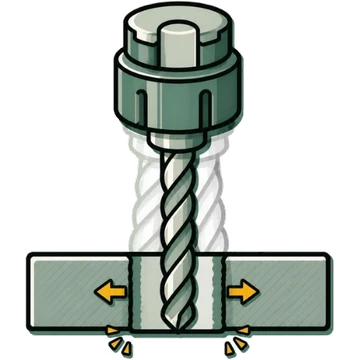
Check first
- Runout when mounting the drill, or spindle play
- Left and right cutting edges are uneven (large lip height difference, asymmetric point angle, eccentric chisel edge)
- Insufficient drill rigidity (long flute length, thin HSS drill)
Try first
- If the deeper part widens, increase the feed to break the chips and reduce the step amount
- When regrinding, keep the lip height difference to 0.02-0.03 mm or less and eliminate chisel edge eccentricity
- Increase rigidity with a carbide drill, a short flute drill, or a drill with a large web thickness
?Likely causes
- Runout when mounting the drill, or spindle playAgreed by 2+ makers[1][2][3][4][5]
- Left and right cutting edges are uneven (large lip height difference, asymmetric point angle, eccentric chisel edge)Agreed by 2+ makers[6][7][2][4][5]
- Insufficient drill rigidity (long flute length, thin HSS drill)Agreed by 2+ makers[6][5][2]
- Chip clogging (the deeper part of the hole widens)Agreed by 2+ makers[3][1][8]
- Feed is low (the hole mouth widens)One maker[3]
- Feed is excessive and cutting load is largeOne maker[2]
- For indexable drills, insufficient coolant or insufficient toughness of the peripheral insertOne maker[1]
✓Fixes
Cutting conditions
- If the deeper part widens, increase the feed to break the chips and reduce the step amountAgreed by 2+ makers[3][8]
- Review the feed per revolution (guideline: drill diameter × 0.02)One maker[2]
Tool
- When regrinding, keep the lip height difference to 0.02-0.03 mm or less and eliminate chisel edge eccentricityAgreed by 2+ makers[7][2][4][9][8]
- Increase rigidity with a carbide drill, a short flute drill, or a drill with a large web thicknessAgreed by 2+ makers[2][6][5]
Setup
- Keep mounting runout to about 0.02 mm or less (select the holder, check the spindle, and measure at each mounting)Agreed by 2+ makers[10][11][8][4][1]
Coolant
- Increase the cutting fluid pressure and flow, and clear clogged filters or oil holesAgreed by 2+ makers[8][1]
Where sources differ: Guideline for hole oversize: about 1% of the diameter for HSS drills, 20-40 μm for carbide drills (Mitsubishi e-learning).
↔Related problems
📚Sources
Causes and fixes are summarized in our own words from cutting-tool makers’ troubleshooting guides and technical data. “Agreed by 2+ makers” means two or more makers say the same thing.
- Sandvik Coromant — Drilling wear and troubleshooting sandvik.coromant.com
- OSG — Causes and countermeasures for oversized holes in drilling faq.osg.co.jp
- OSG — Countermeasures for oversized holes faq.osg.co.jp
- OSG — Series No.24 Drilling, Table 7.4 Damage observation and Table 8.1 Troubleshooting, pp. 48-51 osg.co.jp
- Mitsubishi Materials — Hole making troubleshooting mmc-carbide.com
- Mitsubishi Materials — Advanced Drilling: Trouble shooting mmc-carbide.com
- Mitsubishi Materials — Advanced Drilling: Accuracy & quality mmc-carbide.com
- Tungaloy tungaloy.com
- OSG — Countermeasures for chipping (attached PDF) faq.osg.co.jp
- OSG — Drilled hole becomes rice-ball shaped (polygonal) faq.osg.co.jp
- Mitsubishi Materials — Advanced Drilling: Cutting edge damage mmc-carbide.com