Printed from Kezuriba (kezuriba.net/en/troubles/drill-breakage/)
Drill breaks
Drilling Drilling
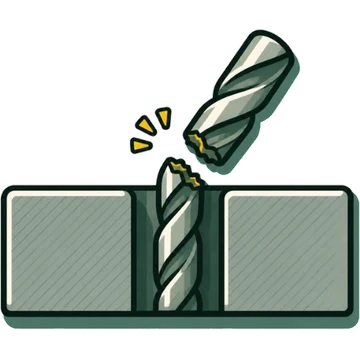
Check first
- Chip clogging
- Feed is too large
- Mounting runout is large
Try first
- Reduce the feed
- Add steps, or increase the through-coolant pressure to evacuate chips
- Check for damage before breakage and regrind or replace early
 How it works: clogging torque and center thrust
Most drill breakage happens when chips clog the flute and the torque suddenly rises. Deep, thin holes clog more easily, and a single peck that is too long causes clogging.[1][2]
The length of one peck (Q) has long been given as "0.5 to 2 times the drill diameter" and so on, but the basis is said to be weak. In a study drilling micro holes in steel with L/D over 10, every drill broke on the first hole without pecking regardless of conditions, and the appropriate Q, determined by looking at thrust, was about 1/10 of the drill diameter. A public research institute study drilling φ0.3 mm and 6 mm deep (L/D 20) in SUS316L also found immediate breakage at steps of 0.125 mm or more, and took 0.075 mm (about 0.25D) as the standard.[1][2]
The chisel edge at the center has a large negative rake angle and crushes the material rather than cutting it. It is said that 50–70% of a drill's cutting force arises here, but this mainly affects the thrust force; the torsional torque comes mainly from the cutting edges nearer the periphery. A wide chisel or no thinning increases the thrust.[3]
On the shop floorThe deeper and thinner the hole, the safer it is to make Q smaller. Choosing a drill with thinning lowers the thrust.[1][2][3]
 Likely causes
- Chip cloggingAgreed by 2+ makers[4][5][6]
- Feed is too largeAgreed by 2+ makers[4][7][6][8]
- Mounting runout is largeAgreed by 2+ makers[4][7][8]
- Insufficient rigidity or instability of the machine or workpieceAgreed by 2+ makers[4][5][6]
- Wear is advanced (chipping or abnormal wear left unaddressed)Agreed by 2+ makers[4][5][6]
- Poor entry, or the entry surface is tiltedAgreed by 2+ makers[6][8]
- Long flute length and low drill rigidityOne maker[7][8]
- Insufficient spindle powerAgreed by 2+ makers[4][5]
 Fixes
Cutting conditions
- Reduce the feedAgreed by 2+ makers[4][7][6][8]
- Add steps, or increase the through-coolant pressure to evacuate chipsAgreed by 2+ makers[5][6][4]
Tool
- Check for damage before breakage and regrind or replace earlyAgreed by 2+ makers[4][5][6]
- Use a drill with a short flute length and a large web thicknessOne maker[7][8]
Setup
 Related problems
Frequently asked questions
- What should I check first on the machine when "Drill breaks" occurs?
- For Drill breaks in Drilling, check these primary causes first: Chip clogging Feed is too large Mounting runout is large
- What is the fastest fix to try for "Drill breaks" without tearing down the setup?
- Start with adjustments that can be made directly at the CNC control or tool holder: Reduce the feed Add steps, or increase the through-coolant pressure to evacuate chips Check for damage before breakage and regrind or replace early
- Does the workpiece material change how "Drill breaks" behaves and how to fix it?
- Yes. Low-carbon and aluminum alloys tend to form built-up edge at low cutting speeds, stainless steels and superalloys work-harden and concentrate heat at the cutting edge if feed is too light, and hardened steels increase radial thrust and flank wear. Match the tool grade, rake angle, and cutting speed to the ISO material group.
 Sources
Causes and fixes are summarized in our own words from cutting-tool makers’ troubleshooting guides and technical data. “Agreed by 2+ makers” means two or more makers say the same thing. The small notes under some items and the “how it works” sections add explanations from papers, company technical reviews, public research institutes, standards, patents and maker data (papers and the like are tagged).
- PaperKim, Lee, Park, Chu (Int. J. Machine Tools Manuf. 49, 2009) — Tool life improvement by peck drilling and thrust force monitoring during deep-micro-hole drilling of steel pure.seoultech.ac.kr
- Public labNanbu, Ochiai, Ehara (Saitama Industrial Technology Center Research Report Vol.10, 2012) — Study on micro deep-hole drilling with a high aspect ratio pref.saitama.lg.jp
- Mitsubishi Materials U.S.A. — Drill Terminology and Cutting Characteristics (Web Thinning) mmc-carbide.com
- Sandvik Coromant — Drilling wear and troubleshooting sandvik.coromant.com
- Tungaloy tungaloy.com
- OSG — Series No.24 Drilling, Table 7.4 Damage observation and Table 8.1 Troubleshooting, pp. 48-51 osg.co.jp
- Mitsubishi Materials — Advanced Drilling: Trouble shooting mmc-carbide.com
- Mitsubishi Materials — Hole making troubleshooting mmc-carbide.com