Printed from Kezuriba (kezuriba.net/en/troubles/drill-position-roundness/)
Hole position shifts or hole is not round (rice-ball shape)
Drilling Drilling
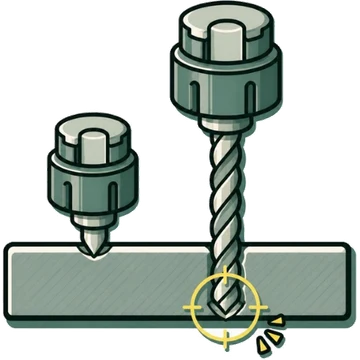
Check first
- The chisel edge slips at entry (drill walk)
- Mounting runout is large
- Variation in lip height unbalances the cutting
Try first
- If it wanders at the entrance, reduce the rotation speed and increase the feed to stabilize it with thrust
- Use a point geometry with good entry, such as X-type thinning
- Keep mounting runout within 20 μm
 How it works: the chisel at the center slides
The chisel edge at the center of a drill has almost zero peripheral speed and a strongly negative rake angle. At entry it cannot cut the material and only pushes against it, so the edge easily slips and the position shifts (so-called "walking").[1][2]
Shortening the chisel with thinning and giving it a rake angle lowers the thrust and improves entry. In a study of φ0.2 mm micro drills, the chisel rake angle and thrust force were strongly correlated, and thrust dropped by up to 70%. Without thinning the angle is a strongly negative about −60°, the best life was at −10 to 0°, and making it too positive weakened the edge and caused chipping.[2][3][1]
→ Calculating cutting force and required power (drill thrust)
 Likely causes
- The chisel edge slips at entry (drill walk)Agreed by 2+ makers[4][5][6]
- Mounting runout is largeAgreed by 2+ makers[7][8][5][9][6]
- Variation in lip height unbalances the cuttingAgreed by 2+ makers[8][5][4]
- The center hole angle and the point angle of the main drill do not match, so contact starts at the shoulderOne maker[10][7]
- Flute length is too longOne maker[9]
- Workpiece surface is not perpendicularOne maker[7][5]
 Fixes
Cutting conditions
- If it wanders at the entrance, reduce the rotation speed and increase the feed to stabilize it with thrustAgreed by 2+ makers[8][4]
- Reduce the feed at entryOne maker[9][6]
Tool
Setup
- Keep mounting runout within 20 μmAgreed by 2+ makers[8][11]Runout here is the maximum − minimum of the readings (TIR) when a dial indicator is placed on the tool and turned one revolution, and the center offset (eccentricity) is half of that.→ Measure runout with a dial indicator (when used for centering)
- Center drill with a point angle equal to or larger than that of the main drill, and keep it separate from chamferingOne maker[10][7]
- Locate with a bushing or guide holeAgreed by 2+ makers[4][5]
 Related problems
Frequently asked questions
- What should I check first on the machine when "Hole position shifts or hole is not round (rice-ball shape)" occurs?
- For Hole position shifts or hole is not round (rice-ball shape) in Drilling, check these primary causes first: The chisel edge slips at entry (drill walk) Mounting runout is large Variation in lip height unbalances the cutting
- What is the fastest fix to try for "Hole position shifts or hole is not round (rice-ball shape)" without tearing down the setup?
- Start with adjustments that can be made directly at the CNC control or tool holder: If it wanders at the entrance, reduce the rotation speed and increase the feed to stabilize it with thrust Use a point geometry with good entry, such as X-type thinning Keep mounting runout within 20 μm
- Does the workpiece material change how "Hole position shifts or hole is not round (rice-ball shape)" behaves and how to fix it?
- Yes. Low-carbon and aluminum alloys tend to form built-up edge at low cutting speeds, stainless steels and superalloys work-harden and concentrate heat at the cutting edge if feed is too light, and hardened steels increase radial thrust and flank wear. Match the tool grade, rake angle, and cutting speed to the ISO material group.
 Sources
Causes and fixes are summarized in our own words from cutting-tool makers’ troubleshooting guides and technical data. “Agreed by 2+ makers” means two or more makers say the same thing. The small notes under some items and the “how it works” sections add explanations from papers, company technical reviews, public research institutes, standards, patents and maker data (papers and the like are tagged).
- Mitsubishi Materials U.S.A. — Drill Terminology and Cutting Characteristics (Web Thinning) mmc-carbide.com
- PaperNanbu, Ochiai, Horio, Kaneko, Watanabe, Matsuda (Journal of the Japan Society for Precision Engineering 77(7), 2011) — Effect of the chisel rake angle formed by thinning in micro deep-hole drilling jstage.jst.go.jp
- Public labNanbu et al. (Saitama Industrial Technology Center Research Report Vol.8, 2010) — Study on micro deep-hole drilling of gas turbine nozzles pref.saitama.lg.jp
- Mitsubishi Materials — Advanced Drilling: Accuracy & quality mmc-carbide.com
- OSG — Series No.24 Drilling, Table 7.4 Damage observation and Table 8.1 Troubleshooting, pp. 48-51 osg.co.jp
- Mitsubishi Materials — Hole making troubleshooting mmc-carbide.com
- OSG — Countermeasures for poor hole position accuracy in drilling faq.osg.co.jp
- OSG — Drilled hole becomes rice-ball shaped (polygonal) faq.osg.co.jp
- Mitsubishi Materials — Advanced Drilling: Trouble shooting mmc-carbide.com
- OSG — Hole position is unstable even though center drilling is done faq.osg.co.jp
- Mitsubishi Materials — Advanced Drilling: Cutting edge damage mmc-carbide.com