Printed from Kezuriba (kezuriba.net/en/troubles/heat/)
Heat generation is large (accuracy loss, shorter tool life)
Turning and milling Turning
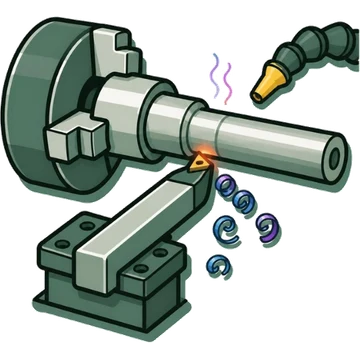
As a rule of thumb, about 80% of the heat generated in cutting is carried away by the chips, and about 10% each goes into the tool and the workpiece. The higher the cutting speed, the larger the proportion carried away by the chips, but with materials that conduct heat poorly, such as heat-resistant alloys and titanium alloys, more heat stays in the tool.[1][2]
Check first
- In materials that conduct heat poorly (heat-resistant alloys, titanium alloys), heat does not escape into the chips and builds up in the tool
- Cutting conditions are too high
- Cutting edge geometry with poor sharpness
Try first
- Reduce cutting speed, feed and depth of cut (start with cutting speed)
- Deliver coolant to the edge in sufficient quantity and keep the temperature constant (in milling, where teeth enter and leave the cut, partial cooling causes thermal cracks; dry or mist is sometimes chosen)
- Use a sharp breaker with a large rake angle and small honing
 How it works: where heat comes from and where it goes
Cutting heat comes from three places: the shear plane where material turns into chips (the largest), the rake face where the chip rubs against the tool, and the flank where the tool rubs against the finished surface. At higher speeds the frictional heat at the flank can no longer be ignored, and as flank wear progresses, the rubbing increases and so does this heat.[2][3][4]
Where it goes is determined by "chip thickness × speed ÷ thermal conductivity" (the thermal number). The faster and thicker you cut, the more heat the chip carries away and the smaller the share going into the workpiece and tool.[2][5][3]
In a finite element calculation example (shear plane heat only, 2D cutting), when the thermal number was small (thin and slow), about 65% went into the workpiece and about 13% into the tool, but at a thermal number of 2 or more, under 5% went into the tool and under 10% into the workpiece. The "about 80% goes into the chips" figure above is a guideline for roughing to ordinary conditions; when cutting thin and slow, as in finishing, the share going into the workpiece is much larger.[3]
There are three ways to measure cutting temperature: using the tool and workpiece as a thermocouple (gives the average temperature of the contact surface, but needs calibration for each combination), embedding thermocouples in the tool or workpiece (no calibration needed, but away from the heat source), and infrared (shows the distribution, but emissivity and cutting fluid and chips cause errors).[6]
On the shop floorDimensional shift from heat in finishing is a matter of share rather than amount of heat. Finish after the heat from roughing has dissipated, even out the workpiece temperature before finishing, and replace edges with advanced flank wear early because they add heat sources.[3][2]
 Likely causes
- Cutting conditions are too highOne maker[7][8]
- Cutting edge geometry with poor sharpnessOne maker[7][8]
- High cutting speed (cutting speed has the largest effect on edge temperature; the effects of feed and depth of cut are smaller)One maker[9][10]
- In materials that conduct heat poorly (heat-resistant alloys, titanium alloys), heat does not escape into the chips and builds up in the toolAgreed by 2+ makers[1][11]
 Fixes
Cutting conditions
Tool
Coolant
 See also
 Related problems
Frequently asked questions
- What should I check first on the machine when "Heat generation is large (accuracy loss, shorter tool life)" occurs?
- For Heat generation is large (accuracy loss, shorter tool life) in Turning, check these primary causes first: In materials that conduct heat poorly (heat-resistant alloys, titanium alloys), heat does not escape into the chips and builds up in the tool Cutting conditions are too high Cutting edge geometry with poor sharpness
- What is the fastest fix to try for "Heat generation is large (accuracy loss, shorter tool life)" without tearing down the setup?
- Start with adjustments that can be made directly at the CNC control or tool holder: Reduce cutting speed, feed and depth of cut (start with cutting speed) Deliver coolant to the edge in sufficient quantity and keep the temperature constant (in milling, where teeth enter and leave the cut, partial cooling causes thermal cracks; dry or mist is sometimes chosen) Use a sharp breaker with a large rake angle and small honing
- Does the workpiece material change how "Heat generation is large (accuracy loss, shorter tool life)" behaves and how to fix it?
- Yes. Low-carbon and aluminum alloys tend to form built-up edge at low cutting speeds, stainless steels and superalloys work-harden and concentrate heat at the cutting edge if feed is too light, and hardened steels increase radial thrust and flank wear. Match the tool grade, rake angle, and cutting speed to the ISO material group.
 Sources
Causes and fixes are summarized in our own words from cutting-tool makers’ troubleshooting guides and technical data. “Agreed by 2+ makers” means two or more makers say the same thing. The small notes under some items and the “how it works” sections add explanations from papers, company technical reviews, public research institutes, standards, patents and maker data (papers and the like are tagged).
- Seco Tools — Tips for Managing Thermal Loads in Milling Processes mscdirect.com
- PaperHirao, Terashima, Zhu, Shirase, Yasui (Journal of the Japan Society for Precision Engineering 64(7), 1998) — A study on the behavior of cutting heat in high-speed cutting doi.org
- PaperWichita State University (thesis) — Improving the thermal modeling of the orthogonal machining process soar.wichita.edu
- PaperWhite Rose eTheses (PhD thesis, 2016) — Non-destructive Evaluation and Condition Monitoring of Tool Wear etheses.whiterose.ac.uk
- PaperJ. Manuf. Mater. Process. (MDPI)4(3) 82, 2020 — Partition of Primary Shear Plane Heat in Orthogonal Metal Cutting mdpi.com
- PaperMaterials (MDPI), 2023 — Review of Cutting Temperature Measurement Methods pmc.ncbi.nlm.nih.gov
- Mitsubishi Materials — Turning troubleshooting mmc-carbide.com
- Mitsubishi Materials — Advanced Turning: Troubleshooting mmc-carbide.com
- Sandvik Coromant — How to improve tool life in turning sandvik.coromant.com
- Sandvik Coromant — Troubleshooting in turning sandvik.coromant.com
- Kyocera — Machine tool FAQ (milling tools) kyocera.co.jp