Printed from Kezuriba (kezuriba.net/en/troubles/material-titanium/)
Titanium and titanium alloy quirks (heat, adhesion, ignition)
Material-specific problems TurningMillingDrillingTappingReaming
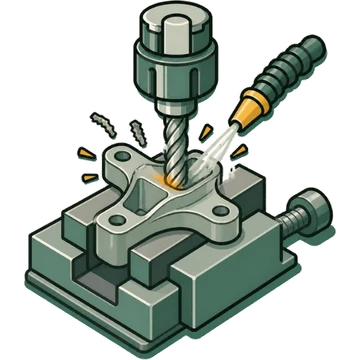
Check first
- Thermal conductivity is low, so cutting heat concentrates at the cutting edge and the tool wears easily
- It is chemically active and reacts with the tool at high temperature, causing seizure and adhesion
- Low feed causes work hardening
Try first
- Keep the cutting speed low to hold down the cutting temperature
- Do not reduce the feed too much (so that heat escapes into the chips and work hardening is avoided)
- Keep the tool load constant with climb milling (down milling; chips go from thick to thin), trochoidal milling and the like
 Likely causes
- Thermal conductivity is low, so cutting heat concentrates at the cutting edge and the tool wears easilyAgreed by 2+ makers[1][2][3][4][5]
- It is chemically active and reacts with the tool at high temperature, causing seizure and adhesionAgreed by 2+ makers[1][5][3]
- Young's modulus is about half that of steel, so deflection and chatter tend to occurOne maker[1]At low speed, process damping (the effect where the flank of the tooth rubs against the vibration wave and suppresses the vibration) works. In end milling of Ti-6Al-4V the stability limit rose up to about 80 m/min, and it widened up to about 113 m/min with a tool that has a small clearance angle on the flank. This is why chatter in titanium often stops when you lower the speed.[6]→ Chatter: process damping that works at low speed
- Large fluctuation in cutting force causes chippingOne maker[2]
- Low feed causes work hardeningAgreed by 2+ makers[3][7]
- Chips tend to be recut in slotting and pocketingOne maker[8]
- Titanium is classified as a flammable solid that may explode as dust or ignite on contact with air (take care when handling fine chips)One maker[9]
 Fixes
Cutting conditions
- Keep the cutting speed low to hold down the cutting temperatureAgreed by 2+ makers[1][10][3]
- Do not reduce the feed too much (so that heat escapes into the chips and work hardening is avoided)Agreed by 2+ makers[3][7]
- Keep the tool load constant with climb milling (down milling; chips go from thick to thin), trochoidal milling and the likeAgreed by 2+ makers[3][5]
Tool
- Use a sharp edge with a large rake angle and tools designed for titaniumAgreed by 2+ makers[3][2][5]
Setup
- Grip firmly with a rigid machine and a shrink-fit or hydraulic holderOne maker[3]
- Prepare for ignition from sparks and chips, and take fire prevention measures when using non-water-soluble oilOne maker[11]
Coolant
 Notes by material
 Related problems
Stainless steel quirks (work hardening, adhesion, notch wear)Aluminum alloy quirks (adhesion, built-up edge, chips)Cast iron quirks (powdery chips, edge chipping, black scale)Hardened steel (high-hardness steel) quirksHeat-resistant alloy (Ni-base alloy, etc.) quirksMagnesium alloy quirks (chip ignition)Copper and copper alloy quirksMild steel (low-carbon steel) quirks
Frequently asked questions
- What should I check first on the machine when "Titanium and titanium alloy quirks (heat, adhesion, ignition)" occurs?
- For Titanium and titanium alloy quirks (heat, adhesion, ignition) in Turning, Milling, Drilling, Tapping, Reaming, check these primary causes first: Thermal conductivity is low, so cutting heat concentrates at the cutting edge and the tool wears easily It is chemically active and reacts with the tool at high temperature, causing seizure and adhesion Low feed causes work hardening
- What is the fastest fix to try for "Titanium and titanium alloy quirks (heat, adhesion, ignition)" without tearing down the setup?
- Start with adjustments that can be made directly at the CNC control or tool holder: Keep the cutting speed low to hold down the cutting temperature Do not reduce the feed too much (so that heat escapes into the chips and work hardening is avoided) Keep the tool load constant with climb milling (down milling; chips go from thick to thin), trochoidal milling and the like
- Does the workpiece material change how "Titanium and titanium alloy quirks (heat, adhesion, ignition)" behaves and how to fix it?
- Yes. Material properties such as thermal conductivity, work hardening, and ductility strongly affect Titanium and titanium alloy quirks (heat, adhesion, ignition). For example, in Pure titanium: Easier to machine than titanium alloys, and tools for stainless steel can be used
 Sources
Causes and fixes are summarized in our own words from cutting-tool makers’ troubleshooting guides and technical data. “Agreed by 2+ makers” means two or more makers say the same thing. The small notes under some items and the “how it works” sections add explanations from papers, company technical reviews, public research institutes, standards, patents and maker data (papers and the like are tagged).
- Nippon Steel — Is titanium hard to machine? Typical machining methods and precautions nipponsteel.com
- OSG — End mill selection and machining characteristics for titanium materials faq.osg.co.jp
- Sandvik Coromant — Troublesome titanium: tips on machining this tough metal sandvik.coromant.com
- Mitsubishi Materials — Workpiece material applications: S series mmc-carbide.com
- Kennametal — 10 Tips for Milling Titanium kennametal.com
- PaperLi, Zhao, Li, He (Journal of Vibroengineering, 2014) — Modeling, identification and application of process damping in milling of titanium alloy extrica.com
- OSG — Why are cutting speeds for heat-resistant alloys lower than for other workpiece materials? faq.osg.co.jp
- Sandvik Coromant — Milling troubleshooting sandvik.coromant.com
- Ministry of Health, Labour and Welfare (MHLW) — Anzen Project (Workplace Safety Site) GHS model label: titanium (CAS 7440-32-6) anzeninfo.mhlw.go.jp
- OSG — Cutting conditions for titanium materials faq.osg.co.jp
- Mitsubishi Materials — Precautions for using cutting tools mmc-carbide.com
- OSG — Coolants suitable for machining titanium materials faq.osg.co.jp
- OSG — Key points for selecting taps for titanium machining faq.osg.co.jp