Printed from Kezuriba (kezuriba.net/en/troubles/material-magnesium/)
Magnesium alloy quirks (chip ignition)
Material-specific problems MillingDrillingTappingTurning
Check first
- It reacts easily with oxygen and water, and the chips burn easily. Pouring water on burning chips may cause an explosion
- Hydrogen gas is released when machining while the chips react with water-soluble fluid
Try first
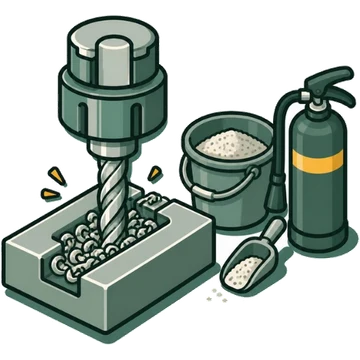
- Clean up chips frequently, store them in a lidded non-combustible container, and keep dry sand on hand for extinguishing
- Do not apply water even if there is a fire. Also do not use ABC powder extinguishers; quietly cover the fire with dry sand or a metal fire extinguishing agent, watch until it cools, and report it to the fire department
- Chips and powder may fall under the hazardous materials (Class 2) of the Fire Service Act, so decide the amount to accumulate and dispose of it early (the Fire and Disaster Management Agency's manual gives a storage guideline of up to about one pail can, about 20 L)
 Likely causes
 Fixes
Setup
- Clean up chips frequently, store them in a lidded non-combustible container, and keep dry sand on hand for extinguishingAgreed by 2+ makers[2][3]
- When machining with water-soluble fluid, ventilate thoroughlyOne maker[1]
- Do not apply water even if there is a fire. Also do not use ABC powder extinguishers; quietly cover the fire with dry sand or a metal fire extinguishing agent, watch until it cools, and report it to the fire departmentAgreed by 2+ makers[4][3][2]
- Chips and powder may fall under the hazardous materials (Class 2) of the Fire Service Act, so decide the amount to accumulate and dispose of it early (the Fire and Disaster Management Agency's manual gives a storage guideline of up to about one pail can, about 20 L)Agreed by 2+ makers[5][6][3]Magnesium is a hazardous material of Class 2 (combustible solids) in Appended Table 1 of the Fire Service Act. Lumps that do not pass through a 2 mm mesh sieve and rods 2 mm or more in diameter are excluded, but chips and powder pass through the sieve and may be covered. The designated quantity is 100 kg or 500 kg depending on the result of the ignition test.[5][6][7]
 Related problems
Stainless steel quirks (work hardening, adhesion, notch wear)Aluminum alloy quirks (adhesion, built-up edge, chips)Titanium and titanium alloy quirks (heat, adhesion, ignition)Cast iron quirks (powdery chips, edge chipping, black scale)Hardened steel (high-hardness steel) quirksHeat-resistant alloy (Ni-base alloy, etc.) quirksCopper and copper alloy quirksMild steel (low-carbon steel) quirks
Frequently asked questions
- What should I check first on the machine when "Magnesium alloy quirks (chip ignition)" occurs?
- For Magnesium alloy quirks (chip ignition) in Milling, Drilling, Tapping, Turning, check these primary causes first: It reacts easily with oxygen and water, and the chips burn easily. Pouring water on burning chips may cause an explosion Hydrogen gas is released when machining while the chips react with water-soluble fluid
- What is the fastest fix to try for "Magnesium alloy quirks (chip ignition)" without tearing down the setup?
- Start with adjustments that can be made directly at the CNC control or tool holder: Clean up chips frequently, store them in a lidded non-combustible container, and keep dry sand on hand for extinguishing Do not apply water even if there is a fire. Also do not use ABC powder extinguishers; quietly cover the fire with dry sand or a metal fire extinguishing agent, watch until it cools, and report it to the fire department Chips and powder may fall under the hazardous materials (Class 2) of the Fire Service Act, so decide the amount to accumulate and dispose of it early (the Fire and Disaster Management Agency's manual gives a storage guideline of up to about one pail can, about 20 L)
- Does the workpiece material change how "Magnesium alloy quirks (chip ignition)" behaves and how to fix it?
- Yes. Low-carbon and aluminum alloys tend to form built-up edge at low cutting speeds, stainless steels and superalloys work-harden and concentrate heat at the cutting edge if feed is too light, and hardened steels increase radial thrust and flank wear. Match the tool grade, rake angle, and cutting speed to the ISO material group.
 Sources
Causes and fixes are summarized in our own words from cutting-tool makers’ troubleshooting guides and technical data. “Agreed by 2+ makers” means two or more makers say the same thing. The small notes under some items and the “how it works” sections add explanations from papers, company technical reviews, public research institutes, standards, patents and maker data (papers and the like are tagged).
- Mitsubishi Materials — Workpiece material applications: N series mmc-carbide.com
- Yamawa — Helpful Tips No.101: Recommended taps for magnesium alloys and precautions yamawa.com
- Fire and Disaster Management Agency (FDMA) — Manual on safety measures for magnesium (June 2016) fdma.go.jp
- Fire and Disaster Management Agency (FDMA) — On initial fire extinguishing of magnesium fires (May 14, 2014, Hazardous Materials Safety Notice No. 129 of the Fire and Disaster Management Agency) fdma.go.jp
- e-Gov Law Search — Fire Service Act, Appended Table 1 (Class 2, item 6 Magnesium; Remark 6) laws.e-gov.go.jp
- e-Gov Law Search — Rules on Regulation of Hazardous Materials, Article 1-3, paragraph 3 laws.e-gov.go.jp
- e-Gov Law Search — Cabinet Order on Regulation of Hazardous Materials, Appended Table 3 (designated quantities) laws.e-gov.go.jp