Printed from Kezuriba (kezuriba.net/en/troubles/material-cast-iron/)
Cast iron quirks (powdery chips, edge chipping, black scale)
Material-specific problems TurningMillingDrillingTappingReaming
Check first
- The casting skin (black scale) is hard and uneven, and sand inclusions greatly shorten tool life
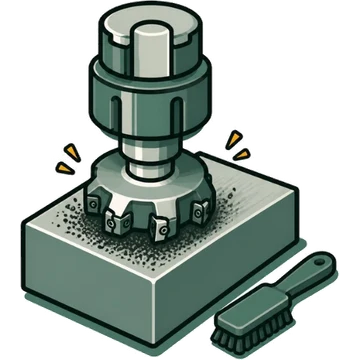
- Gray cast iron produces fragmenting (powdery) chips, and the vibration when they break tends to chip the cutting edge
- Powdery chips tend to advance rubbing wear (cutting force is not that high)
Try first
- For edge chipping, reduce the feed and depth of cut and use a sharp cutting edge
- For sand inclusions and hard surfaces, use a strong edge geometry and reduce the feed
- Straight flute taps (hand taps) are the basic choice. Depth up to about 1.5 times the nominal diameter
?Likely causes
- Gray cast iron produces fragmenting (powdery) chips, and the vibration when they break tends to chip the cutting edgeOne maker[1]
- Powdery chips tend to advance rubbing wear (cutting force is not that high)One maker[1]
- Ductile and malleable cast iron produce long chips and show damage close to that of steel (rake face wear, etc.)One maker[1]
- The casting skin (black scale) is hard and uneven, and sand inclusions greatly shorten tool lifeAgreed by 2+ makers[1][2]
- Edge chipping tends to occur at the exitOne maker[3][1]
- Chips do not connect, so a spiral tap cannot push them out upwardOne maker[4][5]
- Enlargement allowance is small, and internal threads tend to shrinkOne maker[6][7]
✓Fixes
Cutting conditions
- For edge chipping, reduce the feed and depth of cut and use a sharp cutting edgeAgreed by 2+ makers[3][8]
Tool
- Straight flute taps (hand taps) are the basic choice. Depth up to about 1.5 times the nominal diameterOne maker[4][5]
- For better durability, use a powder HSS or carbide tapOne maker[5]
- For ductile cast iron, tool materials of the same family as for steel can sometimes limit damageOne maker[1]
- For sand inclusions and hard surfaces, use a strong edge geometry and reduce the feedAgreed by 2+ makers[2][1]
↔Related problems
Stainless steel quirks (work hardening, welding, boundary wear)Aluminum alloy quirks (welding, built-up edge, chips)Titanium and titanium alloy quirks (heat, welding, ignition)Hardened steel (high-hardness steel) quirksHeat-resistant alloy (Ni-base alloy, etc.) quirksMagnesium alloy quirks (chip ignition)Copper and copper alloy quirksMild steel (low-carbon steel) quirks
📚Sources
Causes and fixes are summarized in our own words from cutting-tool makers’ troubleshooting guides and technical data. “Agreed by 2+ makers” means two or more makers say the same thing.
- Mitsubishi Materials — Workpiece material applications: K series mmc-carbide.com
- Sandvik Coromant — Drilling wear and troubleshooting sandvik.coromant.com
- Mitsubishi Materials — Turning troubleshooting mmc-carbide.com
- OSG — What should be kept in mind when tapping? faq.osg.co.jp
- OSG — Improving tool life when machining FC250 faq.osg.co.jp
- OSG — Tool Communication Series No.6 Taps, "12. Troubleshooting in tapping operations," pp. 59-62 osg.co.jp
- OSG — Series No.34 High-speed synchro taps, "8. Troubles and countermeasures," pp. 28-29 osg.co.jp
- Tungaloy tungaloy.com