Printed from Kezuriba (kezuriba.net/en/troubles/wall-deflection/)
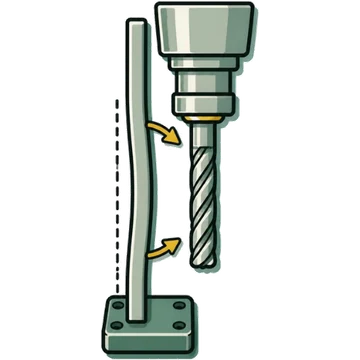
Walls lean or are wavy (end milling)
Turning and milling Milling
Check first
- Depth of cut or feed is large
- Insufficient tool rigidity or long overhang
- Tool wear is large
Try first
- Reduce the depth of cut and use step machining in the axial direction
- Reduce the feed per tooth
- Split into roughing, semi-finishing, and finishing, and reduce the finishing allowance
 Likely causes
 Fixes
Cutting conditions
- Reduce the depth of cut and use step machining in the axial directionAgreed by 2+ makers[2][1][3]
- Reduce the feed per toothAgreed by 2+ makers[2][1][3]
- Split into roughing, semi-finishing, and finishing, and reduce the finishing allowanceAgreed by 2+ makers[2][4]Leaving a thicker stock allowance before finishing makes the natural frequency of the workpiece less likely to drop during finishing, so it is less prone to chatter (in an analysis of a 3 mm thick Ti-6Al-4V plate, going from 0.1 mm to 1.5 mm of remaining stock raised the first natural frequency by about 45%). In die machining, there is also an example where adding semi-finishing between roughing and finishing and making the finishing depth of cut constant eliminated chatter at inside corners.[5][6]→ Chatter (vibration)
- Do the finishing with up millingOne maker[2]Up milling tends to speed up flank wear (see “flank wear is fast”), so limit it to the last finishing pass.[7]→ Flank wear is rapid
Tool
 Related problems
Frequently asked questions
- What should I check first on the machine when "Walls lean or are wavy (end milling)" occurs?
- For Walls lean or are wavy (end milling) in Milling, check these primary causes first: Depth of cut or feed is large Insufficient tool rigidity or long overhang Tool wear is large
- What is the fastest fix to try for "Walls lean or are wavy (end milling)" without tearing down the setup?
- Start with adjustments that can be made directly at the CNC control or tool holder: Reduce the depth of cut and use step machining in the axial direction Reduce the feed per tooth Split into roughing, semi-finishing, and finishing, and reduce the finishing allowance
- Does the workpiece material change how "Walls lean or are wavy (end milling)" behaves and how to fix it?
- Yes. Low-carbon and aluminum alloys tend to form built-up edge at low cutting speeds, stainless steels and superalloys work-harden and concentrate heat at the cutting edge if feed is too light, and hardened steels increase radial thrust and flank wear. Match the tool grade, rake angle, and cutting speed to the ISO material group.
 Sources
Causes and fixes are summarized in our own words from cutting-tool makers’ troubleshooting guides and technical data. “Agreed by 2+ makers” means two or more makers say the same thing. The small notes under some items and the “how it works” sections add explanations from papers, company technical reviews, public research institutes, standards, patents and maker data (papers and the like are tagged).
- Mitsubishi Materials — End mills: troubleshooting mmc-carbide.com
- OSG — Series No.8 End mills, Table 7.1 Troubleshooting, pp. 61-62 osg.co.jp
- Mitsubishi Materials — End milling troubleshooting mmc-carbide.com
- Tungaloy tungaloy.com
- PaperYildiz (Sabanci University, PhD thesis) — Modeling Milling of Thin-Walled Parts Considering Dynamic Structure-Process Interactions research.sabanciuniv.edu
- Public labNishikawa, Himemiya, Kikuta (Hiroshima Prefectural Technology Research Institute, Western Region Industrial Research Center, Research Report No.63, 2020) — Development of a high-precision die machining system (Report 8): development of an NC simulator for chatter analysis in end milling pref.hiroshima.lg.jp
- Sandvik Coromant — Down Milling vs. Up Milling mscdirect.com