How a metalworking company can enter medical device parts machining: common parts and materials, market trends, major makers, the PMD Act, ISO 13485 and the hurdles
Parts makers need no license. The conditions: no unapproved changes, clean delivery, full traceability

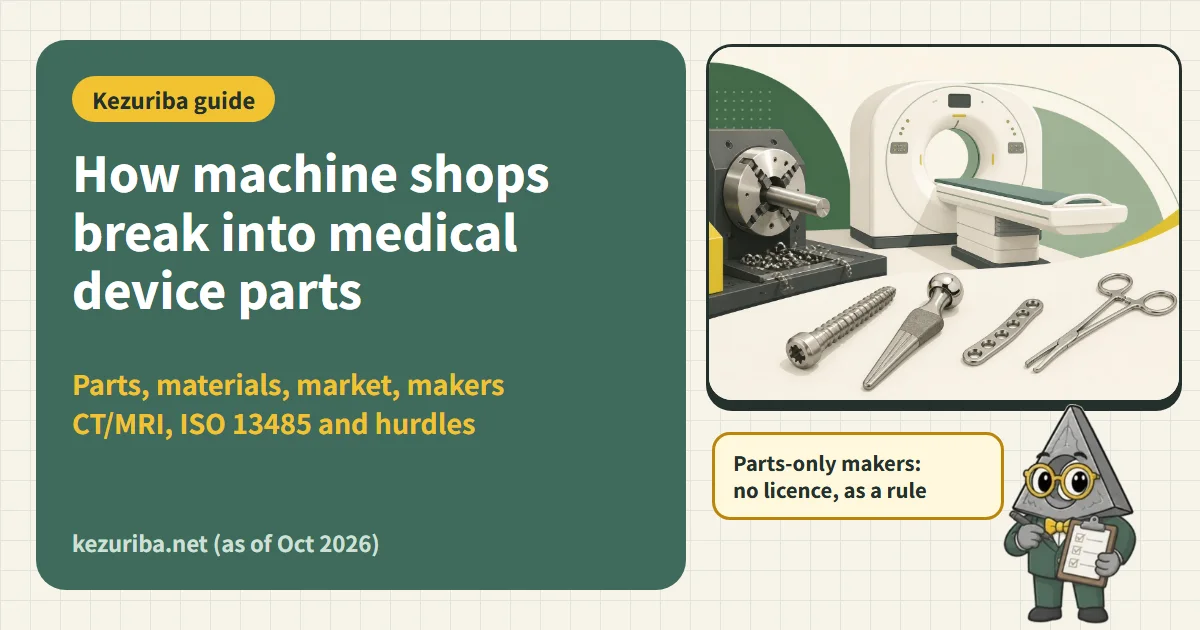
Japan's medical device market grew to about 5 trillion yen in 2024, but imports now exceed domestic production; for artificial joints and the screws and plates that hold bones in place, imports are about four times domestic production. Surgical instruments, implants and endoscopes are also largely made up of precision parts in titanium, cobalt-chromium and stainless steel turned and milled on lathes and machining centers. Diagnostic imaging systems such as CT and MRI, on the other hand, contain large parts too, such as rotating assemblies about 1 m across and magnet vessels weighing several tons. This article covers which parts are most common, market trends and the major medical device makers, large CT and MRI parts and their makers, which laws apply to parts makers (in fact, no license is needed), ISO 13485, entry routes and support, the real hurdles, drawing on public sources from MHLW, PMDA, METI, standards bodies, research papers and others (as of October 2026).
Market trends: bigger, but the growth went to imports
According to MHLW's Statistics of Production by Pharmaceutical Industry, medical devices in 2024 (Reiwa 6) recorded domestic production of ¥2.6642 trillion, imports of ¥3.4542 trillion, exports of ¥1.1445 trillion and domestic shipments of ¥4.7083 trillion for the year[1]. The domestic market (production minus exports plus imports) was about ¥4.9738 trillion, roughly 80% larger than the approx. ¥2.7479 trillion of 2015 (a rough guide only, since the survey method changed along the way)[4].
However, most of the growth went to imports. Domestic production was flat at ¥2.4–2.7 trillion from 2019 to 2024, while imports rose from ¥2.6 trillion to ¥3.5 trillion[1]. An MHLW survey report also classes Japan, along with the US and France, as a net importer, while China and Germany are net exporters[7].
Notes on reading the figures① The survey method changed in 2019, and production came out 28% higher than the year before, so figures cannot be compared directly with 2018 and earlier[1]. ② “Imports” in the statistics are the value of imported products when shipped in Japan, which differs from the import value in trade statistics[1]. ③ The 2024 figures were revised in 2026 and differ from the initial release (imports ¥3.6056 trillion, domestic shipments ¥4.7195 trillion)[1][2].
Which fields rely on imports
For metalworking companies, the category that stands out most is this one: Orthopedic products (artificial joints, bone fixation devices, etc.). In 2024, domestic production was ¥135.4 billion against imports of ¥523.7 billion, the largest of all import categories. The US supplied ¥246.7 billion, nearly half, followed by Switzerland at ¥51.6 billion, Ireland ¥47.9 billion, China ¥32.7 billion and Germany ¥27.9 billion. Orthopedic instruments, such as tools for cutting bone in surgery, also show production of ¥26.9 billion against imports of ¥83.1 billion[1]. For hip prosthesis parts, one device maker has also stated that about 80% of the ceramic femoral heads used in Japan come from overseas[8].
By contrast, endoscopes are a field where Japan is strong: of ¥265.0 billion produced, ¥259.3 billion is exported[1]. There are 1,725 companies making medical devices in Japan; 86% of them produce less than ¥100 million a month, yet together they account for only about 8% of total production[1]. Large makers carry most of the production, with many small producers and parts suppliers spread out beneath them. By prefecture, production value ranks Tochigi, Shizuoka, Ibaraki, Fukushima, Saitama, Aichi, Chiba in that order[3], a useful guide when deciding which regions to target for sales.
The world medical device market was about $517 billion in 2023, with Japan ranked fourth after the US, Germany and China (about a 5% share). Growth of around 6% a year is expected (private research firm data cited in an MHLW document)[7].
Major medical device makers
Below are the major device makers you might sell parts to, with sales for their latest fiscal year. Some figures are company-wide and some cover only the medical segment, so check the “Scope” column. We also list products that contain many machined metal parts.
| Japanese companies | Sales (fiscal year) | Scope | Products with many machined metal parts (examples) |
|---|---|---|---|
| Terumo | ¥1.1319 trillion (FY ended Mar 2026)[9] | Company-wide | Catheters, stents, guidewires, injection needles |
| Olympus | ¥1.0107 trillion (FY ended Mar 2026)[10] | Company-wide (GI endoscopes ¥697.4 billion) | Endoscope distal-end and bending-section parts; treatment devices such as biopsy forceps |
| Fujifilm | ¥1.0989 trillion (FY ended Mar 2026)[11] | Healthcare segment (incl. contract drug manufacturing, etc.) | Endoscopes, X-ray and ultrasound systems |
| Canon | ¥580.6 billion (FY ended Dec 2025)[12] | Medical segment | CT, MRI and ultrasound systems |
| Nipro | ¥523.6 billion (FY ended Mar 2026)[13] | Medical-related business (incl. drug sales) | Dialyzers, injection needles, catheters |
| Sysmex | ¥500.1 billion (FY ended Mar 2026)[14] | Company-wide (incl. reagents) | Analyzers for blood and other samples |
| Nihon Kohden | ¥235.1 billion (FY ended Mar 2026)[15] | Company-wide | Patient monitors, electrocardiographs, AEDs |
| Asahi Intecc | ¥145.4 billion (FY ended Jun 2026)[17] | Company-wide | Guidewires (drawing and stranding of ultra-fine stainless steel and tungsten wire) |
| Fukuda Denshi | ¥139.7 billion (FY ended Mar 2026)[16] | Company-wide | Electrocardiographs, home oxygen therapy and other equipment |
| MANI | About ¥30 billion (FY ended Aug 2025)[18] | Company-wide | Surgical suture needles, ophthalmic knives, dental reamers and files (tiny cut and ground products) |
| Japan Medical Dynamic Marketing (JMDM) | ¥23.9 billion (FY ended Mar 2026)[19] | Company-wide | Artificial joints, bone fixation devices, spinal fixation devices (developed and made by its US subsidiary) |
| Overseas companies | Sales (fiscal year) | Scope | Products with many machined metal parts (examples) |
|---|---|---|---|
| Medtronic (Ireland/USA) | $36.4 billion (FY ended Apr 2026)[20] | Company-wide | Spinal implants, surgical instruments, cardiac devices |
| Johnson & Johnson MedTech (USA) | $33.8 billion (2025)[21] | MedTech segment (orthopedics $9.3 billion) | Artificial joints, bone fixation, spine (DePuy Synthes) |
| Stryker (USA) | $25.1 billion (2025)[22] | Company-wide (orthopedics $9.5 billion) | Hip and knee prostheses, trauma plates and intramedullary nails, surgical power tools |
| Siemens Healthineers (Germany) | About €23.4 billion (FY ended Sep 2025)[23] | Company-wide | CT, MRI and radiotherapy systems |
| BD (USA) | About $21.8 billion (FY ended Sep 2025)[26] | Company-wide | Syringes, injection needles, catheters, surgical instruments |
| Abbott (USA) | About $21.4 billion (2025)[24] | Medical devices segment | Stents, cardiac devices, glucose monitors |
| GE HealthCare (USA) | About $20.6 billion (2025)[27] | Company-wide | CT, MRI and ultrasound systems |
| Boston Scientific (USA) | About $20.1 billion (2025)[25] | Company-wide | Catheters, stents, endoscopic treatment devices |
| Philips (Netherlands) | About €17.8 billion (2025)[28] | Company-wide (incl. consumer products) | Diagnostic imaging systems, patient monitors |
| Zimmer Biomet (USA) | About $8.2 billion (2025)[29] | Company-wide | Knee and hip prostheses, bone fixation devices |
Fiscal years and accounting standards differ by company, so these figures are not suited to ranking. Most large overseas makers have a Japanese subsidiary and import the products they sell in Japan. The big orthopedic makers (J&J, Stryker, Zimmer Biomet) are centered in the US, which matches the fact that nearly half of Japan's orthopedic product imports come from the US[1]. For artificial joints there are also domestic makers, such as a Kyocera group company and Nakashima Healthforce (formerly Nakashima Medical)[8][90].
Which metal parts are common
Nearly 80% of implantable medical devices are made of metal, and for orthopedic implants the figure is about 95%. Stents and guidewires are metal too, because they need both the elasticity to bend smoothly along blood vessels and the strength to keep a vessel propped open[30].
| Field | Typical parts | Main materials | Machining points |
|---|---|---|---|
| Bone fixation devices | Bone screws, plates, intramedullary nails[34][35] | CP titanium, Ti-6Al-4V, Ti-6Al-7Nb, SUS316L equivalent[34] | Long, slender screws are generally machined on Swiss-type lathes with thread whirling[57] |
| Knee prosthesis | Femoral component, tibial tray, fixation screws, stem[31] | Co-Cr-Mo (cast, forged), titanium alloy[31] | Review guideline for the femoral component's bearing surface: Ra 0.1 µm or less[31] |
| Hip prosthesis | Stem, femoral head, cup[32] | Titanium alloy, Co-Cr-Mo, stainless steel | Metal femoral heads that articulate against polymer: surface roughness of 0.05 µm or less as a guide[32]. Ultra-precision turning, then finishing[52] |
| Spine | Screws (monoaxial, polyaxial), rods, hooks, connectors[33] | CP titanium, titanium alloy, stainless steel, Co-Ni-Cr-Mo[33] | Threads, spherical surfaces, rod bending. Cages may also be polymer (PEEK) |
| Dental | Implant fixtures, abutments, screws[36] | CP titanium (JIS H 4650, ASTM F67), Ti-6Al-4V ELI[36] | Sandblasting, acid etching, anodizing (color coding) and wire EDM are listed in the approval standard[36] |
| Surgical instruments | Forceps, scissors, needle holders, orthopedic instruments | Mainly stainless steel (austenitic, martensitic, precipitation-hardening)[38] | Blade mating, spring action, hardening. In the US, reusable instruments need direct UDI marking[48] |
| Endoscopes, surgical robots | Bending-section joint rings, treatment devices, robot forceps | Typically a chain of linked stainless tubular parts[37] | Tiny, thin-walled, long parts. One SME expanded from turning auto parts to making surgical robot parts[87] |
| Stents, guidewires | Metal parts for stents, guidewires, catheters | 316L, Co-Cr, nitinol (ASTM F2063)[30][45] | Fine tubing and wire: the world of wire drawing, laser cutting and polishing rather than machining |
Where lathe and machining center shops can best put their skills to use is in screws and rods for bone fixation and the spine, machining and finishing of artificial joints, surgical instruments, and precision parts for endoscopes and robots. Stents and guidewires belong to the specialist world of wire drawing and laser processing, so they are a stretch for machining shops.
Materials and standards
| Materials | JIS | ISO | ASTM |
|---|---|---|---|
| Implant stainless steel (316L equivalent) | T 7403-1 | 5832-1 | F138 |
| Commercially pure titanium | T 7401-1 | 5832-2 | F67 (Grade 1–4) |
| Ti-6Al-4V | T 7401-2 | 5832-3 | F136 (ELI), F1472 (non-ELI) |
| Ti-6Al-7Nb (vanadium-free) | T 7401-5 | 5832-11 | F1295 |
| Titanium alloys developed in Japan | T 7401-3 (Ti-6Al-2Nb-1Ta), T 7401-4 (Ti-15Zr-4Nb), T 7401-6 (Ti-15Mo-5Zr-3Al) | 5832-14 (Ti-15Mo-5Zr-3Al) | ― |
| Co-Cr-Mo | T 7402-1 (cast), T 7402-2 (wrought) | 5832-4 (cast), 5832-12 (wrought) | F75 (cast), F1537 (wrought), F799 (forged) |
| Nitinol (shape memory alloy) | ― | ― | F2063 (tubing: F2633) |
| Stainless steel for surgical instruments | ― | 7153-1 | F899 |
Standard titles checked on the JSA, ISO and ASTM pages[39][40][41][42][43][44][45][38]. Drawings often specify materials by ASTM number, so also see the ASTM quick reference and Materials database (Ti-6Al-4V, 17-4PH, etc.).
Large parts: CT, MRI and other imaging systems
In contrast to the small parts that go inside the body, imaging systems are built around rotating assemblies about 1 m across and magnet vessels weighing several tons. Looking at medical devices made in Japan in 2024 by generic name, whole-body X-ray CT systems ranked first at ¥88.1 billion. Superconducting whole-body MR systems (MRI) came to ¥31.4 billion. The category that includes CT, “medical X-ray equipment,” exported ¥126.7 billion of its ¥226.0 billion production (the US being the top destination) against imports of ¥80.4 billion: a field where Japan is on the making-and-selling side[1]. On the user side, too, Japan has 184 CT, MRI and PET units per million people, far above the OECD average of 51[91].
CT and MRI systems are controlled medical devices (Class II) and also “specified maintenance-controlled medical devices,” which require specialist management for installation and maintenance[92][93]. Even so, as with other medical devices, a company that makes parts to drawing and delivers them does not need a PMD Act license (see the section on the law). Since most are structural parts that never touch the body, what matters is less cleanliness than dimensions, runout, balance, welding and non-magnetic properties.
Makers producing imaging systems in Japan
| Company | Main sites in Japan | Products | Segment sales (fiscal year) |
|---|---|---|---|
| Canon (formerly Canon Medical Systems) | Nasu Operations (Otawara, Tochigi) | CT, MRI, X-ray, ultrasound, etc. Canon has announced that it plans to take over Canon Medical Systems' businesses other than domestic sales and service as of April 1, 2026[95]. The company's head office has moved to Kawasaki[96] | Medical ¥580.6 billion (FY ended Dec 2025, incl. ultrasound, in-vitro diagnostics, etc.)[94] |
| Canon Electron Tubes & Devices | Otawara, Tochigi | Electron tubes such as X-ray tubes[94] | ― |
| Fujifilm (formerly Hitachi's diagnostic imaging business) | Fujifilm Healthcare Manufacturing (head office in Kashiwa, Chiba; 11 sites in Japan)[97] | CT, MRI, X-ray, etc. Took over the business from Hitachi in March 2021[98]. Also offers 0.4 T and 0.3 T open permanent-magnet MRI[134] | Healthcare segment ¥1.0989 trillion (FY ended Mar 2026, incl. contract drug manufacturing, etc.)[11] |
| GE HealthCare Japan | Plant at the Hino head office (Hino, Tokyo) | CT, MRI, ultrasound probes (2013 announcement)[99]. In January 2026 it opened a facility that 3D-prints collimators for nuclear medicine and CT[100] | GE HealthCare Imaging $9.245 billion (2025)[105] |
| Shimadzu | Shimane Shimadzu (Izumo, Shimane), etc. | Angiography, X-ray fluoroscopy (X-ray TV), general radiography, mobile X-ray, etc. Does not make CT or MRI[101] | Medical systems ¥73.8 billion (FY ended Mar 2026)[102] |
Among overseas players, Siemens Healthineers' Imaging segment had €13.182 billion (FY ended Sep 2025)[104], and Philips' Diagnosis & Treatment €8.531 billion (2025)[107]. Siemens' Japanese subsidiary handles import sales, repair and maintenance, and does not manufacture in Japan[103]. GE HealthCare lists Siemens Healthineers, Philips, United Imaging (China), Mindray (China) and Canon as its main global competitors[106].
CT: a rotating assembly about 1 m across
| Part | Example sizes and figures | Example materials and methods | What matters in machining |
|---|---|---|---|
| Rotor (rotating frame/disc) | Bore about 78 cm. One rotation in 0.275 s puts 48.5 G on the gantry[114] | Cast aluminum alloy, 15–20 mm wall thickness[115], a disc stamped from steel plate[116] etc. | If parts shift by more than 0.15 mm, image quality drops sharply[115]. Unbalance is measured in two planes and corrected with weights[117] |
| Main bearing | Ultra-thin-section bearing with a 1,041.4 mm pitch diameter and 12.7 mm balls[118]. Another example: 1,050 mm diameter, up to 300 rpm, carrying over 1,000 kg[120] | Thin-section ball bearings. Some have a built-in damping mechanism to suppress vibration (about half the amplitude of conventional ones)[119] | Example: bearing housings 300–2,000 mm in diameter finished by turning and milling in one setup[121] |
| Slip ring | ID up to 1,270 mm. Transfers several kW of power and over 20 Gbps of data to and from the rotating side[122] | Power by contact, data contactless | Runout and flatness of large-diameter rings |
| X-ray tube | Anode diameter e.g. 166 mm[123] | Molybdenum disc with a tungsten-rhenium focal track, liquid-metal bearing[123] | The mounting on the rotor must withstand 40 G or more[124] |
| Collimator | 913 plates in a 16-slice example[125] | Thin tungsten plates inserted into slots[125] | Slot machining, thin-plate accuracy |
| Couch top | ― | Foam core sandwiched in CFRP. About 5 times as X-ray-transparent as aluminum alloy[126] | Molded part; fitting metal brackets |
MRI: multi-ton magnets and "non-magnetic" parts
| Part | Details |
|---|---|
| Superconducting magnet | A coil wound with NbTi superconducting wire. A 0.5 T example is 1.79 m high, 1.8 m wide and 1.85 m long, and weighs 7,900 kg including cryogen. Field inhomogeneity is corrected with thin iron sheets or thin iron rods (shims)[127]. Some companies specialize in NbTi wire for MRI[137] |
| Cryostat (low-temperature vessel) | The helium vessel is surrounded by a thermal shield and enclosed in a vacuum vessel. The main parts use fully welded construction to hold a high vacuum for years, and the thermal shield's material and thickness are set by eddy-current analysis. The internal weight is carried by low-conductivity FRP[127]. In one example, the vacuum vessel is mild steel plate that doubles as a magnetic shield, the bore is non-magnetic stainless, and the helium vessel and thermal shield are aluminum[128] |
| Gradient coil | Copper or other conductors set in resin. There is also a patent for aluminum conductors[129] |
| Shielded room | An RF shield that encloses all 6 faces of the room in metal, and a magnetic shield of many layers of electrical steel sheet (0.35–0.5 mm)[136]. Closer to sheet-metal and construction work |
| The shift to less helium | A 1.5 T superconducting MRI that uses no liquid helium (and needs no vent pipe)[130], and sealed designs with helium cut to 7 L[131] or 0.7 L[132] are on the market. There is also research on an MgB2 magnet cooled by cryocoolers alone that ramps up its field in about 8 minutes[133]. Vessel construction is changing, and so is the way heat-transfer and welded parts are made |
| Open permanent-magnet MRI | 0.4 T and 0.3 T permanent magnets; no liquid helium[134]. Some models support the magnet on a single pillar[135] |
Parts near an MRI must be "non-magnetic"Annealed SUS304 is not attracted to a magnet, but cold working turns it into martensite and makes it magnetic. SUS316L transforms less readily, but heavy working still gives it weak magnetism[138]. In measurements by ORIST (Osaka Research Institute of Industrial Science and Technology), the relative permeability of SUS304 was 1.024 on the flat part of a sheet, 1.051 at a bend, 1.225 at the thread of a bolt and 1.624 at its head[139]. Bending, heading and heavy cutting bring out magnetism, so if the drawing specifies permeability, add a step to measure with a low-permeability meter after machining. In MRI rooms, there have been accidents in which oxygen cylinders or IV stands brought in were pulled into the magnet[140].
Where to pitch large parts
- Canon: Its "Procurement Information" page has a form for supplier proposals and the steps to start doing business[108].
- Shimadzu: Its procurement policy and contact (Procurement Department) are public, and quality control and CSR are checked before business starts[109].
- Fujifilm: The group's procurement policy is public[110].
- GE HealthCare Japan: Publishes supplier requirements and information on its supplier portal[111].
- Regional contacts: Tochigi Prefecture is recruiting members for an industry promotion council that covers medical and welfare equipment, and companies planning to enter can join[112]. Chiba Prefecture's "Chiba Medical Network" supports matching with device makers and medical sites[113].
- Supplying component makers: Japanese bearing makers also mass-supply CT bearings in Japan and abroad (2008 announcement)[119], and there are overseas specialists in bearings, slip rings and X-ray tubes[120][122][123]. Instead of going to equipment makers directly, you can also take on housings and structural parts for these component makers.
Who large equipment parts suitCompanies that already have large lathes, vertical lathes, horizontal boring mills, 5-axis gantry machines, large-part welding and annealing, and CMMs, and have made large parts for semiconductor equipment or machine tools. Rather than in the world of cleaning and sterilization that implants live in, you can compete on records of dimensions, runout, balance, welding and non-magnetism. Of the medical rules, advance notice of changes and traceability (section on the law) are required here just the same.
The machining: difficult-to-cut materials and “after cutting”
| Topic | What is known |
|---|---|
| Heat in titanium alloys | Ti-6Al-4V has low thermal conductivity; at high cutting speeds the cutting temperature keeps rising until it nears the melting point[50]. End-milling tool life is shorter than in carbon steel, and as wear progresses, dimensions and surface roughness go out of tolerance[49] |
| Titanium chip fires | Chips can ignite when cutting at high speed with small depths of cut, and what matters more than depth of cut or feed is cutting speed[51]. Manage the fire risk together with your choice of oil-based cutting fluid |
| Cobalt-chromium | Hard to cut: high hardness, low thermal conductivity, work hardening[56]. In micro-milling, the machined surface hardened to 597–710 HV in one case[54]. Cutting high-carbon Co-Cr for knee prostheses with cBN tools gave 0.6 µmRz, with 10 m/s as the optimum cutting speed[53] |
| Finishing femoral heads | A report of Co-Cr-Mo femoral heads turned on an ultra-precision lathe and finished with an electron beam, improving form accuracy from 2–3 µm to 0.7 µm[52] |
| Passivation and marking | ASTM F86 is the main reference for surface treatment and marking of metallic implants, and ASTM A967 for chemical passivation of stainless steel parts. One aim is to remove iron particles and the like embedded in the surface by cutting, grinding or blasting[46] |
| Cleaning | Cleaning of orthopedic implants is covered by ISO 19227: design, validation and routine control of the cleaning process, and evaluation of residues, particles, cytotoxicity and more[47] |
| New processes | There is also research on cutting Ti-6Al-4V while cooling with liquid nitrogen to refine surface grains below 100 nm, improving sliding properties and biocompatibility[55] |
What changes on the shop floor is "after cutting"Even if the dimensions are right, a part left with burrs, cutting oil or iron particles is a reject in medical work. For products that go through a step to remove machining oils and the like, the MAH has to document its cleanliness and contamination-control requirements (QMS Ordinance, Art. 41)[61]. Expect your cutting oil brand, washer settings, deburring method and marking method to become conditions of the deal itself. For cutting conditions, see the cutting conditions calculator; for tool wear, the tool life article.
The law: does a parts maker need a license?
In the medical device world, licensing is split between the marketing authorization holder (MAH) licence, held by whoever is responsible for placing devices on the market (Type 1–3 licences depending on the risk of the devices), and manufacturer registration for each site where devices are made[58]. Manufacturer registration is required for sites that carry out design, main assembly and other main manufacturing steps, sterilization, or storage of finished products in Japan (for general medical devices, the three other than design)[59].
| Your position | What you need | Basis |
|---|---|---|
| A company that machines parts to drawings and delivers them | In principle, no licence or registration. The customer with substantive responsibility for the product registers as the "main assembly" site | The MHLW Q&A gives this very example: outsourcing the machining of orthopedic implants to a metalworking company[60]. The Guidebook on Supplying Materials and Components also states that component suppliers are not medical device manufacturers and are outside the scope of the PMD Act[64] |
| A company that itself sterilizes parts supplied as sterile | Registration as a "sterilization" site | Same Q&A[60] |
| A contract manufacturer that takes on the whole process and is responsible for how the product turns out | Registration as a "main assembly" site | Same Q&A[60] |
| A company that sells its own instruments as medical devices (Route D) | MAH licence and manufacturer registration. General medical devices (Class I) are notified to PMDA product by product (no review) | PMD Act, Art. 23-2-12[58] |
However, being outside the law is not the same as having nothing required of you. MAHs are subject to the QMS Ordinance (aligned with ISO 13485:2016 by a 2021 revision; the inspection standard since March 26, 2024)[62], and through their purchasing controls, requirements reach parts companies[61].
- Selected, and watched continuously (Art. 37): You are evaluated on your ability to supply, track record, impact on quality and the risk of the intended use; your performance is monitored and you are re-evaluated[61].
- Orders come with process, equipment and personnel requirements (Art. 38): Purchasing information covers not just specifications but requirements for in-plant procedures, processes and equipment, operator qualification and the quality system. In addition, agreeing in writing that "changes affecting conformity will be notified in advance" is mandatory[61].
- Receiving inspection and on-site audits (Art. 39): The scope of verification depends on risk, and you may be subject to witnessed inspections or audits[61].
- Traceability (Arts. 48 and 49): Traceability down to components, and for implantable devices, records down to the components and work-environment conditions that affect quality[61]. You need material mill certificates and lot records.
- Validation for processes that can't be checked afterward (Art. 45): For processes such as cleaning, passivation and welding, whose results can't be verified afterward, the process itself is validated, with procedures covering equipment, operators, acceptance criteria and approval of process changes[61]. In the industry, installation, operational and performance qualification of equipment are called IQ, OQ and PQ.
Product liability and contracts
A government survey also lists as an issue cases where component makers refuse or hesitate to supply for medical devices, fearing they will be held liable for medical accidents[68]. The Product Liability Act provides a component-manufacturer defence: if a defect arose solely from following the finished-product maker's design instructions and you were not negligent, you are not liable (Art. 4(2); the parts company bears the burden of proof)[67]. A METI pamphlet says there were 4 product liability lawsuits involving medical devices in Japan from 2012 to 2021, and in none was a component supplier found liable[65].
| What to settle in the contract | Why |
|---|---|
| Approved specification | Record drawings, materials and inspections as the "purchaser's specification". This underpins the component-manufacturer defence[64] |
| Notice of changes and discontinuation | When materials or processes change, the device maker must judge whether a partial change application or minor change notification is needed. Allow for that time, notify early and keep supplying[64][63] |
| Allocation of liability | Responsibility for selection, no warranty of fitness for the intended use, liability caps, etc. The government has published model clauses[66] |
| Insurance | Product liability insurance covers injury to people and damage to property; costs such as voluntary recalls are separate. Combining it with E&O insurance for manufacturers is recommended[65] |
| Joint development or not | Parts whose uses and purposes were defined jointly in development are not covered by the component-manufacturer defence. Define the scope of liability first[64] |
ISO 13485: do you need it, and when to get it
ISO 13485 (JIS Q 13485:2018 in Japan) is a quality management standard that adds medical-device-specific requirements to ISO 9001[69]. The biggest difference from ISO 9001 is that "regulatory compliance comes first", and it adds risk management throughout product realization, contamination control, validation, traceability and more[70].
- Not mandatory for parts companies: The standard's introduction says suppliers providing components and the like "can choose it voluntarily, or may be required to by contract"[69]. With it, some customers may waive their second-party audit[70].
- Time and order: According to certification bodies, it takes roughly 1–1.5 years from starting to registration, and you need a shipping record for the products in scope. More parts and materials makers are getting certified[71]. So rather than "certify first, then sell", it is realistic to get certified in parallel with your first customer.
- Cost: Audit fees are quoted individually based on headcount and number of sites; there is no published guideline[71]. Get quotes from several certification bodies.
- Revision: ISO 13485:2016 was "confirmed" without revision, and one certification body says the current edition will stay until 2030[72].
Rules overseasThe US FDA's quality rule was revised to incorporate ISO 13485 by reference (QMSR) and took effect on February 2, 2026[73]. This rule does not apply to manufacturers of components or parts of finished devices, but the same thinking reaches them through manufacturers' purchasing controls[74]. The EU MDR also requires manufacturers' quality systems to include the selection and control of suppliers and subcontractors, and notified bodies can make unannounced audits at supplier sites if needed[75]. If you work with overseas manufacturers, you may face audits in English.
Entry routes and where to get support
| Route | What it looks like | Best suited to |
|---|---|---|
| A Contract machining of parts | Deliver parts made to drawings to device makers' purchasing or R&D | Companies with a clear specialty such as difficult-to-cut materials, micro parts or long, slender parts |
| B Partner to a contract manufacturer | Become a subcontractor to a contract manufacturer (CMO/OEM) that takes on work up to assembly from device makers | Companies that first want to get used to the medical rules |
| C Medical–engineering collaboration | Work with device makers to create new instruments or parts from the needs of doctors or universities | Companies good at prototyping and proposals. In joint development, settle the allocation of liability first[64] |
| D Own products | Obtain the business licences and launch your own instruments as medical devices | Companies that can make instruments from scratch. In one case, dental instruments grew to over 60% of sales[88] |
- Trade shows: Closest to pitching parts machining is the Medical Device Development Expo (MEDIX) (Tokyo, June 16–18, 2027; Osaka, October 6–8, 2027)[78]. Medtec Japan 2027 runs April 21–23, 2027, at Tokyo Big Sight[77]. Medical Japan focuses mainly on hospitals and nursing care[79].
- Medical Device Development Support Network (MEDIC): An AMED program with the University of Tokyo Hospital as secretariat; it offers consultation on development and commercialization[80]. The Guidebook on Supplying Materials and Components is also posted there[64].
- AMED's Medical-Engineering Collaboration Global Expansion Program: Subsidies for development with medical institutions and MAHs (two-thirds subsidy rate, up to 70 million yen a year for non-clinical work). Applications for FY2026 closed in February[81].
- PMDA's RS General Consultation: Free, about 20 minutes per session. Questions about business licences themselves go to the prefecture's pharmaceutical affairs division[82].
- Regional contacts: Tokyo Medical-Engineering Collaboration HUB Organization[83], the Osaka Chamber of Commerce and Industry's Next-Generation Medical System Industrialization Forum (matching meetings and sales pitch sessions)[84], Fukushima Medical Device Development Support Center[85], Shizuoka Prefecture's Pharma Valley Center[86] , among others.
Companies that have entered
| Company (location) | Original business | How they entered |
|---|---|---|
| M-Tech (Hitachinaka, Ibaraki) | Turning automotive parts | Developed technology for micro and long, slender parts used inside the body under a national subsidy program, obtained ISO 13485, set up a base in Germany, and exports precision parts for surgical robots and forceps[87] |
| Suntechno (Namegata, Ibaraki) | Small-diameter shafts and pins | Obtained a manufacturing licence in 1996 and moved into dental instruments. Medical devices are over 60% of sales[88] |
| Sado Seimitsu (Sado, Niigata) | High-mix precision parts machining | With 150+ machining centers, CNC lathes and other machines, it makes titanium alloy implants and endoscope parts alongside aircraft and semiconductor equipment parts[89] |
| Nakashima Propeller (Okayama) | Marine propellers | Entered artificial joints with its propeller curved-surface machining skills; spun off its medical division in 2008[90] |
Order of steps to entry (guideline)
- Choose your target field: Equipment parts, surgical instruments and implants have very different requirements. Start close to your strengths (difficult-to-cut materials, micro parts, long parts, mirror finishes). A survey by the Kinki Bureau of Economy, Trade and Industry lists these as keys to success: personal connections, taking an objective view of demand for the end product, choosing jobs where spec changes are kept in check and that can be made steadily for a long time, and using outside expertise where you are weak[76].
- Add the systems: Build lot traceability, change control, procedures for cleaning, burrs and foreign matter, and contract templates (approved specification, change notification) on top of ISO 9001.
- Prototypes and audits: Undergo the manufacturer's factory audit and submit prototypes and inspection certificates. For cleaning and passivation, validation records are required too.
- Production and ISO 13485: Once you have a shipping track record, go for certification[71]. Certification also helps when selling to overseas manufacturers and contract manufacturers.
The real hurdles and how to deal with them
| Hurdle | Details | Example countermeasures |
|---|---|---|
| No changes without notice | Changes that affect conformity must be notified in advance, as agreed in writing[61]. The customer's approval application may even specify the subcontractor's manufacturing conditions[60] | Set an internal rule that treats replacing machines, changing tools or cutting fluid, and changing subcontractors as "changes" |
| Long ramp-up | ISO 13485 alone takes 1–1.5 years, and you need a shipping track record[71] | Build a track record where requirements are lighter, such as equipment parts |
| High mix, low volume, long-term supply | Medical devices are a high-mix, low-volume market, and the question is whether you can produce steadily for a long time[76] | Shorten setups, secure materials, and put rules on discontinuation notices into the contract |
| Cleanliness and validation | Contamination control, cleanliness control and process validation are required[61] | Partner with specialists for cleaning and passivation. If you do it in-house, keep the records too |
| Liability concerns | Some parts makers hesitate to supply[68] | Define the scope of liability up front with approved specifications, sample clauses and insurance[64][66] |
| Foreign players are strong | Orthopaedic product imports are about 3.9 times domestic production[1] | Put the other way, there are few domestic makers. Approach the Japanese subsidiaries of foreign manufacturers and companies that make artificial joints in Japan |
Compared with aerospace and defense
| Medical devices | Aircraft | Defense | |
|---|---|---|---|
| Quality standard | ISO 13485 (optional for parts makers) | JIS Q 9100 (often required by customers) | JIS Q 9100, etc. (depends on the item) |
| Laws that apply to parts makers | None in principle (requirements come via purchasing controls) | None in principle (responsibility lies with the customer) | Contract clauses (government oversight, security of secrets) |
| Heaviest burden | Cleanliness, change control, traceability | First article inspection, special processes (Nadcap) | Bidding qualification, security of secrets |
| Main materials | Titanium alloys, Co-Cr, stainless steel | Aluminum alloys, titanium alloys, nickel alloys | Depends on the item |
| Demand swings | Relatively small (the domestic market keeps growing) | Large (plunged during COVID-19) | Depends on the budget |
Titanium alloy machining and record keeping pay off in both aerospace and medical. In fact, some companies make titanium alloy implants and endoscope parts alongside parts for aircraft and semiconductor equipment[89].
FAQ
- Do I need a medical device manufacturer registration just to machine parts?
- As a rule, no. The customer, who bears substantial responsibility for the quality of the product, registers. However, registration is required if you carry out the sterilization yourself for parts whose sterility must be assured, or if you take on the whole process as a contract manufacturer responsible for the product[60]. If in doubt, check with your customer or the pharmaceutical affairs division of your prefectural government.
- Can I do business without ISO 13485?
- It is not a legal requirement; it depends on the customer[69]. But certification requires a shipping track record[71], so the realistic approach is to start your first business with ISO 9001 plus medical-oriented procedures (traceability, change control, cleaning) and pursue certification in parallel.
- If there is an accident, can the parts maker be sued too?
- If you made the part as instructed by the customer's design and were not negligent, you are not liable under the component-manufacturer defence (Art. 4(2)) of the Product Liability Act[67]. This is also why you exchange approved specifications and keep inspection records[64].
- Which field is easiest to enter?
- Parts for equipment that does not touch the body often have lighter requirements for cleanliness and the like than implants, so they suit building a track record (it depends on the part's role, so check with your customer). Surgical instruments and implants have heavier requirements, but for that reason there are fewer domestic makers; orthopaedic product imports in particular are about 4 times domestic production[1].
- Where can I buy material?
- Drawings specify material by standards such as ISO 5832 or ASTM F136, so buy material that comes with a mill certificate to that standard from distributors approved by the customer. It may also be customer-supplied, so check before quoting.
Hole and fit data: Fits and Tolerances, and dimensional change from surface treatment: How to tell black oxide from plating, and how dimensions change; rising tool prices: Tungsten Price Surge and Carbide Tools.
Sources
- MHLW, “Annual Report of Statistics of Production by Pharmaceutical Industry 2024” (revised edition, PDF)
- MHLW, “Overview of the 2024 Annual Report of Statistics of Production by Pharmaceutical Industry” (initial release)
- Yakuji Nippo, “[Revised 2024 annual report, Statistics of Production by Pharmaceutical Industry] Medical device production ¥2.66 trillion, imports ¥3.45 trillion” (Apr 2026)
- Cabinet Office, Annual Report on the Ageing Society 2026, Fig. 1-2-5 (domestic medical device market size over time, PDF)
- JFMDA, “Medical devices: year-by-year trends” (PDF)
- JFMDA, MDPRO Mini Column No. 226, “The medical device market in 2014 was about ¥2.8 trillion” (PDF)
- MHLW, “Research project on the Basic Plan for Medical Devices,” preliminary survey results: domestic and international survey (Material 2-3, PDF; world market from Fitch Solutions, company rankings from Medical Design & Outsourcing data)
- Kyocera Medical, “Start of supply of hip prosthesis products to Nakashima Healthforce Co., Ltd.” (Dec 2025, PDF)
- Yakuji Nippo, “Terumo: results for the fiscal year ended March 2026”
- Olympus, “Consolidated financial results for the fiscal year ended March 2026 [IFRS]”
- Fujifilm Holdings, “Consolidated financial results for the fiscal year ended March 2026 [US GAAP]” (PDF)
- Canon, “2025 financial results materials” (PDF)
- Nipro, “Financial results for the fiscal year ended March 2026” (PDF)
- Sysmex, “Consolidated financial results for the fiscal year ended March 2026 [IFRS]”
- Yakuji Nippo, “Nihon Kohden: results for the fiscal year ended March 2026”
- Fukuda Denshi, “Consolidated financial results for the fiscal year ended March 2026 [Japanese GAAP]”
- Asahi Intecc, “Consolidated financial results for the fiscal year ended June 2026 [Japanese GAAP]”
- MANI, “Financial results for the fiscal year ended August 2025”
- Japan Medical Dynamic Marketing (JMDM), “Financial results for the fiscal year ended March 2026”
- Medtronic, "Fourth quarter and full year fiscal 2026 results"
- Johnson & Johnson, “Form 10-K (FY2025)”
- Stryker, “Full-year 2025 results materials” (PDF)
- Siemens Healthineers, "Q4 FY2025 results"
- Abbott, "Fourth-Quarter and Full-Year 2025 Results"
- Boston Scientific, "Results for fourth quarter and full year 2025"
- BD, “Fourth Quarter and Full Year Fiscal 2025 Results” (Form 8-K Exhibit 99.1)
- GE HealthCare, "Fourth quarter and full year 2025"
- Philips, "Fourth-Quarter and Annual Results 2025"
- Zimmer Biomet, "Fourth quarter and full-year 2025 results"
- Takao Hanawa, “Recent research and development trends in metallic biomaterials”, Journal of the Japan Society for Technology of Plasticity (Sosei-to-Kakou), Vol.3 No.25 (2020)
- MHLW, “Review guideline for knee prostheses” (notice Yakushokuki-hatsu No. 0306004, PDF)
- MHLW, “Review guideline for hip prostheses” (notice Yakushokuki-hatsu No. 0306001, PDF)
- MHLW, “Review guideline for spinal internal fixation devices” (notice Yakushokuki-hatsu No. 0306007, PDF)
- MHLW, “Review guideline for internal fixation screws and plates,” Appended Table 1 (2010, PDF)
- MHLW, “Review guideline for intramedullary nails for internal fixation” (notice Yakushokuki-hatsu 1203 No. 1, PDF)
- MHLW, “Approval standard for dental implants” (2009, posted by Wakayama Prefecture, PDF)
- Japanese Patent No. 5432569, “Joint ring for endoscope bending tube, endoscope bending tube, and endoscope device”
- ASTM F899-23, "Wrought Stainless Steels for Surgical Instruments"
- Japanese Standards Association, “JIS T 7401 (Titanium materials for surgical implants)”, title pages of each part
- Japanese Standards Association, “JIS T 7402 (Cobalt-based alloys for surgical implants)”, title page
- Japanese Standards Association, “JIS T 7403-1 (Stainless steel for surgical implants)”, title page
- ISO, “ISO 5832-3:2021 Implants for surgery — Metallic materials — Part 3” and other parts of the 5832 series
- ASTM F136, "Wrought Titanium-6Aluminum-4Vanadium ELI Alloy for Surgical Implant Applications"
- ASTM F75-23, "Cobalt-28 Chromium-6 Molybdenum Alloy Castings"
- ASTM F2063-18, "Wrought Nickel-Titanium Shape Memory Alloys for Medical Devices"
- ASTM F86-21, "Surface Preparation and Marking of Metallic Surgical Implants"
- ISO 19227:2018, "Implants for surgery — Cleanliness of orthopedic implants"
- eCFR 21 CFR 801.45 (UDI direct marking)
- Korenaga et al., “A Study on Predicting Tool Flank Wear in End Milling of Titanium Alloy”, Journal of the Japan Society for Precision Engineering, Vol.83, No.5 (2017)
- Ueda, Hirai and Shamoto, “Experimental study on cutting temperature and its effects in high-speed turning of difficult-to-cut materials with ceramic tools”, Transactions of the JSME (2017)
- Sato et al., “Combustion of chips in cutting titanium alloys”, JSPE Autumn Meeting 2011
- Yoshikawa et al., “Proposal of a new finishing method for Co-Cr-Mo alloy for hip prostheses”, JSPE Spring Meeting 2007
- Ueda et al., “High-efficiency machining of medical cobalt-chromium alloy with binderless cBN tools”, JSME 15th Manufacturing and Machine Tool Conference (2024)
- Allegri G. et al., “An Experimental Study on Micro-Milling of a Medical Grade Co-Cr-Mo Alloy Produced by Selective Laser Melting”, Materials (2019)
- Hardt M. et al., “Experimental study on surface integrity of cryogenically machined Ti-6Al-4V alloy for biomedical devices”, Procedia CIRP 71 (2018)
- Zaman H.A. et al., “Machinability of Cobalt-based and Cobalt Chromium Molybdenum Alloys – A Review”, Procedia Manufacturing 11 (2017)
- A tool maker's technical resource, “Bone screw machining”
- e-Gov Law Search, “Act on Securing Quality, Efficacy and Safety of Products Including Pharmaceuticals and Medical Devices” (PMD Act), Articles 23-2, 23-2-3 and 23-2-12
- e-Gov Law Search, “Ordinance for Enforcement of the Act on Securing Quality, Efficacy and Safety of Products Including Pharmaceuticals and Medical Devices”, Article 114-8
- MHLW, “Q&A on the handling of manufacturers of medical devices and in vitro diagnostics” (Oct 20, 2014, PDF)
- e-Gov Law Search, “Ministerial Ordinance on Standards for Manufacturing Control and Quality Control of Medical Devices and In Vitro Diagnostics” (QMS Ordinance)
- Osaka Prefecture, “On the revised QMS Ordinance”
- Shizuoka Prefecture Pharmaceutical Affairs Division, “Medical Device Mini Guide No.4: QMS points to note when changing raw materials of medical devices” (PDF)
- Cabinet Secretariat, MEXT, MHLW and METI, “Guidebook on Supplying Materials and Components for Medical Devices (revised edition)” (Jan 2017, posted on MEDIC, PDF)
- METI, “To companies supplying semiconductors and electronic components to medical device makers” (PDF)
- METI, “About the pamphlet on supplying semiconductors and electronic components for medical devices” (sample contract clauses)
- e-Gov Law Search, “Product Liability Act”, Article 4
- MHLW, “Survey project to understand the supply chains of pharmaceuticals and medical devices: summary of results” (PDF)
- Japanese Standards Association, “JIS Q 13485:2018” standard preview (PDF)
- JMA Quality Assurance Registration Center (JMAQA), “What is ISO 13485?”
- Japan Quality Assurance Organization (JQA), “ISO 13485 FAQ”
- TÜV NORD, “ISO 13485:2016 reconfirmed” (Jan 2026)
- Federal Register, “Medical Devices; Quality System Regulation Amendments” (89 FR 7496)
- eCFR 21 CFR 820.1 Scope
- Regulation (EU) 2017/745 (MDR)
- Kinki Bureau of Economy, Trade and Industry, “Survey report on the challenges small and medium-sized manufacturers face when commercializing medical devices” (2014, PDF)
- Medtec Japan official site
- Manufacturing World Japan, “Medical Device Development & Manufacturing Expo (MEDIX)”
- Medical Japan official site
- Medical Device Development Support Network (MEDIC), “About the operating organizations”
- AMED, “FY2026 Medical–Engineering Collaboration Global Expansion Program (R&D projects): call for proposals” (PDF)
- PMDA, “RS General Consultation” (regulatory science)
- Tokyo Medical–Engineering Collaboration HUB Organization
- Osaka Chamber of Commerce and Industry, “Forum for Industrialization of Next-Generation Medical Systems (MDF)”
- Fukushima Medical Device Development Support Center
- Pharma Valley Center (Shizuoka Prefecture)
- Small and Medium Enterprise Agency, “300 Thriving SMEs and Small Businesses” 2018: M-Tech Co., Ltd. (PDF)
- Small and Medium Enterprise Agency, “300 Thriving SMEs and Small Businesses” 2018: Suntechno Co., Ltd. (PDF)
- J-Net21 (Organization for Small & Medium Enterprises and Regional Innovation, SMRJ), “Overcoming the handicap of a remote island to trade with 900 companies: Sado Seimitsu Co., Ltd.” (2025)
- Okayama University magazine Icho Namiki No.71, alumni profile (PDF)
- OECD, “Health at a Glance 2025: Japan” (country note, PDF)
- PMDA package insert, “Whole-body X-ray CT system” (JMDN 37618010)
- PMDA package insert, “Superconducting-magnet whole-body MR system” (JMDN 37654000)
- Canon, “Annual Securities Report, 125th fiscal period” (PDF)
- Canon, “Notice on the succession of part of Canon Medical Systems Corporation's business through a company split (simplified absorption-type split)” (Dec 2025, PDF)
- Canon Medical Systems, “Company profile”
- Fujifilm Healthcare Manufacturing, “Company profile”
- Hitachi, “Conclusion of an absorption-type split agreement for the transfer of the diagnostic imaging business to Fujifilm” (PDF)
- GE, “GE Healthcare Japan reaches cumulative production of 500,000 ultrasound probes” (2013)
- GE HealthCare Japan, “News release (company overview section)” (2026)
- Shimadzu, “Annual Securities Report, 163rd fiscal period” (PDF)
- Shimadzu, “Consolidated financial results for the fiscal year ended March 2026 [Japanese GAAP]” (PDF)
- Siemens Healthcare (Japan), “Company profile”
- Siemens Healthineers, “Q4 FY2025 Earnings Release and Financial Information” (PDF)
- GE HealthCare, "Fourth quarter and full year 2025 financial results"
- GE HealthCare, “Form 10-K (FY2025)”
- Philips, “Q4 and full year 2025 quarterly report” (Form 6-K)
- Canon, “Procurement information” (supplier proposal page and steps to start doing business)
- Shimadzu, “Procurement information”
- Fujifilm, “Procurement”
- GE HealthCare Japan, “Suppliers”
- Tochigi Prefecture, “Tochigi Industrial Promotion Council: call for members” (PDF)
- Chiba Prefecture, “Chiba Medical Network”
- Canon Medical Systems, “How does CT work?”
- Patent US8130900B2, “Computed tomography gantry rotor”
- Patent US9668330B2, “Gantry of X-ray CT system”
- Patent US6412345B1, “Balancing of rotational components of CT imaging equipment”
- Patent US6367980B1, “Ultra thin type rolling bearing and cage therefor”
- NTN, “Development of a low-vibration bearing for CT scanner gantries” (2008)
- Franke, "Application example Computer tomograph"
- Franke, "Customer story: mill-turn technology for CT scanners"
- Moog, "Key Slip Ring Technology Behind Medical CT Systems"
- Varex Imaging, “GS-54715-L product data sheet” (PDF)
- Patent US8971480B2, “System and method for mounting x-ray tube on a CT gantry”
- Patent JP4301609B2, “Collimator for computed tomography system”
- A couch-top maker's product page, “X-ray-transparent medical couch top”
- Watanabe et al., “Superconducting magnets for MRI”, Mitsubishi Denki Giho Vol.66 No.5 (1992, PDF)
- Patent US4771256A, “Integral shield for MR magnet”
- Patent JP6366948B2, “Magnetic resonance imaging apparatus and gradient coil”
- Eizo Joho Medical, “Fujifilm Healthcare's completely zero-helium 1.5-tesla superconducting MRI ‘ECHELON Smart ZeroHelium’” (2024)
- Philips press release (ECR2024, reduced-helium MR)
- Siemens Healthineers, "MAGNETOM Flow"
- Hitachi R&D, “Development of a magnesium diboride superconducting magnet that can rapidly generate the magnetic field space needed for MRI” (2021)
- Fujifilm, “New model of permanent-magnet open MRI system launched” (Jul 2026)
- INNERVISION, “APERTO Lucent Plus (0.4 T permanent-magnet MRI)”
- A shielded-room contractor's catalog, “RF and magnetic shielded rooms for MRI systems” (PDF)
- Japan Superconductor Technology (JASTEC), “NbTi superconducting wire”
- Tokushu Kinzoku Excel, “Non-magnetic stainless steel”
- ORIST Technical Sheet No.18-10, “Quality control of non-magnetic stainless steel with a low-permeability meter” (2018, PDF)
- PMDA Medical Safety Information, Special Issue No.3, “Precautions during MRI examinations” (PDF)
More articles
 Gears
GearsQuieting Gears by Deliberately Making Teeth Differ: Gleason's MicroForm (Psychoacoustic Tooth Flank Modification) Explained
 Industry
How a Metalworking Company Can Enter Aircraft Parts Machining: 4 Entry Routes, JIS Q 9100, First Article Inspection, Nadcap, Export Control, Hurdles
 Industry