Gear cutting tools and conditions
Construction and types of hobs, pinion cutters, skiving cutters, shaving cutters and broaches; tool materials and coatings; how hobbing conditions are set; and cutting examples published by makers.
⚙Hob
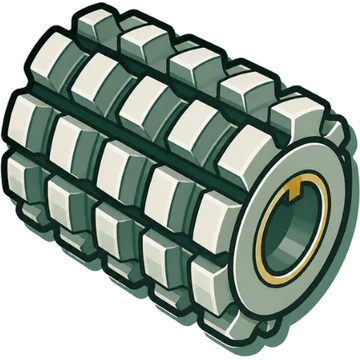
Construction
- Solid hobs: one-piece HSS, PM-HSS or carbide. Small-diameter shank hobs also exist[1][2][3][4]
- Assembled/brazed hobs: carbide blades brazed to a steel body, or blades inserted in it / indexable. Also used for large modules (examples: KSK carbide brazed hob, LMT CarbideLine-H/-I, Gleason E-Z Cut)[2][4][5]
- Multi-start hobs: more starts raise efficiency, but fewer cutting edges take part in generation, so polygonal error increases. Guidelines "workpiece teeth ÷ starts ≥ 9" and "starts × axial feed (mm/t.rev) ≤ 8" (Nidec)[1][6][7]
- Small-diameter high-accuracy hobs (micron hobs / fine pitch hobs): for ultra-small modules m0.1–0.5 (DTR); KSK also makes carbide micron hobs[8][9][10]
Tooth profiles
- Standard tooth profile (JIS example: addendum 1.25m, whole depth 2.25m = cutting depth + c)[2]One source / reference
- Topping (TOP): cuts the outside diameter at the same time as the profile. Outside diameter and tooth thickness are controlled together[2][8]
- Semi-topping (S-TOP): adds a tip chamfer at the same time, preventing dents, burrs and noise[2][8]
- Protuberance (PP/PSP/PGP): a relief at the tooth root so that no stock is left at the root before shaving (PSP) or before grinding (PGP)[2][8]
- Also available for stub teeth, modified profiles, splines (involute, square), sprockets, timing pulleys and worms[8][9]
Accuracy classes
- ISO 4468:2020: specifies the accuracy of general-purpose hobs (modules 0.5–40) in 7 classes, 4A, 3A, 2A, A, B, C, D (4A is the highest)[11][12]
- DIN 3968: makers produce hobs in Class A, AA and AAA (DTR, Gleason). AA is a guideline for finish gear cutting at DIN grades 6–7, A for pre-grinding[8][13][7]
- JIS B 4354: KSK follows JIS B 4354 type J for standard hob dimensions. The division of accuracy classes in JIS B 4354 could not be confirmed in public sources[2]One source / reference
Cutting direction
- Climb (the hob advances from the bottom end of the workpiece to the top end) and conventional (from the top end to the bottom end)[1]One source / reference
Carbide skive hob (finishing after hardening)
- Carbide skive hobs (skiving hobs): hobs for finishing gears after hardening (HRC52–58). KSK: brazed, m1.5–25, negative rake angle 30°/25°. DTR: m0.5–5, DIN AAA. Not the same as power skiving (machining with crossed axes using a rotating tool)[2][8]
A “skiving hob” is a carbide hob for finishing hardened gears. It is a different tool from the cutters used in power skiving, where the tool runs on a crossed axis.
⚙Pinion (shaper) cutter

Types
- Disk type (DISK)[14][9][15]
- Bell type / hub type (BELL / hub; Liebherr also has a hub type with internal teeth)[14][9][15]
- Shank type (Morse taper #2, #3, #4): for small-diameter internal gears[14][9][15]
- Wafer cutter: a disposable type using a thin coated disk in a dedicated holder (Liebherr)[15]One source / reference
- Indexable carbide shaper cutter (Gleason Opti-Cut)[16]One source / reference
Specifications
- Accuracy is usually DIN class A (equivalent to gear JIS grades 4–5). The material is usually SKH55 type; for high speed and high hardness, PM-HSS (ASP30 type)[14]One source / reference
- For internal gears, the number of teeth is chosen so as to avoid interference (involute interference, trimming, etc.)[14]One source / reference
⚙Skiving cutter
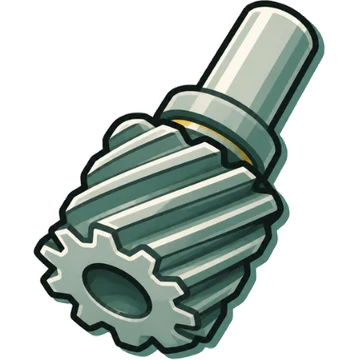
Types
- Conical and cylindrical: the conical type has a relief angle built into its geometry, while the cylindrical type must be tilted or offset[15]One source / reference
- Disk, bell, shank and solid carbide types (KSK), indexable (Liebherr, LMT)[9][15][17]One source / reference
- Super skiving cutter: a multi-edge tool derived from the barrel-shaped threaded wheel for internal gear grinding, with gashes, a relief angle and a taper in the roughing section (Mitsubishi Heavy Industries → Nidec)[18][19]One source / reference
Tool materials
⚙Shaving cutter

Types
- By method: for conventional, diagonal, underpass and plunge[20][9][13]
- For internal gears (internal shaving)[21][22]
Specifications
- Liebherr: modules 0.5–12.7, helix angle up to 45°, max outside diameter 305 mm and width 65 mm, straight or spiral flutes[15]One source / reference
- Gleason: maximum module 18 (10 for internal gears), maximum diameter 350 mm (250 for internal gears). Products of the Viganò plant are modules 1–5[22][13]One source / reference
- Used meshed at an axis crossing angle of 5°–15°[20]One source / reference
Tool materials
⚙Broach
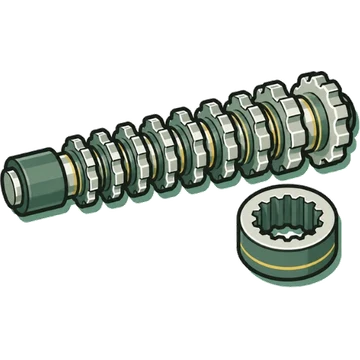
Types
- Internal broaches: round, spline, serration, square, special forms[24][25]
- Helical broaches: for internal helical gears (Nachi-Fujikoshi's off-normal helical broach optimizes the gash helix angle)[18][26]
- Surface broaches: for outer surfaces (fir-tree slots of turbine blade roots, etc.)[24][27][25]
Tool materials
- SKH55 (equivalent to M35) is standard; others are GRANMET BR and the PM-HSS grades MAC-B and MAC-D (Nidec). Surface treatments: nitriding, TiN, PVD (Nidec Nano Dynamic, Nachi-Fujikoshi DuAl EX/GX)[28][29][24]One source / reference
Cutting speed
◆Tool materials
- Melted HSS: SKH51, SKH55, etc. (Nidec selection map). Nidec MACH11 and MACH13 are explicitly melted HSS, and MACH7 is a hob HSS. Nachi-Fujikoshi FMH and FMH-VX are new melted HSS dedicated to hobs (FMH2 and FMH-SV also belong to the FMH series)[30][32][33][1][34][29]One source / reference
- Powder HSS (PM-HSS): ASP30 and ASP60 (DTR), Gleason PM-HSS (G90 is a proprietary material aimed between PM-HSS and carbide), Nidec GRANMET SK (powder-metallurgy material for skiving cutters). Nidec MX-1 is described as combining the toughness of PM-HSS with the wear resistance of melted HSS, and GRANMET SF as a high-speed material (neither is explicitly classified)[35][5][36][37][38][39][40]One source / reference
- Carbide: for high-speed dry cutting and finishing after hardening. KSK states cutting time of 1/3–1/10 and wear of 1/5 compared with HSS hobs[2][3][4][41]One source / reference
Coatings
- TiN: HV 2300, maximum service temperature 600℃ (KSK). At high temperature the Ti in TiN oxidizes and becomes brittle (Mitsubishi)[2][41]One source / reference
- TiCN: HV 3000, 400℃ (KSK)[2]One source / reference
- TiAlN: HV 3300, 900℃ (KSK). Al is selectively oxidized in the surface layer and forms a strong film (Mitsubishi Super Dry)[2][41]One source / reference
- AlCrN: HV 3200, 1100℃ (KSK). Nachi-Fujikoshi's DuAl GX for broaches is AlCr-based[2][29]
- Proprietary maker films: Nidec Super Dry I/II/III, MightyShield Σ (HV4000), ε, Super Coat, Nano Dynamic; Nachi-Fujikoshi Hyper AP1/Hyper DuAl SP/GP/DuAl EX/VX/Hyper DS1; DTR MAX series, D1/D2; Gleason TiNite/AlNite/AlCroNite/AlCroNite GearPro; LMT Nanosphere 2.0[30][42][34][43][44][13][45]One source / reference
- Handling of regrinding: some specifications recoat after regrinding the rake face, while others are used without a rake face coating (Nachi-Fujikoshi)[34]One source / reference
Grade and coating names are makers’ product names. Hardness and service temperatures are makers’ published figures measured in different ways, so they cannot be compared across makers.
÷Hobbing formulas
- Hob speed N [min⁻¹] = 1000 × V [m/min] ÷ (π × hob outside diameter D [mm])[41][46]Confirmed not from a statement of the formula itself, but because the figures in two published examples (φ58, 1370 min⁻¹, 250 m/min / φ32, 8000 min⁻¹, 804 m/min) agree with it
- Hobbing time T = Z2 × (A + b + O) ÷ (n1 × Z1 × Sz) (Z2: number of workpiece teeth, Z1: number of hob starts, n1: hob speed, Sz: feed per workpiece revolution, A: approach, b: face width, O: overrun)[7]One source / reference
- From the above, table speed nt = n1 × Z1 ÷ Z2, axial feed rate F [mm/min] = Sz [mm/rev] × n1 × Z1 ÷ Z2[7]One source / referenceDerived by rearranging the formula in S91
- For helical gears the feed is applied along the workpiece axis, and the actual feed is the tabulated feed ÷ cos(helix angle)[7]One source / reference
- Feed mark height Δsf ≈ (1/8) × f² ÷ Rc × sin αn (f: feed per workpiece revolution, Rc: pitch cylinder radius of the hob, αn: pressure angle) = f² sin αn ÷ (4 × hob pitch diameter). A formula giving the result in μm for standard full-depth teeth, Δsf ≈ 250 f² sin αn ÷ (2Rk − 2.314m) (Rk: hob outside radius), is also given. Feed marks are generally smaller than polygonal error[47]One source / reference
- Effective shift length of the hob S = hob tooth length l − (K + 2a), K = k + k0, k0 = Ca × cosβ ÷ tan αn × cos τ, a ≈ π/2 × m (Ca: hob addendum, τ: hob setting angle)[48]One source / reference
Rules of thumb
- Guideline for the number of starts: workpiece teeth ÷ starts ≥ 9. When increasing the number of starts, starts × axial feed (mm/t.rev) must not exceed 8[6]One source / reference
- Guideline for starts and gashes (Nidec): workpiece teeth 20 or fewer → 1 start with 10–12 gashes (finishing, before shaving), 2 starts with 12–14 gashes. 21 or more → 1 start with 10 gashes, 2–3 starts with 12–14 gashes, 4–5 starts with 14–17 gashes (before shaving)[6]One source / reference
- Limits of multi-start hobs (Kothari): 2 starts max m5.5, min 13 teeth; 3 starts m4.5, 17; 4 starts m3, 20; 5 starts m2.5, 25. DIN grades 4–6 use 1 start, grades 7–8 up to 2 starts, grades 9–10 up to 3 starts. Minimum gashes: 1 start 9–12, 2 starts 12–13, 3 starts 13–17, 4 starts 17–19, 5 starts 17–21[7]One source / reference
- Pros and cons of multiple starts: efficiency and wear resistance (thicker chips) improve, but gear cutting accuracy tends to drop by one grade and chipping is more likely[6][1]One source / reference
- Single-pass cutting up to about module 4; two passes above that (Kothari). Two passes for modules over 3 with a small number of teeth[7]One source / reference
- Coated hobs allow a 10–15% higher cutting speed. Above module 3 mm, the larger the module, the lower the cutting speed (Kothari)[7]One source / reference
Cutting speed guides
- Achievable cutting speed by tensile strength (Kothari's table): 600 N/mm² … HSS wet 120 / carbide dry 320 / carbide wet 305 m/min, 700 … 110/290/280, 800 … 100/270/240, 900 … 85/240/200, 1000 … 70/210/180, 1100 … 60/180/160[7]One source / reference
- Wet cutting with HSS hobs has conventionally been 100–120 m/min. Raised to 200 m/min with Super Dry Coat and to 250 m/min with Super Dry II (Mitsubishi Heavy Industries, 2006)[41]One source / reference
- Nidec selection map (steel, HB160–300): hob up to 50–300 m/min, pinion cutter 50–100 m/min, shaving cutter up to 100/150 m/min, broach up to 5 m/min[30]One source / reference
- Applications of Nachi-Fujikoshi hob coatings: DuAl VX 80–150, DuAl EX 60–180 (about 150 on the product page), Hyper DuAl GP 80–180, Hyper DuAl SP 300 or more (dry), Hyper AP1 300 or more (water-soluble) m/min[34][49][50][51]One source / reference
- Dry-cutting hobs (special HSS + multilayer coating) at about V = 180 m/min: DTR, Chongqing Tool Factory. KSK machining example: 165 m/min[8][52][2]
- Gear shaper cutting speed: SE25A maximum stroke rate 1800 min⁻¹, cutting speed raised from 90 to 130 m/min. In an internal gear comparison, gear shaper 50–90 m/min, super skiving 130 m/min[41][18]One source / reference
- Shaving cutting speed: plunge and underpass 145 m/min, diagonal and conventional 120 m/min (workpiece under 2000 rpm, shafts under 1000 rpm)[20]One source / reference
Printed from Kezuriba (kezuriba.net/en/gears/tools/)
▤Cutting examples published by makers
Guideline values published by manufacturers and in technical articles, with machining examples. The examples are single cases under specific conditions, not recommended values. Read them as single examples for that combination of workpiece, machine and tool.
Nidec Machine Tool (incl. journals from the Mitsubishi Heavy Industries era)
| Tool | Workpiece | Tool spec | Dry / wet | Cutting speed | Feed |
|---|---|---|---|---|---|
| Hob | m2.25 PA17.5° 46T HA23° SCM415 | MX-1, 3 starts 16 gashes, Super Dry III (rake and flank faces) | Dry (climb, no shift, 80 m) | 250 m/min | Axial 2.4 mm/rev[37] |
| Hob | m2.25 PA17.5° 52T HA23°LH SCM415 (HB180) | φ75 MACH7, 3 starts LH 14 gashes, Super Dry III (rake face coated) | Not stated (same-hand, climb, no shift) | 250 m/min | Axial 2.4 mm/rev[1] |
| Hob | m2.25 46T | MACH11 / MACH7 + Super Dry III | Dry (climb, no shift, 40 m) | 300 m/min | Axial 2.4 mm/rev[32] |
| Hob | m2.25 NT46 PA17.5° HA23° 15CrMo4 | GRANMET SF | Not stated | 400 m/min | Axial 1.7 mm/rev[39] |
| Hob | m2.7 PA20° HA31°RH NT69 width 25 SCM420H | φ90 4 starts 16 gashes GRANMET SF + MightyShield Σ | Not stated (no shift, 50 pieces, cutting length 100 m) | 350 m/min | Axial 2.3 mm/rev[40] |
| Hob | m2.7 NT15 PA20° HA30° 20Cr4 (pinion) | 4 starts 12 gashes MACH7 + MightyShield Σ | Dry | 180 m/min | Axial 1.0 mm/rev[42] |
| Hob | m2.3 NT55 PA15° HA27° 20Cr4 (counter gear) | 4 starts 14 gashes + MightyShield Σ | Not stated | Not stated (the page shows 180 m/min in the same field as example 1) | Axial 2.0 mm/rev[42] |
| Hob | m3 NT18 PA18° HA30° | MACH13 | Dry (climb) | 150 m/min | 1.0 mm/rev[33] |
| Hob (GE15FR Plus) | m0.5, outside diameter about 50 mm, face width 15 mm (number of teeth not readable from the page) | Hob diameter 32 mm (table value; consistent with π×32×8000/1000≈804), spindle 8000 min⁻¹Pitch accuracy stated to be equivalent to ISO grade 0 | Not stated | 804 m/min | 0.5 mm/t.rev[46] |
| Hob | m1.4 34T face width 25 PA17.5° HA22.5°RH | Solid hob φ58, 4 starts 16 gashes, Super Dry II, 1370 min⁻¹ | Dry (climb) | 250 m/min | 2.0 mm/rev (cycle 14.3 s)[41] |
| Pinion cutter | m3 PA14.5° 30T spur φ94 face width 28 SCM420H (HB180) | 51T φ157.5 MACS + Super Dry (rake face coated) | Dry (Super Dry) | Strokes 450/900/700 str/min | Circular 2.7/2.7/0.76 mm/str, radial 0.01 mm/str[53] |
| Pinion cutter | m2 PA20° 38T spur φ81 face width 16.5 SCr420H (HB180) | 66T φ137.068 MACS + Super DryAfter 4000 pieces: profile JIS N6, helix N4 equivalent | Dry (Super Dry) | Strokes 700/1200/1200 str/min | Circular 2.51/1.26/1.26 mm/str, radial 0.01/0.015/0.015 mm/str[53] |
| Pinion cutter | m2.25 NT27 HA31.5° width 15 SCM415 | NT57 MAC-B (HSS) + PVD | Not stated | Strokes 800/1200 /min | Circular 0.5/0.3 mm/str (90 s) → large circular feed 4.0/2.0 mm/str (35 s), radial 0.02/0.01 mm/str[54] |
| Pinion cutter | m1.3 PA30° spur NT30 carburized steel | Outside diameter 30 NT20 MX-1 + Super Dry | Not stated | Strokes 850/920 str/min | Circular 1.5/0.5 mm/str, radial 0.020/0.012 mm/str[38] |
| Pinion cutter (SE25FR) | m0.4, outside diameter about 64 mm, face width 13 mm (number of teeth not readable from the page) | —Pitch accuracy stated to be equivalent to ISO grades 2–3 | Not stated | 750 str/min, 63.6 m/min | Circular 0.416 mm/str, radial 0.002 mm/str (2.08 min)[55] |
| Pinion cutter (gear shaper) | m2.5 φ75 spur stroke width 21 | SE25A | Dry | 760/1200 str/min, 50/80 m/min | — (49 s; conventional machine 73 s)[41] |
| Skiving cutter | m1.5 70T PA20° HA20° SCM440 (HB270–300) | MX-1 / GRANMET SK + MightyShield Σ | Not stated | 70 m/min | Axial 0.4–0.1 mm/rev[36] |
| Super skiving | Internal m2 57T PA20° HA18°RH SCM415 | Super skiving cutterGear shaper under the same conditions: 50–90 m/min, 180 s | Not stated | 130 m/min (cycle 90 s) | —[18] |
| Shaving cutter | General conditions | — | — | Plunge and underpass 145 m/min, diagonal and conventional 120 m/min | Workpiece speed under 2000 rpm (shafts under 1000 rpm)[20] |
| Shaving cutter | m1.7 PA17.5° HA36° (cutter NT113 HA21°) | Fine pitch, Super Coat | — | Speed 220 rpm | Feed 0.4 mm/min (plunge)[20] |
| Threaded grinding wheel (grinding) | m3 31T PA20° HA20°RH outside diameter 105 face width 40 | Wheel outside diameter 300, 3 starts, overall length 125 | — | Wheel speed 2580/3800 min⁻¹ | Axial 0.8/0.4 mm/rev (78 s, new JIS grade 1)[41] |
| Broach | S55C (HB165–225) | GRANMET BR +PVD | Not stated | 5 m/min | — (total cutting length 40 m)[31] |
Nachi-Fujikoshi
| Tool | Workpiece | Tool spec | Dry / wet | Cutting speed | Feed |
|---|---|---|---|---|---|
| Hob | m2 PA20° NT75 SCr20 (as written) | φ100 6 starts 16 gashes FMH-SV, Hyper AP1 (rake face coated) | Water-soluble (climb) | 400 m/min | 1.0 mm/rev[34] |
| Hob | m2.3 PA14.5° NT50 SCM420 | φ75 3 starts 14 gashes FMH, Hyper AP1 | Water-soluble (climb) | 280 m/min | 2.3 mm/rev[34] |
| Hob | m2.5 PA16° NT54 SCM420H | φ95 3 starts 12 gashes FMH, Hyper DuAl SP | Dry (climb, no shift) | 300 m/min | 3.0 mm/rev[34] |
| Hob | m2 PA15° NT79 S45C (280HB) | φ70 3 starts 12 gashes FMH2, Hyper DuAl SP | Dry (climb) | 110/160 m/min | 3.0/2.6 mm/rev[34] |
| Hob | m2.5 PA15° NT40 SCM420H | φ95 3 starts 12 gashes FMH, Hyper DuAl GP | Oil-based (climb, no shift) | 150 m/min | 2.2 mm/rev[34] |
| Hob | m2.45 PA15.5° NT40 SCr420H | φ95 3 starts 12 gashes FMH, DuAl EX (rake face not coated) | Dry (climb, no shift) | 160 m/min | 2.2 mm/rev[34] |
| Hob | m2.3 HA21°LH NT47 S53C (250–300HB) | φ80 3 starts 12 gashes, DuAl VX (rake face not coated) | Oil-based (climb) | 70 m/min | 1.5 mm/rev[34] |
| Hob | m2.4 PA14°30′ SCM420H | 3 starts 12 gashes FMH-SV (rake face coated) | Dry | 400 m/min | 1.7 mm/rev[29] |
| Hob (scope of application) | — | Hyper DuAl GP general conditions 80–180 m/min, Hyper DuAl SP 300 m/min or more, DuAl EX 60–180 m/min (catalog) / about 150 m/min (product page), DuAl VX 80–150 m/minThe EX speed is expressed differently in S40 and S42 | — | As stated at left | —[49] |
| Skiving cutter | Internal m1.5 PA20° 70T HA20°RH SCM420 face width 25 | 30T spur FAX55, Hyper DuAl GP (rake face coated) | Oil-based | Sliding speed 148 m/min (cutter 1600 rpm) | 0.05 mm/rev (90 s, profile deviation 7 µm = new JIS grade 6)[29] |
| Broach | m1.0 PA37.5° NT27, S48C (260HB) | High-speed semi-dry broach | Semi-dry (minimal mist 4 cc/h) | Previously 5 m/min → 50 m/min | —[27] |
Kyushu Seimitsu (KSK)
| Tool | Workpiece | Tool spec | Dry / wet | Cutting speed | Feed |
|---|---|---|---|---|---|
| Hob | m1.68 PA17.5° 46T face width 30 SCM420 | φ80 overall length 150 5 starts RH 16 gashes, KH98S + AlCrN | Dry (climb) | 165 m/min | 3.0 mm/rev[2] |
| Carbide brazed hob (application) | High-hardness material, high-speed cutting | Carbide brazed hob | — | V = 300 or more (depending on conditions) | —[2] |
⚙Related
📚Sources
Values without a mark agree in at least two sources from different publishers.
- Nidec Machine Tool — Precision cutting tools | Hobs (product page)
- Kyushu Seimitsu Kogyo — KSK precision cutting tools general catalog (PDF)
- Gleason — Carbide Tools
- LMT Tools (LMT Fette) — CarbideLine
- Gleason — Hobs & Milling Cutters
- Nidec Machine Tool — Cutting Tool News: Design tips for hobbing cutter starts and flutes (PDF)
- Gear Technology India — V. Kothari, Guiding Principles for Defining Gear Hobbing Processes in New Part Development
- DTR — 공구사업 HOB
- Kyushu Seimitsu Kogyo — Products
- Kyushu Seimitsu Kogyo — Top page (news)
- BSI Knowledge — BS ISO 4468:2020 Gear hobs. Accuracy requirements (summary)
- technickenormy.cz (standards sales site) — ISO 4468:2020 Gear hobs - Accuracy requirements (summary of scope and classes)
- Gleason — Gleason Cutting Tools s.r.l., Viganò, Italy
- DTR — 공구사업 PINION
- Liebherr-Verzahntechnik — Precise and productive. Gear tools (brochure PDF)
- Gleason — Shaping Tools
- LMT Tools (LMT Fette) — Expanded gear cutting expertise
- Mitsubishi Heavy Industries — MHI Technical Review Vol.52 No.1 (2015) MHI Super-Skiving System for Longer Tool Life and Enhanced Efficiency in Internal Gear Cutting
- Mitsubishi Heavy Industries — Press release: "Mitsubishi Super Skiving System" developed to machine internal gears with a barrel-shaped multi-edge tool (2014)
- Nidec Machine Tool — Precision cutting tools | Shaving cutters (product page)
- Nachi-Fujikoshi (NACHI) — Internal shaving (product page)
- Gleason — Shaving Tools
- Nidec Machine Tool — Cutting Tool News: MightyShield ε (shaving cutters)
- Nidec Machine Tool — Precision cutting tools | Broaches (product page)
- DTR — 공구사업 브로치
- Nachi-Fujikoshi (NACHI) — Off-normal helical broaches (product page)
- Nachi-Fujikoshi (NACHI) — Semi-dry broaches (product page)
- Nidec Machine Tool — Cutting Tool News: BROACH TOOL / Types and Applications
- Nachi-Fujikoshi (NACHI) — Precision tools: gear cutting tools and broaches, Catalog No.2305 (2016)
- Nidec Machine Tool — Cutting Tool News: Selection Map / Tool materials, Surface treatments (PDF, 2021)
- Nidec Machine Tool — Cutting Tool News: GRANMET BR for broaching tools (PDF)
- Nidec Machine Tool — Cutting Tool News: MACH11 HOB (PDF)
- Nidec Machine Tool — Cutting Tool News: MACH13 HOB
- Nachi-Fujikoshi (NACHI) — Hyper AP1/Hyper DuAl SP/GP/DuAl EX/VX hobs, Catalog No.2302-4 (2023)
- Gear Technology (AGMA Media) — Company directory: DTR Corp. (formerly Dragon Precision Tools)
- Nidec Machine Tool — Cutting Tool News: GRANMET SK (skiving cutters)
- Nidec Machine Tool — Cutting Tool News: MX-1 HOB
- Nidec Machine Tool — Cutting Tool News: MX-1 SHAPER CUTTER (PDF)
- Nidec Machine Tool — Cutting Tool News: GRANMET SF (PDF)
- Nidec Machine Tool — Case: GRANMET SF + MightyShield Σ
- Mitsubishi Heavy Industries — Mitsubishi Heavy Industries Technical Review Vol.43 No.3 (2006) Gear machining machines and precision cutting tools supporting the production of automotive transmission gears
- Nidec Machine Tool — Cutting Tool News: New Coating MightyShield Σ
- Nachi-Fujikoshi (NACHI) — Air skiving system (dry skiving cutters) (product page)
- DTR — Coating 코팅가이드
- LMT Tools (LMT Fette) — SpeedCore
- Nidec Machine Tool — High-accuracy hobbing machines, GE15FR series
- Seimitsu Kikai (Journal of the Japan Society of Precision Engineering) Vol. 29, No. 1 (1963) — Morozumi: Effect of errors during hobbing on gear accuracy (J-STAGE)
- Nidec Machine Tool — Cutting Tool News: Effective hob shift length
- Nachi-Fujikoshi (NACHI) — HyperDuAl GP/SP hobs (product page)
- Nachi-Fujikoshi (NACHI) — DuAl EX/VX hobs (product page)
- Nachi-Fujikoshi (NACHI) — Hyper AP1 hobs (product page)
- Chongqing Tool Factory Co., Ltd. — Dry-cutting hobs
- Nidec Machine Tool — Precision cutting tools | Pinion cutters (product page)
- Nidec Machine Tool — Cutting Tool News: High speed shaping cut - Large circumference feed (PDF)
- Nidec Machine Tool — High-accuracy gear shapers SE25FR/FR Plus, SC40FR