Machining EV Parts: Parts That Shrink and Grow, eAxles and Battery Cases, Quiet Gears, Major Japanese Companies, Machine and Cutting Tools, New Technology, How to Enter
Let's see which parts shrink and which grow. Quietness is a battle of microns!

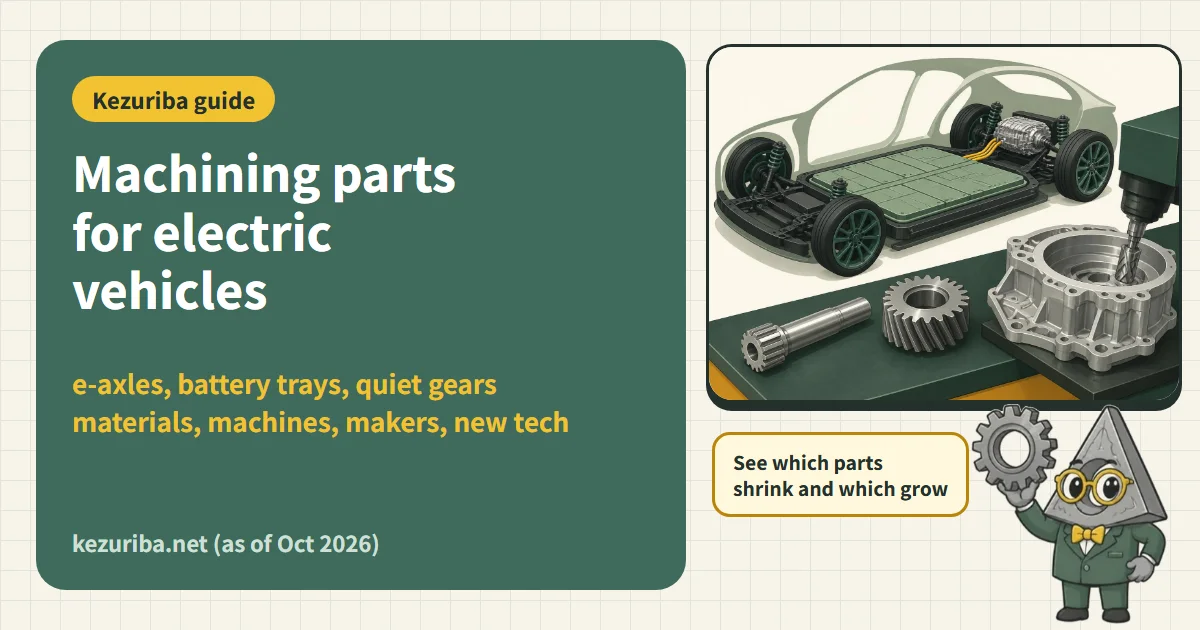
As electric vehicles (EVs) spread, parts for engines and multi-speed transmissions decrease, while parts for the "eAxle", which integrates the motor, inverter and reducer, and for battery cases increase. But growth varies widely by region, and in Japan hybrids (HV) account for 60% of new cars. In this article, after taking an honest look at the sales figures, we cover which parts shrink and which grow, Size and requirements of each part, key points for each material, quietness (NVH) and gear finishing, the machine tools and cutting tools used, the major Japanese companies, New machining methods in papers and technical reports, and entry routes, required systems, support and hurdles, based on statistics from the IEA and industry associations, manufacturers' technical materials, and papers, technical reports and patents from J-STAGE and elsewhere (as of October 2026).
Why look at EVs now: the honest numbers
According to the IEA, EVs sold worldwide in 2025 (battery-only BEVs plus plug-in PHEVs) exceeded 20 million, about 1 in 4 new cars (25%). Sales grew about 20% from the previous year, and BEVs made up about 65%. For 2026, about 23 million are expected, close to 30% of new cars[1][2].
| Region (2025) | EV sales | Share of new cars | Recent trend |
|---|---|---|---|
| China | Over 13 million | About 55% | Over 60% of the global total |
| Europe | Over 4 million | About 28% | CO2 rules tightened; up about 30% |
| USA | About 1.5 million | Just under 10% | Slightly below the previous year, partly due to the end of tax credits |
| Japan | Just over 100,000 | Under 3% | Sluggish for 2 years in a row; HVs are about 1/3 of new cars |
From the IEA "Global EV Outlook 2026"[1]. Japan's figures include kei cars. Global EV sales in Jan–Mar 2026 were reported down 8% year on year due to policy changes in China and the U.S., so growth is not a straight line[2].
Looking at registered vehicles in Japan (passenger cars excluding kei cars), of the 2.53 million sold in 2025, HVs were 60.4%, gasoline cars 31.9% and diesel cars 4.5%, while PHEVs and BEVs were just 1.6% each, a small share[3]. The government's target is "100% electrified vehicles in new passenger car sales by 2035", but "electrified" here includes HVs[4]. Engine parts made in Japanese plants are not going to disappear any time soon.
Parts shipments are changing too. According to a survey by the Japan Auto Parts Industries Association (JAPIA), in FY2024 drive, transmission and steering parts fell about 16% and engine parts fell about 6%, while parts for electrified vehicles such as HVs and EVs rose about 15% to ¥1.3 trillion (6.6% of the total)[7]. In machine tool orders, domestic orders from the auto industry fell for the third straight year in 2025 to ¥87.1 billion (of which auto parts ¥56.9 billion), about one-third of the ¥248.3 billion of 2018. Meanwhile, overseas auto-industry orders came to ¥272.4 billion, with large orders continuing for EVs in China and for combustion-engine vehicles in North America[8].
Plans changeIn Japan too, Toyota's battery plant in Kanda, Fukuoka Prefecture, was postponed twice in 2025[18][19], Nissan cancelled construction of its battery plant in Kitakyushu[20], and SUBARU postponed the launch of its in-house BEVs[21] (all according to media reports). In June 2026, the Ministry of Economy, Trade and Industry (METI) also pushed back its target of 150 GWh a year of domestic battery production capacity from "by 2030" to "from 2030 to the mid-2030s"[5]. With EV work, the hard part is not whether it will come, but when and how much.
Parts that shrink, stay and grow with EVs
The often-quoted figure that "a combustion-engine car has about 30,000 parts and an EV about 20,000" also appears in a report commissioned by METI, but only as "it is said that". The counting basis is unclear, so treat it as a rough guide[6]. You may also see the claim that "EVs will cut demand for machining by about 47%", but we could not find the original source, so this article does not use it.
What can be checked with numbers is the change in shipment value by product category. Comparing FY2023 and FY2024 in the same survey gives the following.
eAxles rose about 50% and power control units, which include inverters, about 20%, while ATs (automatic transmissions) fell about 19%, transmission gear and shaft parts about 21%, and exhaust pipes and mufflers about 29%[7]. For companies that have been machining gears and shafts, work on multi-speed transmissions shrinks, and work on single-speed reducers and motor shafts appears in its place. That is the closest picture. However, reducers have fewer gears, and in exchange the demands for quietness are much stricter (see a later section).
Size and requirements of each part
| Part | Materials | Example size | Requirements (examples) | Main processes |
|---|---|---|---|---|
| Motor shaft (rotor shaft) | Steel (carburized or induction-hardened) | A few hundred mm long | Some designs are hollow to carry cooling oil[44]. Bearing seats, splines, oil holes. For one assembled design, a production line turns 2 parts → laser-welds them → induction-hardens the bearing areas → finish-turns → grinds, at 47 seconds per shaft[43] | Turning, hard turning, cylindrical grinding, rolling |
| Reducer gears | Carburized and quenched steel | OD from tens of mm to about 200 mm | Motors spin at up to about 16,000–20,000 rpm[29][30]. One comparison puts the helix slope deviation fHβ target at ±4 µm for EVs versus about ±13 µm for combustion-engine transmissions[29] | Hobbing/skiving → heat treatment → gear grinding/honing |
| Planetary ring gear (internal gear) | Carburized and quenched steel | OD from 100-odd mm to several hundred mm | Used in coaxial eAxles. A method has appeared that polishes to Ra 0.1 µm while keeping the post-grinding accuracy of ISO grade 3–5[35] | Skiving, internal gear grinding |
| Motor (stator) housing | Aluminum die casting (ADC12, AlSi10Mg types) | Stator bore ID 200–240 mm (example)[59] | Coaxiality of bearing bores and stator bore; roundness and cylindricity of bearing seats, to keep the air gap (between rotor and stator) uniform[60]. Leak-tightness of water-cooling channels[62] | Horizontal machining centers, PCD boring tools |
| Reducer case and cover | Aluminum die casting | Several hundred mm | Bearing bore position and coaxiality, mating-face flatness and sealing faces | Horizontal machining centers, PCD tools |
| Inverter case and cooler | Aluminum (extruded, die-cast, pressed), copper | Several hundred mm | Removes heat from power semiconductors. Coolers are normally made with thin fins by press forming or die casting, not machined from solid[27][28] | Machining (mounting faces, coolant ports), FSW |
| Battery case / tray | Aluminum extrusions or die castings, steel sheet | About 2 m wide | Example: 4–12 extruded panels joined by FSW into a floor up to 2.4 m wide[56]. Example: mega casting reduced 60+ parts to 3[55] | FSW, large-part machining (holes, taps, seal grooves) |
| Busbars and terminals | Copper (oxygen-free copper, Cu-Mg alloys), aluminum | Tens to hundreds of mm | Carry high current. There are copper alloys made for terminals and busbars[64] | Pressing, bending, drilling and chamfering, deburring |
| Giga/mega-cast body parts | Aluminum die casting | 1–2 m class | Dimensional distortion is a major issue[52]. Secondary machining of mounting faces and holes | Large 5-axis and gantry machining centers, measurement |
Figures are examples from manufacturer materials, patents and papers, and vary by vehicle and parts maker.
The eAxle for Toyota's new bZ4X (167 kW, front) is reported to have improved efficiency by raising gear accuracy and reshaping the case to reduce oil churning losses[24]. In the October 2024 specifications, the front reduction ratio is 13.786: a single-stage reducer brings the motor speed down to about 1/14[25]. Because one gear ratio covers the whole speed range, the quality of that one gear set determines noise and efficiency.
Key points by material
Aluminum die castings and extrusions: coaxiality and leak-tightness
ADC12 (JIS H 5302), common for housings, is a die-casting alloy containing 9.6–12.0% Si and 1.5–3.5% Cu[58]. Its hard Si particles wear tools quickly, so PCD tools are often used for finishing. In one stator-bore example, roughing removes up to 6 mm to take off the casting draft, the bore is finished in three stages (roughing, semi-finishing, finishing), and the aluminum is cut with PCD while steel parts (such as bearing liners) are cut with carbide edges[59].
- Coaxiality in one clamping: To get coaxial bearing bores, finishing the opposite bore in the same clamping by back-boring is recommended[60]. For bearing bores in small housings, there are requirements such as roundness under 0.01 mm, diameter tolerance IT7 and Rz under 10 µm[61].
- Thin walls deflect under clamping: A bore distorted by clamping force springs back when unclamped and loses roundness. Set the clamping positions and forces before fine-tuning cutting conditions.
- Check leak-tightness: Water-cooling channels and cases leak if machining opens up porosity (small voids inside the casting). In mass production it is standard practice to manage this down to the leak-test reject rate[62].
Carburized steel gears and shafts: remove heat-treatment distortion last
Gears go through "gear cutting → carburizing and quenching → gear grinding", with the final grinding removing heat-treatment distortion. Shaft bearing seats are the same, and research is advancing on "hard turning", cutting hardened steel with cBN tools instead of grinding. A paper comparing the two on carburized 18CrNiMo7-6 (about 58–63 HRC) found that dry hard turning gave a finer surface than grinding (Ra 0.17 µm vs 0.31 µm) and larger compressive residual stress at the surface, and among specimens that broke in rotating-bending fatigue tests, life was about 2.2 times longer[42]. Whether more can be finished on lathes when you are short of grinders is worth considering in light of this.
Copper busbars and flat wire: adhesion and burrs
Copper is soft and gummy, so it sticks to cutting edges and forms burrs easily. A CIRP review concludes that deburring costs money without adding value, so the first step is to design processes that don't create burrs[63]. Motor windings have shifted from round wire to flat wire (hairpins), adding welding steps. Copper absorbs less than 5% of infrared laser light and is hard to weld, whereas blue lasers (about 445 nm) are 45–65% absorbed; one study found that conduction-mode welding cut spatter by about 90%[50]. There is also a patent that splits the beam into a core and a ring to reduce spatter and porosity[51]. On the machining side, stripping and trimming the hairpin ends and keeping surfaces clean before welding directly affect quality.
Electrical steel: cut edges degrade magnetic properties
Stator and rotor cores are made by punching thin electrical steel sheets about 0.25 mm thick and stacking them[49]. Punching (shearing) degrades magnetic properties near the cut edge and increases iron loss (power lost as heat in the core). A JFE study estimated that about one-third of the increase comes from plastic strain, and the remaining two-thirds occurs in a zone about twice the sheet thickness wide from the cut edge[45]. Research has also shown that degradation is smaller with finer grains and less edge rollover[46], that interlocking (dimples that hold the stack together) and shrink fitting also increase iron loss[47], and that laser cutting, used for prototypes, increases iron loss more than wire EDM[48].
What matters for machining shopsIf you turn the OD of a rotor with a stacked core, or shrink-fit a core into a housing, motor efficiency can drop even with the dimensions right. Press die wear and clearance, and the interference of interlocks and shrink fits, are control items that also affect "magnetic quality".
Quietness (NVH) and gears: gear grinding, skiving and finishing
EVs have no engine noise, so gear whine that used to be masked becomes audible. A gear-grinding machine maker explains that gear noise stands out up to about 80 km/h (above that, tire and wind noise dominate), and that even about 0.1 µm of waviness on the tooth flank is said to be enough to cause noise[29]. During regenerative braking the torque reverses, so both left and right flanks need the same quality[30].
| Issue / method | Details | Figures / source |
|---|---|---|
| Ghost noise | As continuous generating grinding with threaded wheels spread, noise at orders that are not integer multiples of the mesh order (ghost orders) became a problem. Honda R&D clarified the relationship between those orders, waviness along the tooth trace, and grinding conditions | Transactions of the JSME (2009)[31] |
| Noisy even within tolerance | Even gears with high accuracy grades can make noise from periodic sub-micron waviness. Causes include grinding wheel imbalance, dressing roll runout, and vibration of the machine or workpiece support. Metrics for waviness are not yet standardized | Review (2025)[32] |
| Can't measure every part | Measuring profile, helix and pitch on every tooth and analyzing the waviness takes 4–6 minutes per part, while grinding takes under 1 minute. Process monitoring that runs order analysis on signals during grinding to catch anomalies is advancing | KAPP NILES[29] |
| Polish grinding | A finishing grind brings the roughly Ra 0.3 µm of continuous generating grinding down to about Ra 0.1 µm. But it only changes roughness; waviness and profile errors are set by the preceding grind | Reishauer[30] |
| Honing / superfinishing | Honing, which finishes by meshing the gear with an internal-gear-shaped stone, produces crossing lay patterns that scatter periodic noise. A reduction of several dB has been reported for finishing combined with grinding | Review (2025)[32], CIRP review[33] |
| Targeted waviness | Methods have been proposed that deliberately add targeted waviness to the flank to reduce noise, or increase the shift amount to break up the lay pattern | Liebherr[34] |
| Skiving | Cuts internal gears fast, but tool life is short. Splitting the cut into multiple passes with shifted tool phase reduced cutting force by up to 49% (University of Tokyo, Komatsu). The effect of feed rate is under 1 µm by calculation, but deviations in experiments were larger (Aisin Seiki, Kyoto Institute of Technology) | JSPE (2021)[39], Transactions of the JSME (2015)[38] |
Noise isn't always caused by machiningIn one case where a reducer was noisy even though its gears were within tolerance, comparing prototypes ground under different conditions showed that the cause lay in the reducer design[34]. For a machining company, being able to record and show the conditions you machined under is a strength when isolating the cause.
Flank waviness and noise: Quieting gears by deliberately making teeth differ (MicroForm); internal gear finishing: Polishing internal gears in mass production; skiving's weak points: New technologies that solve skiving's two weak points.
Machine tools and cutting tools for EV parts
| Application | Machine / tool | Examples (makers' published data) |
|---|---|---|
| Finishing reducer gears | Gear grinders (continuous generating, threaded wheel) | A model said to mass-produce gears for EV transmissions at ISO grade 3 equivalent, with simultaneous bias modification on both flanks and low-noise grinding functions (Nidec Machine Tool ZFA)[36]. Dressing-free CBN threaded wheels (Liebherr)[34] |
| Internal gears | Internal gear grinders, skiving machines | A method that grinds internal gears by continuous generating with a barrel-shaped threaded wheel, cutting grinding time to 1/4 of the conventional method (Mitsubishi Heavy Industries, now Nidec Machine Tool)[37]. Gear skiving machines for small and medium internal gears (Kashifuji KPS21/30)[87]. Dry air skiving (Nachi-Fujikoshi)[88] |
| Gear process integration | Skiving centers, multitasking machines | Turning, gear cutting and drilling in one clamping, with 3D tooth flank modifications built in (JTEKT)[40]. A 5-axis vertical machining center that automatically attaches a gear grinding unit, cutting internal gear cycle time from 32 to 17 minutes (DMG MORI)[85] |
| Shafts | Lathe and grinder lines | A line producing assembled rotor shafts at 47 seconds each (EMAG)[43] |
| Housings, cases | Horizontal machining centers, PCD tools | Finishing the stator bore with 3-stage boring tools, with separate edges for aluminum and steel (MAPAL)[59] |
| Battery cases, coolers | FSW (friction stir welding) machines | Machining centers usable for FSW of inverter, battery and motor cases (Yamazaki Mazak)[86]. FSW with upper and lower heads (PTG)[56] |
| Giga casting | Ultra-large die casting machines | 9,000 t clamping force (UBE Machinery UH9000)[79], 12,000 t (Shibaura Machine DC12000GS)[80] |
Models and figures are examples from each company's published materials. The right choice depends on the part and volume.
For cutting-condition calculations, see the Calculators; for gear basics, the Gear study; and for gear machining methods and tools, Gear machining methods.
Major Japanese companies: where the work comes from
EV parts are split into those automakers make in-house, those made by Tier 1s (system parts makers), and those outsourced further down. When choosing sales targets, pin down "who issues the drawings" and "which plant makes the part". Scale figures are the latest full-year values from each company's published materials.
eAxles, motors, inverters
| Company | What they make for EVs | Main sites in Japan | Scale (approx.) |
|---|---|---|---|
| AISIN | eAxles for BEVs (BluE Nexus design, used in the bZ4X and others), electric units for HVs | Aichi (Anjo, etc.) | Revenue ¥5.1177 trillion (FY ended Mar 2026). Plans capacity for 4.5 million electric units a year[65][66] |
| DENSO | Inverters for HVs and BEVs, SiC power semiconductors, battery monitoring | Aichi (Anjo, Toyota), Fukushima (Tamura) | Revenue ¥7.5399 trillion (FY ended Mar 2026)[67][68] |
| Astemo | e-Axles, inverters for electrified vehicles, rectangular-wire motors | Miyagi (Murata), etc. | Revenue about ¥2.2 trillion (FY ended Mar 2026, unlisted)[70][71] |
| Nidec | E-Axle (integrated motor, inverter and reducer; mass production mainly overseas) | Kyoto (HQ, development) | —[69] |
| Meidensha | EV motors and inverters, e-Axles | Aichi (Kiyosu), Yamanashi, Shizuoka (Numazu) | Net sales ¥326.2 billion (FY ended Mar 2026)[72] |
| JATCO | 3-in-1 motor/inverter/reducer units, 5-in-1 for e-POWER | Shizuoka (Fuji) | Not listed[73] |
| Musashi Seimitsu Industry | Differentials, differential gears, planetary assemblies, gearboxes for FCEVs | Aichi (Toyohashi) | Net sales ¥347.2 billion (FY ended Mar 2026)[74][75] |
Die casting, batteries, copper
| Company | What they make for EVs | Main sites in Japan | Scale (approx.) |
|---|---|---|---|
| Ryobi | Aluminum die castings such as eAxle cases, motor cases, onboard charger cases and battery cases | Hiroshima (Fuchu), Shizuoka (Shizuoka, Kikugawa), etc. | Die casting business ¥274.3 billion (FY ended Dec 2025)[76][77] |
| Ahresty | Cases for battery-related units, battery brackets | Aichi (Toyohashi), Tochigi, Yamagata, Kumamoto | —[78] |
| UBE Machinery | Ultra-large die casting machines for giga casting (9,000 t) | Yamaguchi (Ube) | —[79] |
| Shibaura Machine | Ultra-large die casting machines (12,000 t) | Shizuoka (Numazu, Gotemba) | —[80] |
| Prime Planet Energy & Solutions | Prismatic batteries for HVs, PHEVs and BEVs (Toyota 51%, Panasonic Holdings 49%) | Hyogo (Himeji, Kasai, Sumoto), Tokushima | Not listed[82] |
| Mazda | New module and pack plant for batteries using cylindrical cells (planned 10 GWh/year) | Yamaguchi (Iwakuni) | —[22] |
| Honda, GS Yuasa | Plan for domestic mass production of BEV batteries (20 GWh/year) | — | —[23] |
| UACJ | Battery cases from aluminum extrusions (with integrated cooling channels) | Tochigi (Oyama), Aichi, etc. | —[81] |
| Sumitomo Electric (Sumitomo Electric Wintec) | Flat (rectangular) magnet wire for motors | Shiga (Koka), Niigata (Myoko) | —[84] |
| SWCC | Flat wire for automotive motors, insulated flat wire for high-voltage busbars, oxygen-free copper | Mie (Inabe) | —[83] |
| Mitsubishi Materials | Copper alloys for terminals and busbars, oxygen-free copper strip | — | —[64] |
Sites are from each company's published materials and are not exhaustive. Battery plant plans can change (see "Plans change" above).
In giga casting, Toyota has announced a policy of dividing the body of its next-generation BEVs into three large integrated sections (front, center and rear)[54], and has unveiled equipment that cuts die changes, which normally take about 24 hours, to about 20 minutes[53]. Honda casts its battery case in sections with 6,000 t-class mega casting, consolidating more than 60 parts into 3, and joins the seams with 3D FSW. With jigs and tools that allow joining as-cast, without machining anything except the mating faces, Honda eliminated three machining processes, the company says[55].
Will machining work shrink? As Honda's example shows, there is a clear trend toward avoiding machining through integration and clever joining. On the other hand, the larger the casting, the bigger the problem of dimensional distortion[52], so mounting faces and holes are machined to fit. Being able to measure large castings and machine them to match their distortion will be valuable going forward.
New machining methods in papers and technical reports
| Topic | What's new | What it means on the shop floor |
|---|---|---|
| Double-sided inverter cooling | A 3-in-1 structure that cools the power module from both sides and shares the housing with the motor and reducer, increasing current without adding weight (Nissan et al.)[26]. Cooler fin shapes were determined by topology analysis and designed to be made on high-speed production presses (DENSO)[27] | The cooler itself is a pressed or die-cast part. Machining work remains in case mounting faces, coolant ports and sealing faces |
| Gear digital twin | Linking two digital twins, performance (gear analysis) and machining (skiving simulation), to shorten prototype evaluation (JTEKT)[41] | With fewer prototype rounds, the accuracy and records of the first prototype matter more |
| Hard turning | Finishing carburized steel with cBN tools instead of grinding beat grinding in surface finish and fatigue life[42] | Some grinder load can be shifted to lathes |
| Hollow shaft | Two hollow members are friction-welded, and the inner weld flash is used as a wall that divides the cooling oil flow (patent application)[44] | More parts made by combining joining and turning |
| Processing damage in electrical steel | The mechanisms by which shearing, interlocking, shrink fitting and laser cutting increase iron loss are being clarified[45][47][48] | Machining that preserves "magnetic quality", not just dimensions |
| Copper hairpin welding | Conduction-mode welding with a blue laser cuts spatter by about 90%. Cycle time increases from 0.5 to 1.0 seconds[50] | Quality of trimming and stripping before welding |
| Mega casting distortion | Die temperature, cooling channels, solidification time and ejection determine residual stress and distortion; countermeasures are die-shape compensation and simulation-based prediction (Chalmers University of Technology)[52] | Plan secondary machining setups on a "measure first, then cut" basis |
| Evaluating flank waviness | A review covering the link between waviness and noise, measurement methods and differences between finishing methods[32], and a review of grinding and finishing overall[33] | Keep records of grinding conditions, wheel balance and dressing |
Entry routes: 4 paths
| Route | What it looks like | Best suited to |
|---|---|---|
| A. Current customers going electric (most realistic) | Switch to HV/EV parts for the Tier 1s and Tier 2s you already supply with engine and transmission parts. In Japan, where HVs dominate, parts for both engines and motors will continue | Companies with auto parts mass-production experience and an IATF 16949 system |
| B. Precision rotating parts | Motor shafts, reducer gears, differentials, internal gears. Gear grinding and honing for quietness, finishing of hardened steel | Companies strong in gear and shaft machining, post-heat-treatment finishing and measurement |
| C. Large/thin aluminum parts | Motor, reducer and inverter cases, battery cases, secondary machining of giga castings. Coaxiality and leak-tightness, FSW | Companies with horizontal/large machining centers, PCD tools and leak-testing experience |
| D. Equipment, jigs, prototypes | Equipment parts and jigs for battery and motor plants, prototypes of motors and cases in development | Companies strong in one-offs and short lead times. An entry point before mass production |
If battery plant construction is delayed, route D's equipment work slips too. In Japan, where the EV share is low, starting with route A, "work that serves both HVs and EVs", is the path least exposed to the ups and downs.
Required systems: IATF 16949 and PPAP
| Item | Details | What to prepare |
|---|---|---|
| IATF 16949 | The quality management system standard for the auto industry (current edition 2016). Certification is often required for production parts. Revision work began in October 2024[13] | Build on ISO 9001 and add automotive-specific requirements (product safety, special characteristics, change control, etc.) |
| APQP, PPAP | APQP is quality planning up to mass production; PPAP is a submission showing you can make conforming parts under production conditions and at production rates. Together with FMEA, MSA (measurement system analysis) and SPC (statistical process control), they are called the "Core Tools". APQP's 3rd edition came out in March 2024[14] | Process flow diagram, FMEA, control plan, measurement system analysis, process capability (Cpk) results |
| Traceability | Being able to trace records of material, production lot, equipment and measurement | Linking mill certificates to lots, marking or QR codes, record retention |
| Change control | Changing machines, tools, conditions or subcontractors requires customer approval. Records help when tracing the cause of noise complaints | A system that prevents unauthorized changes, and a change request procedure |
| Functional safety | ISO 26262 is the functional safety standard for electrical/electronic systems in production vehicles[15]. It rarely applies directly to metal-parts machining companies; they are involved by reliably controlling the special characteristics on drawings | Control of critical dimensions and characteristics on drawings |
As with JIS Q 9100 for aircraft and ISO 13485 for medical devices, the core is consistently making the same thing with a fixed process, and proving it with records. Compared with our articles on entering aircraft, medical devices and semiconductors (Aircraft / Medical devices / Semiconductors), the auto industry has the strictest requirements for volume, price and process capability of them all.
Trade shows and support
- Mikata Project: A METI program supporting mid-sized and small auto parts suppliers. It has consultation desks in all 47 prefectures, and it also covers efforts to apply technology built up on engine and transmission parts not only to electrified-vehicle parts but to new fields such as aircraft, defense and shipbuilding, offering seminars, individual consultations, expert dispatch and introductions to capital investment subsidies[9]. Regional Bureaus of Economy, Trade and Industry also run business conversion support programs[10].
- Capital investment subsidies: The first round of the "New Business Expansion and Monozukuri" subsidy (SME Support Japan) closes at 18:00 on Oct 30, 2026. Caps vary by track and headcount; the New Business Expansion track covers half of costs[11][12]. If wage-increase and other targets are not met, you may be asked to pay the subsidy back.
- Automotive Engineering Exposition (JSAE): 2027 is scheduled for Yokohama, May 26–28, and Nagoya, July 21–23[16]. Engineers from automakers and Tier 1s attend, and you can see real eAxles and battery cases.
- AUTOMOTIVE WORLD: The Tokyo show is Feb 17–19, 2027, at Tokyo Big Sight[17].
Application periods and conditions change every year. Check each organization's page before applying.
Order of steps to entry (guideline)
- Check which current work will shrink: Will your customers' parts remain in HVs, or disappear with BEVs? Ask customers about their electrification plans.
- Choose a target: Rotating parts (shafts, gears), large/thin aluminum parts (cases), or equipment and prototypes? Decide based on your own machines and measuring instruments.
- Add systems and equipment: IATF 16949 principles, measurement of gears, roundness and roughness, leak testing. For processes you lack (heat treatment, FSW, cleaning), decide on partners first.
- Refine conditions through prototypes: Meet dimensional and noise requirements in prototypes, then demonstrate process capability under production conditions (PPAP).
- Production and growth: Keep up with model changeovers and meet price demands through automation and multi-machine operation. Grow work that serves both HVs and EVs.
The real hurdles and how to deal with them
| Hurdle | Details | Example countermeasures |
|---|---|---|
| Unpredictable growth | Large regional differences; BEVs are 1–2% of new cars in Japan[3]. Battery plants keep being postponed or cancelled[19][20][5] | Equipment and work shared between HVs and EVs. Don't bet only on BEVs |
| Current work shrinks | Shipments of ATs, transmission parts and mufflers fell by around 20%[7] | Start talking with customers about the next parts before the decline |
| Quietness requirements | Even 0.1 µm of waviness can cause noise[29]. 100% inspection isn't feasible | Control grinder balance and dressing, monitor the process, record conditions |
| Designing out machining | Cases where integrated casting and joining cut machining steps[55] | Add value by measuring large parts and machining to match their distortion |
| Volume and price | Process capability under production conditions, and continuous price-down demands | Shorter setups, automation, process integration |
| Capital investment | Gear grinders, large machines and FSW machines are expensive. Domestic machine tool orders from the auto industry have fallen three years in a row[8] | Invest only after securing order prospects. Check subsidy conditions[11] |
Companies that fit, and those that should think twice
- Strong in post-heat-treatment finishing and measurement of gears and shafts
- Can achieve coaxiality and leak-tightness on thin/large aluminum parts
- Experienced in auto parts mass production and IATF 16949
- Can provide process capability (Cpk) data and lot records
- Can have customers on both the HV and EV sides
- Planning to buy big equipment right away on the assumption of BEV growth
- Mainly one-offs, with no experience of production pricing and process capability
- Used to improving by freely changing conditions at the operator's discretion
- Measuring equipment covers only dimensions; can't measure roughness, roundness or gears
FAQ
- As EVs increase, will lathe and machining center work disappear?
- It won't disappear, but its content will change. In Japan, 60% of new cars are HVs, so engine parts remain too[3]. What shrinks are parts for multi-speed transmissions and mufflers; what grows are parts for eAxles, inverters and batteries[7].
- What certifications are needed to machine EV parts?
- As with parts for combustion-engine cars, mass production often requires IATF 16949 and documentation following core tools such as PPAP[13][14]. For prototypes and equipment parts, you can sometimes start with ISO 9001.
- What makes EV gears so difficult?
- With no engine noise and motors spinning at high speed, even slight flank waviness becomes audible noise. In one example, the helix tolerance is about one-third of that for combustion-engine transmissions[29]. Gears can be noisy even when they meet the accuracy grade, so controlling grinding conditions and the wheel is important[31][32].
- Will machining work shrink as giga casting spreads?
- The number of parts and process steps will fall[55]. But distortion is an issue for large castings[52], so mounting faces and holes are still machined. You need equipment and skills to measure large parts and machine them to fit.
- Is there anywhere to get advice?
- METI's Mikata Project has consultation desks in all 47 prefectures[9].
Gear grinding and noise: MicroForm article; internal gear finishing: internal gear polishing article; rising tool prices: Tungsten Price Surge and Carbide Tools; material properties: Materials database.
Sources
- IEA, "Global EV Outlook 2026 — Trends in electric cars" (2026)
- IEA news, "Close to 30% of cars sold this year are set to be electric…" (2026)
- Japan Automobile Dealers Association, "Registrations by Fuel Type and Manufacturer (Passenger Cars), Annual Statistics (2021–2025)" (Jan 2026, PDF)
- METI, "Green Growth Strategy Through Achieving Carbon Neutrality in 2050 (Automobile and Storage Battery Industries)" (PDF)
- METI, "Battery Industry Strategy revised into the Battery and Power Supply Industry Strategy" (Jun 2026)
- METI commissioned study, "FY2022 (Reiwa 4) Survey on Trends for Improving the Technological and Development Capabilities of Regional Auto Parts Suppliers in Light of the Shift to Electrification: Report" (PDF)
- JAPIA, "Auto Parts Shipment Survey Results FY2024" (Mar 2026, PDF)
- Japan Machine Tool Builders' Association (JMTBA), "Machine Tool Supply and Demand Trends: Metal Machine Tool Statistics (Jan–Dec 2025 results)" (Mar 2026, PDF)
- METI, "Automotive Industry 'Mikata Project'"
- Chubu Bureau of Economy, Trade and Industry, "Business Conversion Support Program for Auto Parts Suppliers"
- Organization for Small & Medium Enterprises and Regional Innovation, Japan (SME Support Japan), “New Business Expansion and Monozukuri, Commerce and Service subsidy”
- J-Net21, "First call guidelines published for the New Business Expansion and Monozukuri subsidy"
- IATF Global Oversight (IATF 16949)
- AIAG, "Quality Core Tools (APQP, CP, PPAP, FMEA, MSA, SPC)"
- ISO 26262-1:2018, "Road vehicles — Functional safety — Part 1: Vocabulary"
- JSAE, "Automotive Engineering Exposition"
- RX Japan, "AUTOMOTIVE WORLD Tokyo"
- Toyota Motor, "Certification of the 'Supply Assurance Plan for Storage Batteries'"
- Newswitch, "Toyota postpones construction of Kanda, Fukuoka battery plant again" (media report)
- Nissan decides to cancel construction of new battery plant in Kitakyushu (media report)
- MONOist, "SUBARU to postpone launch of in-house BEVs" (May 2026, media report)
- Mazda, "New module and pack plant for automotive cylindrical lithium-ion batteries" (Jan 2025, PDF)
- Honda, "METI certifies 'Supply Assurance Plan for Storage Batteries' for development and mass production of high-capacity, high-output lithium-ion batteries" (Apr 2023)
- AISIN, "Newly developed eAxle adopted for TOYOTA's new bZ4X" (2025)
- Toyota Motor, "bZ4X Main Specifications" (Oct 2024, PDF)
- Namiki et al., "Development of a High-Power Inverter for Electric Vehicles Using a New Double-Sided Cooling Power Module", Transactions of the Society of Automotive Engineers of Japan Vol.57 No.2, pp.412-417 (2026)
- Saito et al., "Development of a Double-Sided Stacked Cooler for Inverters", JSAE 2026 Spring Congress Proceedings No.41-26 (2026)
- SME Agency Supporting Industry Program (Sapoin), "R&D of Ultra-High-Efficiency Super-Fine-Pitch Die-Cast Coolers for Si/SiC Power Modules for Next-Generation Vehicles", final report (2016, PDF)
- M. Witzsch (KAPP NILES), "Kapp Niles Examines Intelligent Generating Grinding for E-mobility", Gear Technology, March/April 2022
- W. Graf (Reishauer), "Polish Grinding of Gears", Gear Technology, Nov/Dec 2023
- Egami, Kondo, Sakaguchi, "Mechanism of Ghost Noise Caused by Gear Grinding with a Threaded Wheel", Transactions of the JSME Series C Vol.75 No.757, pp.2575-2580 (2009)
- "Surface Waviness of EV Gears and NVH Effects—A Comprehensive Review", World Electric Vehicle Journal 16(9), 540 (2025, Széchenyi István University)
- P. Krajnik, F. Hashimoto, B. Karpuschewski, E. J. da Silva, D. Axinte, "Grinding and fine finishing of future automotive powertrain components", CIRP Annals 70(2), pp.589-610 (2021)
- Liebherr, "Gear solutions for e-mobility: Grinding" (Evotion 21, 2021)
- MONOist, "Nidec Machine Tool's internal gear polishing" (Mar 2024, media report)
- Nidec Machine Tool, "Launch of the ZFA Series, a global standard gear grinding machine" (Oct 2024)
- Mitsubishi Heavy Industries, "New machining method for the ZI20A internal gear grinding machine", news release (2011)
- Tachikawa, Kurita, Nakamura, Moriwaki, "Study on Skiving of Internal Gears (Effect of Feed Rate on Machining Accuracy)", Transactions of the JSME Vol.81 No.831, 15-00105 (2015)
- Arakane et al., "Cutting Force Reduction Using Step-Over in Power Skiving", Proceedings of the 2021 JSPE Spring Meeting, pp.378-379 (2021)
- JTEKT, "Development of 3D Tooth Flank Generation Technology by Gear Skiving", JTEKT ENGINEERING JOURNAL No.1018
- S. Takasu et al., "Development of the Gear Processing Digital Twin", JTEKT Engineering Journal No.1021E (2025)
- Y. Zhang, S. Yuan, W. Gao, X. Yang, M. Zhang, Z. Peng, "Dry Hard Turning versus Grinding—The Influence of Machining-Induced Surface Integrity on Fatigue Performance", Coatings 13(5), 809 (2023)
- EMAG, "Rotor Shafts Production Line for E-Mobility Applications"
- German patent application DE102018009832A1, "Hollow shaft for a rotor of an electric machine" (Daimler, published 2019)
- Senda, Ishida, Nakasu, Yagi, "Changes in Iron Loss and Magnetic Domain Structure of Non-Oriented Electrical Steel Due to Shearing", IEEJ Transactions on Fundamentals and Materials Vol.125 No.3, pp.241-246 (2005)
- Zaizen et al., "Effect of Grain Size on the Iron Loss Increase of Non-Oriented Electrical Steel During Shearing", IEEJ Transactions on Fundamentals and Materials Vol.138 No.11, pp.576-581 (2018)
- Fujimura et al., "Effects of Interlocking and Shrink Fitting on the Magnetic Properties of Laminated Ring Cores", IEEJ Transactions on Fundamentals and Materials Vol.137 No.4, pp.236-241 (2017)
- Sato, Todaka, "Evaluation of Iron Loss Distribution in Laser-Cut Electrical Steel Using Thermal Iron Loss Measurement", Journal of the Japan Society of Applied Electromagnetics and Mechanics Vol.31 No.2, pp.305-311 (2023)
- Nippon Steel, "Magnetic Properties of Electrical Steel"
- M. Zutt et al., "Copper Hairpin Welding Utilizing a 4 kW Blue Laser", Procedia CIRP 143, pp.416-419 (2026)
- European patent EP3938136B1, "Hairpin welding method" (TRUMPF, 2023)
- K. Wärmefjord, J. Hansen, R. Söderberg, "Experimental and industrial insights into distortion control for megacasting", Procedia CIRP 145, pp.252-257 (2026)
- Toyota Motor, "Manufacturing technologies supporting the future" (2023)
- Toyota, "Toyota Unveils New Technology That Will Change the Future of Cars" (Jun 2023)
- Honda, "Production technologies to realize 'Thin, Light'" (Honda 0 Tech MTG 2024)
- PTG, "Powerstir dual weld-head friction stir welding for electric vehicle OEMs"
- Kobe Steel, automotive solutions material (battery cases, PDF)
- Yamaha Motor, "Japanese Industrial Standards Data – Aluminum alloy die casting" (JIS H 5302 values)
- MAPAL, "Internal and External Machining of the Stator Housing"
- MAPAL, "Machining solutions for electric motor housings: bearing and position bores"
- MAPAL, "E-mobility: Solutions for small motor housings"
- GF Casting Solutions, "E-Axle Housing"
- J. C. Aurich et al., "Burrs—Analysis, control and removal", CIRP Annals 58(2), pp.519-542 (2009)
- Mitsubishi Materials, "Development of MSP8, a Cu-Mg copper alloy for high-current automotive terminals and busbars" (2016)
- AISIN, Consolidated Financial Results for the FY ended March 2026 (PDF)
- AISIN, "Building a Global Production System for Annual Production of 4.5 million Electric Units" (2025)
- DENSO, "Announces Year-End Financial Results" (Apr 2026)
- DENSO, "DENSO Fukushima begins inverter production" (Sep 2024)
- Nidec, "Ni200Ex" product news (2021)
- Astemo, "Astemo by the Numbers"
- Hitachi, "Mass production of inverters for electrified vehicles begins at Miyagi No. 4 Plant" (May 2022)
- Meidensha, Consolidated Financial Results for the FY ended March 2026
- JATCO, "Expanded adoption of 'X-in-1' electric powertrains" (Jun 2026)
- Musashi Seimitsu, "First order from Honda for a gearbox for a new fuel cell vehicle"
- Musashi Seimitsu, Consolidated Financial Results for the FY ended March 2026
- Ryobi Die Casting, "Responding to vehicle electrification"
- Ryobi, "Financial Highlights"
- Ahresty, "Toward a future of lightweighting and electrification"
- UBE, "UBE Machinery Expands Lineup of Ultra-Large Die Casting Machines for Giga Casting Applications" (May 2025)
- Shibaura Machine, "Order received for new ultra-large die casting machine with world-class 12,000-ton clamping force" (Apr 2025)
- UACJ, "Battery Enclosures"
- Prime Planet Energy & Solutions, "Company Profile"
- SWCC, "Automotive-related products"
- Sumitomo Electric Wintec, "Products (flat magnet wire)"
- DMG MORI, "Gear Production+: a solution that integrates gear machining processes in one machine" (Nov 2024, PDF)
- Yamazaki Mazak, "Friction Stir Welding (FSW) Technology"
- Kashifuji, "Gear Skiving Machine KPS21/30"
- Nachi-Fujikoshi, "NACHI Technical Report 2026 New Year Vol.124: Air Skiving System" (PDF)
More articles
 Materials
Machining PEEK and Other Plastics: How They Differ from Metals, Cutting Conditions and Tools, Annealing, Dimensions and Plastic Gears
 NC
NC11 Machining Simulators That Run in Your Browser: CAM, Machining Center, CNC Lathe, 5-Axis, Gears, Grinding
 Gauges